
AI and Robotics Power Ocado’s Smart Fulfilment Technology
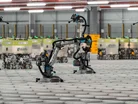
Ocado is pushing the boundaries of automation by embedding AI and robotics into its fulfilment operations.
With the complexity of grocery logistics demanding more than conventional automation can offer, Ocado’s use of machine learning (ML), computer vision and robotic precision is reshaping how goods are picked, packed and shipped.
This transformation is led by Ocado’s robotic arms, powered by its On Grid Robotic Pick (OGRP) system.
These arms are not only reducing labour dependency but also adapting in real time to challenges that arise in high-paced fulfilment centres.
The technology delivers continuous improvements and productivity gains across a global network, reinforcing Ocado’s position in the AI-led logistics sector.

Automating complexity with AI and robotics
Online grocery fulfilment is a particularly complex area of logistics.
The sheer number and variety of stock-keeping units (SKUs) mean that traditional robotic systems often fall short.
Each item might demand a different grasping technique and many are delicate, oddly shaped or temperature-sensitive.
Ocado’s AI-powered robotic arms address these challenges using a combination of computer vision, sensor-driven intelligence and deep reinforcement learning.
These systems operate around the clock, using advanced ML algorithms to optimise how each item is handled.
The robots are trained through a mix of human demonstration — behaviour cloning — and trial-and-error — reinforcement learning — allowing them to constantly refine their actions and improve accuracy.
This enables them to adapt to new SKUs without manual reprogramming, a critical requirement in the ever-changing world of grocery retail.
Ocado’s robotic arms also feature smart pressure and motion sensors.
These sensors provide the arms with tactile feedback, allowing for careful handling of items that might spill or break.
The arms can dynamically adjust their grip, making them suitable for a variety of packaging and temperature zones — chilled, ambient or frozen.
Building fleet intelligence for scalable efficiency
Ocado’s use of AI is not limited to individual robots.
The arms operate as part of a connected fleet, where learnings from one robotic system are shared across others.
This enables what Ocado calls “fleet learning” — a model in which performance data, mistakes and successes inform updates across all systems.
- Increased picking accuracy
- 24/7 operation
- Handling of fragile and varied items
- Improved labour productivity
- Optimised packing density
- Reduced labour dependency
This distributed intelligence means the entire robotic workforce improves collectively.
As more data is gathered from real-world fulfilment scenarios, the AI models behind the technology continue to evolve, improving accuracy, speed and reliability.
In 2024 alone, Ocado reports that “we picked over 30 million items using OGRP and saw huge productivity gains with just a small number of arms installed”.
The company plans to scale rapidly in the coming year, citing real-world experience with this technology as a key differentiator in the logistics market.
The arms extend picking hours, increase throughput and reduce the need for human involvement.
They also allow staff to be redeployed to other tasks, supporting wider efficiency goals in fulfilment centres without the need to expand physical infrastructure.

Laying the groundwork for generalised AI in logistics
Ocado is not just solving problems in the present — it is investing in AI models that will shape logistics in the future.
The company is exploring diffusion models, a method behind many generative AI systems.
These models aim to generalise the capabilities of robotic systems, making it possible for the technology to adapt to an even wider array of use cases without being retrained for each one.
Ocado says: “Our teams continue to leverage the latest breakthroughs in Machine Learning.
“To expand OGRP’s picking capabilities and understand how to generalise these skills beyond its current applications, we are exploring diffusion — a model which underpins the Gen AI revolution.
“This will allow us to tap into previously unattainable efficiency levels, as we continue redefining supply chains worldwide.”
The company’s focus on generalisation will allow its AI systems to transition across multiple environments and sectors.
While grocery logistics remains a demanding and dynamic challenge, Ocado’s model demonstrates that AI and robotics can overcome the complexities of SKU variation, delicate item handling and efficient space usage.
Ocado’s success in deploying AI at scale serves as a reference point for other sectors seeking to adopt robotic automation.
The combination of ML, behaviour cloning and reinforcement learning enables a robust approach to real-time learning and system improvement.
The integration of AI into robotic arms not only solves practical problems but creates a foundation for continual advancement across global supply chains.
With AI and robotics converging in increasingly capable systems, Ocado is setting new standards for operational efficiency and flexibility in the logistics sector — standards that other technology-forward businesses may soon follow.
Explore the latest edition of Technology Magazine and be part of the conversation at our global conference series, Tech & AI LIVE.
Discover all our upcoming events and secure your tickets today.
Technology Magazine is a BizClik brand