How Humanoid Robots are Changing the Face of Manufacturing
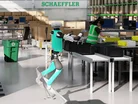
Imagine working in a factory setting and looking at the colleague next to you.
But the colleague is actually a robot — albeit somewhat human-like in appearance.
Humanoid robots are designed to mimic human movements and are being integrated into production lines for tasks like assembly and logistics, promising increased efficiency and flexibility.
A collaboration between Accenture, Schaeffler, Nvidia and Microsoft is making waves in this space, shifting approaches to industrial automation by blending physical AI, humanoid robotics and advanced simulation tools to address workforce challenges and operational inefficiencies.
Accenture: Reinventing industrial automation with physical AI and robotics

Debuted at Hannover Messe 2025, Accenture, Schaeffler, Nvidia and Microsoft demonstrated a blueprint for factories where humans, robots and AI systems collaborate seamlessly.
“As a leading motion technology company, Schaeffler leverages disruptive innovations such as physical AI, digital twins and humanoid robots to enhance operational excellence across our global manufacturing network,” says Andreas Schick, Chief Operating Officer at Schaeffler.
“In collaboration with strong partners like Accenture, we constantly explore how disruptive technologies from Nvidia and Microsoft can increase our flexibility and efficiency.
“This is how we want to jointly shape the production of the future.”
“Physical AI is reinventing industrial automation as it offers efficient ways to train and control entire fleets of AMRs, mobile adaptive manipulators and general-purpose humanoid robots,” adds Patrick Vollmer, Global Industry Group Lead, Industrials at Accenture.
“Our collaboration with Schaeffler, Microsoft and Nvidia shows how clients and strategic partners can co-innovate on turning emerging technologies into solutions to help manufacturers tackle flexibility, productivity and workforce challenges.”
Impact on Schaeffler’s factories and distribution centres
Schaeffler is leveraging humanoid robots like Agility Robotics’ Digit and Sanctuary AI’s Phoenix to enhance flexibility and efficiency in its factories and distribution centres.
These robots handle tasks such as material transport, tote handling and spare part kit assembly, integrating seamlessly into workflows designed for humans.
By employing Nvidia Omniverse’s digital twin simulations, Schaeffler plans facility layouts and tests robot fleets virtually, reducing commissioning times and optimising automation levels — ranging from manual processes to fully automated systems with humanoid robots.
According to Accenture’s research, 43% of industrial leaders expect humanoids to become standard in assembly lines, driven by their adaptability and ease of deployment.
In line with this, Accenture and Schaeffler are starting to adopt Mega — an Nvidia Omniverse Blueprint — to test robot fleets, including general-purpose humanoid robots, in industrial digital twins of factories and warehouses.
Nvidia and digital twin innovation
At the core of this transformation lies Nvidia Omniverse, a platform enabling hyper-realistic, physics-accurate simulations of factories and warehouses.
Physical AI — a fusion of robotics and AI — enables robots to learn tasks by observing human workers. At Schaeffler’s facilities, vision AI tools like Nvidia Metropolis capture human movements and translate them into simulations, where robots practice tasks repeatedly.
Sanctuary AI’s multi-dexterous humanoid robot, Phoenix, for instance, learns to compile spare part kits by analysing digital twin data, accelerating skill acquisition without disrupting live operations.
As well as this, Omniverse’s Mega blueprint allows testing multi-robot fleets — including AMRs and humanoids — in virtual environments before real-world deployment.
“Tomorrow’s factories require complex collaboration between humans, industrial automation systems and multi-robot fleets,” said Mike Geyer, head of digital twins at Nvidia.
“By using Mega and Nvidia Omniverse to simulate and test various types of robots at scale in industrial digital twins, Accenture and Schaeffler are reinventing their industrial operations with physical AI.”
While humanoid robots promise efficiency gains, their adoption raises questions about workforce displacement and safety.
Accenture’s strategy emphasises human-robot collaboration, positioning AI as a tool to augment — not replace — workers.
For instance, Gen AI assistants help staff troubleshoot issues faster, reducing downtime without eliminating jobs.
Explore the latest edition of Technology Magazine and be part of the conversation at our global conference series, Tech & AI LIVE.
Discover all our upcoming events and secure your tickets today.
Technology Magazine is a BizClik brand