Dassault Systèmes and NVIDIA: The Future of Design
Computers are useless. They can only give you answers.
Pablo Picasso’s skepticism on computer science in 1968 would have been based on a big, cumbersome mainframe computer that used punch cards – like the ones used by banks and insurance companies – for database management.
We’ve come a long way since then and if Picasso were alive today, he would most likely be using computers, or an agentic AI agent on his phone or laptop, to aid his creativity.
“Picasso’s statement is still partially true today,” says Gian Paolo Bassi, Senior Vice President of Mainstream Innovation and Customer Role Experience at Dassault Systèmes. “Computers… AI… can only answer questions but who asks them? Who is the one that articulates the words and makes the machine a tool? We do.
“People who use AI are empowered to do what humans do best – create. I don’t believe in the notion that AI will put people out of business but it will transform how business gets done.
“Today, you can’t go to work in an office without knowing how to use a computer. Is the need for the office worker any less than it was during Picasso’s time? No. I don’t believe in the dystopian view that AI will replace our jobs. There is always a button to go into manual mode if you’re able to handle it.”
McKinsey & Company’s 2023 report, Generative AI and the future of work in North America survey found that a significant majority – often up to 70-80% – of the tasks performed in many North American jobs involve routine, repetitive or administrative duties rather than creative, high-level strategic work.
“That is not the best use of human intelligence,” Gian says. “Humans are very good at imagining and articulating problems – and we have so many problems to solve that I don’t think there will be a lack of demand for human creativity.”
For example, a software engineer no longer needs to spend hours writing repetitive boilerplate code. Instead, they can focus on defining the architecture and the logic of the system with AI, much like an architect sketching the blueprint for a building rather than cutting the wood.
Blueprints and bookshelves: democratising design
Gian has been an engineer for most of his life, having begun his career as a tech lead on parametric solid modelling, which is a 3D computer-aided design (CAD) technique that uses rules, constraints and dimensions to build geometric models.
Now, he leads the team at SOLIDWORKS, a brand owned by Dassault Systèmes that provides 2D and 3D product development solutions to millions of designers, engineers and businesses around the world.
“I specialise in the concept of functional design,” he explains. “Although AI was around back then, it wasn’t practical because the models I was working with were too complex for the computers. But today, if you want to create an object for a specific function, you can tell the computer how to do it in natural language.”
The ability to use AI for software engineering can be likened to building a set of bookshelves, which requires dimensions, sketches, geometric knowledge and more.
“The job of an engineer has been to translate an object that needs building – often from a customer’s description of a product – into something that can be built in technical terms,” Gian says.
“Today, if the CAD technology is really smart, you can design a bookshelf yourself. You don’t need an expert in computational geometry. This is what we’ve been building with SOLIDWORKS – we want to be prompt based so users can explain what they want easily.”
Simulating reality to perfect the physical world
SOLIDWORKS is just one of 12 brands at Dassault Systèmes that support industries across the manufacturing, life sciences and healthcare, and cities and infrastructure sectors. Because these fields deal with heavy machinery, buildings and biology, the brand’s focus has naturally shifted toward Physical AI.
“We introduced AI many years ago in SOLIDWORKS,” Gian notes. “But physical AI is an AI that creates models and operates on real things.
“For example, an autonomous vehicle is operated by AI but it is highly physical because it acquires data from the physical world and puts it into a digital model, which then transfers that knowledge and puts it back into the physical world when the car drives. An autonomous vehicle needs to be in sync with the physical world, to handle unpredictable traffic or malfunctions.”
Gian helps to provide precise simulation software so that vehicles can undergo digital crash tests, enabling manufacturers to accurately predict what will happen in every possible scenario.
“Digital simulation is fundamental for AI to be operative in the context of the physical world,” Gian highlights.
Simulation technology can also be used in hospitals to understand how the airflow of a HVAC system can contain germs, leading to the correct types of filters being installed, and for manufacturers looking to open a new warehouse, taking into account location for transport routes, stock and geopolitical situations.
“Physical AI is linked to the ability to simulate the world,” Gian says. “We are active in 12 industries so we not only create things like aeroplanes, cars and digital watches, but we also work with big pharma companies to build molecules for medicines and help to run clinical trials.”
- Up to 80% of North American jobs involve routine, repetitive or administrative duties rather than creative, high-level strategic work, according to McKinsey research.
Dassault Systèmes’ 3D virtual twin technologies, combined with NVIDIA’s AI infrastructure, open models and software libraries, empowers customers to work with virtual companions on the agentic 3DEXPERIENCE platform.
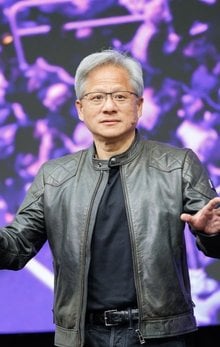
“Physical AI is the next frontier of AI, grounded in the laws of the physical world,” said Jensen Huang, founder and CEO of NVIDIA, in February 2026 when the partnership was announced.
“Together with Dassault Systèmes, we’re uniting decades of industrial leadership with NVIDIA’s AI to transform how millions of researchers, designers and engineers build the world’s largest industries.”
In practice, this means embedding NVIDIA’s advanced computing directly into Dassault’s core testing environments to simulate reality with unprecedented speed and accuracy.
“NVIDIA chose to partner with us because our simulation technology can predict almost anything – whether it's airflow, crash dynamics, electromagnetic fields or molecular reactions,” Gian says.
“The concept is very simple – just like you use Google to search for answers or Amazon for shopping, we provide the virtual twin technology to predict the behaviour of products, supply chains and more to help with the everyday operations of a business.

Putting specialised knowledge to work
Shortly after the NVIDIA partnership in February, Dassault Systèmes introduced Virtual Companions, a new category of AI-powered experts on its 3DExperience platform to help users create, test and validate work. Instead of hunting for commands that could be in the thousands, you can talk to a specialised bot, or three.
“Aura has specialised knowledge on the use of our software and can offer guidance on the best materials to use or the regulations you should adhere to,” Gian explains.
“Meanwhile, Leo is the engineer that can tell you why your product might fail, its durability and more. And Marie specialises in life science, talking to the best type of molecule to be used for a drug.”
The virtual companions understand user intent, reason and orchestrate actions across the full life cycle of products and services, from conception to usage and regeneration. Ensuring accuracy, traceability and trust, they simulate behaviours and consequences before anything physically exists.
“The time has come to put knowledge to work by creating a new kind of teamwork between humans and Virtual Companions to make the invisible visible and the impossible possible before anything physically exists, accelerating innovation cycles while protecting the most critical assets,” said Pascal Daloz, CEO of Dassault Systèmes, during 3DEXPERIENCE World 2026.
“Digital simulation is fundamental for AI to be operative in the context of the physical world ”
Nearly sixty years after Picasso noted that computers “can only give you answers”, the technology has finally evolved to match our imagination. But as Dassault Systèmes and NVIDIA push the boundaries of physical AI, the core dynamic hasn’t changed, in that the machine still requires human intent to function.
“My dream of functional modelling 30 years ago is happening right now,” Gian says. “Not on a geometric level but with AI-powered prompts and simulation.”
By stepping out of the tedious, manual weeds of engineering and into the role of orchestrators, humans are freed to do what they do best. AI can provide the answers at unprecedented speeds, but humanity retains the most critical job of all – knowing which questions to ask next.
Did you know?
The tech anxiety Picasso felt in 1968 echoes loudly today. Modern creators are fiercely defending the human monopoly on questions.
For example, Australian singer Nick Cave has publicly said that AI could have a “humiliating effect… on us as a species”, stating that its “intent is to completely sidestep the sort of inconvenience of the artistic struggle, going straight to the commodity”.
Meanwhile, the late artist David Hockney uses iPads to create and dismisses AI art as “uncreative” because it lacks the crucial element of human sight and emotion.
Did you know?
Company portals


Executives

Gian Paolo Bassi
SVP of Mainstream Innovation
Jensen Huang
Founder and CEO

Pascal Daloz
CEO