Panasonic Opens One of the World's Largest EV Battery Plants
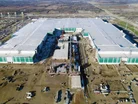
Panasonic has officially opened its new cylindrical lithium-ion battery factory in De Soto, Kansas.
At 4.7 million square feet in size, the facility is one of the largest gigafactories in North America.
The Japanese firm began mass production of 2170 battery cells on 14 July, with plans to achieve an annual production capacity of approximately 32GWh.
The Kansas factory is one of the largest single investments the company has made in its 107-year history and it represents the most significant economic development project in Kansas state history.
Built on a 300-acre site spanning more than 225 American football fields, the facility cost US$4bn to construct and is expected to create up to 4,000 jobs.
Panasonic's manufacturing strategy
The Kansas facility forms part of Panasonic Energy's dual-region manufacturing model, complementing its existing Nevada Gigafactory which has operated since 2017.
The Nevada facility currently maintains an annual capacity of approximately 41GWh and employs more than 4,000 people, having delivered more than 11 billion battery cells to date.
Once fully operational, the combined capacity of both North American facilities will reach approximately 73GWh annually.
"The opening of our Kansas Factory marks a major milestone in our journey to scale advanced battery production in the United States," says Kazuo Tadanobu, CEO of Panasonic Energy.
"This achievement would not have been possible without the strong support of our local partners and the State of Kansas. Together, we are accelerating the shift to electrification, reinforcing regional supply chains, and nurturing the next generation of battery talent."
A new level of productivity
The Kansas factory incorporates labour-saving production lines designed to achieve approximately 20% higher productivity compared to the Nevada facility.
Panasonic Energy plans to introduce products using advanced materials that will increase cell capacity by around five per cent in the near future.
The company's lithium-ion cells feature an industry-leading volumetric energy density of 800Wh/L and have powered approximately 3.7 million electric vehicles with around 19 billion cells supplied as of March 2025.
The cells have maintained a strong safety record, with no vehicle recalls attributed to Panasonic Energy batteries to date.
Allan Swan, President and Chief Operating Officer of Panasonic Energy North America, is particularly enthused by the sustainability of the project.
"We believe that we will continue to succeed if we scale our business in a way that is sustainable for our people, sustainable for our business, sustainable for our industry, and sustainable for our planet," he says.
Panasonic's position in a competitive market
The facility's opening comes at a time when car manufacturers are looking to rapidly expand their production of EVs in an effort to meet growing consumer demand and regulatory requirements.
While there is no nationwide regulation for the phasing out of petrol-fuelled car sales in the US, several states, such as California, have adopted regulations that will ban the sale of internal combustion engine vehicles from 2035.
With this sea change on the horizon, Panasonic is looking to position itself as a key supplier to global automotive manufacturers going forward, using its three decades of experience in lithium-ion battery manufacturing.
Around the world, Panasonic produces 70 battery cells every second, generating more than six million cells daily across its operations.
The Kansas factory's annual production capacity of 32GWh will provide sufficient batteries to power approximately 500,000 EVs once it's fully operational.

The economic impacts
Beyond direct employment, the facility is expected to generate approximately 8,000 total jobs including positions in supplier and related industries.
Panasonic Energy is collaborating with institutions such as the University of Kansas to establish long-term industry-academia partnerships focused on technological advancement and specialised talent development.
The company views this collaboration as contributing to the economic growth of De Soto and the broader Kansas region whilst supporting the revitalisation of the US manufacturing sector.
The facility's scale becomes apparent in its physical dimensions, with three passenger planes able to line up nose-to-tail in the central common area between the factory's two wings.
Walking every square foot of the facility would require nearly 13 days of continuous movement, which speaks to the sheer scale of the operation.
It is a project that is significant not only to Panasonic or the EV sector, but also the people of Kansas.
“Politics is the art of the possible, and the grand opening of the Panasonic plant in De Soto ushers in a new era for Kansas — a proud step forward in our mission to bring manufacturing jobs back to America, where they belong," says Ty Masterson, President of the Kansas Senate.
Mayor of De Soto, Rick Walker, is especially emotional about the opening of the plant.
“As someone who grew up in De Soto, I've spent years driving past this site when the lights were out and the future was uncertain," he says.
"Seeing it come back to life — with Panasonic Energy as the anchor — is deeply meaningful.
"There’s a new energy in De Soto — not just in batteries, but in the spirit of the community and the momentum we’ve created together. It’s a powerful moment for our city, and one our community can be proud of."