
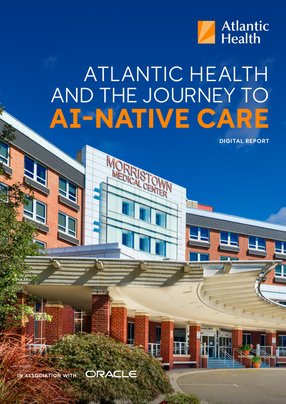
Atlantic Health is a leading not-for-profit healthcare provider serving more than half of New Jersey, with its 25,000-strong workforce providing quality care for 7.5 million people across 14 counties.
Sunil Dadlani serves as Executive Vice President, Chief Information and Digital Officer, and Chief Cybersecurity Officer at Atlantic Health, where he leads technology, digital transformation, data and analytics and cybersecurity strategy across an eight hospital integrated health system. The organisation includes Morristown Medical Center and Overlook Medical Center, both internationally recognised for clinical excellence and counted among the world’s top hospitals.
Atlantic Health is on a journey grounded in digital innovation. As Sunil describes it, the goal is to become AI native, with intelligence embedded across the fabric of the organization rather than layered on as an afterthought.
“Our mission is to design, develop and deliver the highest quality, most innovative and personalised care while building healthier communities and improving the lives of those we serve,” he says.
“At the core of our mission is clinical innovation, research, education, consumer and clinician experience and operational excellence.”
For Sunil, executing this core mission involves designing and delivering a robust digital backbone.
“The complexity in healthcare is extraordinary,” he adds. “When you compare it to any other industry vertical, healthcare – by far – is the most complex and most regulated. Consumer expectations are changing, as are regulations and the workforce dynamic. It’s always a very fast-paced environment.
“We’re privileged to work with outstanding colleagues, leadership teams and industry partners. That collaboration is making a meaningful difference. Our work ultimately has a direct impact on human lives.”
Leading national healthcare through digital innovation
Atlantic Health is going through a digital innovation journey which began with building a unified architecture, replacing dozens of fragmented legacy systems with a resilient, cloud-first and data-first infrastructure. This foundation allowed the system to move into a pilot phase for AI, deploying technologies in clinical decision-making, radiology triaging and improving consumer engagement across the network.
In 2025, the system’s vital statistics showed more than one million unique encounters and 100,323 annual admissions, highlighting the massive scale at which these digital tools must operate.
As Sunil sees it, digital innovation is not defined by a set of tools, but by a unified journey shaped by leadership across every part of the health system. Digital tools are accelerators, but they must do more than introduce new technology. They must create tangible value by improving patient outcomes, strengthening safety, expanding access and enhancing the overall patient experience.
“To lead nationally, we make deliberate strategic decisions early on that we are not going to start with algorithms,” he explains. “We are not going to start with vendors. We are really going to start with asking the right questions. Digital innovation is not about one particular leader or one particular department. It is a cohesive journey of the entire organisation.”
Because continual evolution is a necessity in an era of unprecedented disruption, the system ensures it is laser-focused on keeping the human at the centre of every technological decision made. While AI systems can outperform humans in pattern recognition and computational tasks, Sunil believes human judgement must always augment these capabilities to ensure safety and accountability, rather than take humans out of the equation because liability of clinical decisions is with humans and not black box algorithms.
The system uses a governance framework where clinical, legal and financial leaders collaborate to provide guardrails for innovation, ensuring that patient safety and outcomes remain the priority.
Sunil explains: “Through anything and everything we do – no matter how many advancements AI will make in automation or smart decisions – our core principle is that we will always keep humans at the centre of every single innovation that we do.”
How tech ensures clinical success in imaging and virtual care
Atlantic Health is already seeing success in digital innovation, particularly in the system’s radiology workflows, where AI-driven decision support assists with acute conditions such as strokes and pulmonary embolisms. These systems help clinicians prioritise critical cases and reduce variability in care, leading to more proactive treatment for patients who require immediate medical intervention.
Telehealth has also evolved from episodic urgent care to longitudinal management of chronic diseases and behavioural health, significantly improving patient convenience and the continuity of care.
The system’s virtual urgent care platform, Atlantic Anywhere, helps decompress physical sites while expanding access to high-quality care for the millions of people in the service area.
Sunil continues: “This reduces avoidable emergency visits and increases continuity of care because access is a core pillar for Atlantic Health.”
For Atlantic Health, the next area of development is expanding its agentic AI use cases.
“Our next AI era could be where we use all flavours of technologies,” Sunil says. “We use predictive AI to predict, generative AI to generate and agentic AI will act because, in healthcare, you really drive the value where the action is.
“Agentic AI is going to take the next level of innovation where it truly enables end-to-end AI enablement.”
Sunil adds that, because of this change in approach to AI, care will continue to move from predictive to prescriptive. However, his main focus is clear: Atlantic Health’s next phase of AI will have responsible AI at its core.
Authentic leadership in the age of AI
For Sunil, it is clear that authentic leadership going forward requires orchestration and transparency, focusing on the integration of smart systems rather than just controlling the technology itself.
“Authentic leadership starts with integration, orchestration and architecture,” he says. “It demands a mindset rooted in continuous adaptation, disciplined change management and lifelong learning.”
“Authentic leadership also requires transparency – not only about what AI can do, but also about the risks it brings. To me, the priority is not getting carried away by the pace of AI innovation, but remaining focused on our core mission of caring for patients and serving our communities.”
As AI reshapes the industry, leaders at Atlantic Health are striving to be architects of change, intentionally designing how technology is built, tested and operationalised within clinical environments. To avoid simply reacting to disruption, the organisation avoids starting with generic technology and instead focuses on co-designing solutions with a robust ecosystem of strategic partners.
Sunil says: “Any organisation or leader that sits on the fence or they are reacting to AI – that’s the shortest and the quickest path to irrelevance and obsolescence.
“Organisations that lead in healthcare are those architecting AI intentionally, which means truly putting discipline around AI – how it is designed, built, tested and monitored. You should also never start with the algorithm, technology or the vendor. If you start with the workflow, you can shape the digital transformation.”
When handling lots of sensitive data, digital and operational resilience offers more than just an elevated level of care – it also ensures patient data privacy and protects their information from falling into the hands of cybercriminals. It also ensures that, if an incident does occur, Atlantic Health can maintain care continuity.
In an environment shaped by vast amounts of sensitive data, digital and operational resilience is essential not only to delivering high quality care, but also to protecting patient privacy and securing information from cybercriminals. Just as importantly, it helps ensure care continuity if a disruption or incident occurs.
The system employs a multi-layer defence, including zero-trust architecture – a security model that requires strict verification for every person and device trying to access network resources.
“Upgrading our entire network infrastructure to build a very resilient, zero-based cybersecurity posture was nowhere near glamorous but it is incredibly essential,” Sunil says. “Cybersecurity is a core part of our mission. In the world we are living in, the velocity, variety and impact of cybersecurity is only going to exponentially grow, so the core part of resiliency is how prepared you are and how well you can respond.
“At Atlantic Health, when we talk about being a resilient healthcare system, the mission must continue safely and reliably under every circumstance, no matter what the environment is.”
This has been built through a multilayer approach made up of multifactor authentication, zero-trust architecture, proactive cyber defence, AI-enabled detection, prevention, mitigation, microsegmentation and macro segmentation, as well as enterprise risk ranking and monitoring.
“Digital and operational resilience does not mean that you are going to prevent attacks or you are going to avoid outages,” Sunil adds.
Strategic partnerships that secure Atlantic Health’s digital future
With all of this to consider, Sunil believes the greatest risk is undisciplined investment, where technology is implemented without a clear use case or a strong governance framework to manage it.
He encourages leaders to stay relevant by remaining curious and data-literate, understanding that AI is an augmentation of human skill rather than a complete substitution for professional expertise.
“You have to understand that the shelf life of your skill set is getting shorter every day,” Sunil says. “Technology is moving at such speed that even regulation, governance and policy can lag behind. That is why it is critical to stay curious, remain data literate and remember that AI is about augmentation, not replacement. AI alone will not replace you, but a person with strong AI fluency may.”
Oracle, a global technology company providing integrated cloud services and hardware, serves as a vital strategic partner for the health system’s operational transformation. Atlantic Health is working with Oracle to implement Oracle Fusion, a suite of cloud applications designed to manage various business functions within a single platform.
This partnership allows the system to eliminate disparate legacy systems for finance, supply chain and human resources, unifying data and workflows across the entire organisation. It also provides a unified platform which, in turn, gives more visibility into operations and allows for more transparent, real-time decision-making for the system’s leadership team.
“Although as a health system we don’t endorse products or partnerships, we are very conscious about the fact that we cannot do this alone,” he shares. “You need to have a good partner ecosystem invested in your mission.”
He says that the way Atlantic Health works with Oracle is not a transactional relationship but a true understanding of the system’s vision and a commitment to co-development.
He adds: “As part of our partner ecosystem, Oracle plays an important role.”
It is this collaborative, innovative and forward-thinking approach that Sunil is taking with him at Atlantic Health as he looks ahead to the next 12 to 18 months. This period will be critical as the system seeks to operationalise AI at the enterprise level, moving beyond pilot projects to full-scale implementation.
Sunil concludes: “There is a fine balance to be struck if you are to accelerate and move forward at the rate of innovation but, at the same time, you cannot put your guardrails down and make your organisation vulnerable to an unintended risk.
“At the end of the day, responses should be singular – it is patients and communities we are serving. They are the real reason we’re doing all of this and the consequences can be enormous if you’re not very prudent with your approach.”
Company portals

Executives
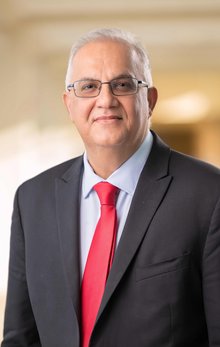
Sunil Dadlani
Executive Vice President, Chief Information and Digital Officer, and Chief Cybersecurity Officer