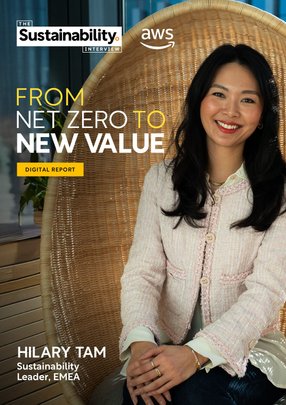
Sustainability is at an inflection point. After years focused on compliance and reporting, the function is evolving into a strategic driver of business value – and the leaders navigating this shift are redefining what's possible.
Hilary Tam has spent more than 15 years in sustainability and has watched the function move from “doing the right thing” at the margins to shaping core business strategy. As Sustainability Leader for Amazon Web Services (AWS) across Europe, the Middle East and Africa, she now works with customers to accelerate their journeys using cloud and AI.
While in recent years much of the focus has been on compliance, reporting and regulation, especially in Europe, Hilary empowers sustainability leaders to move beyond these requirements. As organisations build the data infrastructure needed to meet these demands, a key realisation is emerging, “Once you have that data foundation, if you're using it just for reporting purposes, then you're really leaving value on the table,” Hilary points out. Using that same data, enabled by cloud and AI, the opportunity now is to drive efficiency, optimisation, better products and richer customer experiences, turning sustainability from obligation into opportunity.
The era of Commercial Sustainability
Hilary is part of a new wave of leaders moving sustainability from a cost centre towards driver of growth, resilience and competitiveness. In practice, that means integrating sustainability into core operations and business strategy rather than bolting it on at the edge so that when priorities shift, it remains central to how the organisation runs and grows.
“We're entering this phase that I like to call commercial sustainability,” she explains, “which is where sustainability teams are becoming much more strategic commercially and thinking about how they're impacting either the top or bottom line.” Beyond its established role in operational excellence, risk management and talent attraction, she sees sustainability as central to the future growth trajectory and long-term success of the business.
Realising this potential, however, requires sustainability leaders to “speak the language of business,” from balance sheets to return on investment. “I don't think we should be afraid,” Hilary reassures, “because those use cases where sustainability is good for people, planet and the business are becoming more and more evident.” Her advice to sustainability leaders in executive or board discussions is clear: start from growth and value creation, not just targets, emissions and carbon, so the conversation becomes strategic rather than purely reactive.
This strategic framing is particularly critical when tackling Scope 3 emissions, which are both a challenge and an opportunity. While many organisations have focused on Scope 1 and 2, Scope 3 remains “a massive challenge that no organisation can really solve on their own”. Here, Hilary sees technology and platform thinking as critical, enabling data sharing or access across value chains to create end‑to‑end supply chain visibility and optimisation. The hardest problems, from supply chain intelligence to logistics optimisation, are also where she believes innovation potential is greatest.
Cloud and AI as powerful enablers
The strategic shift Hilary describes requires the right infrastructure and tools to deliver on that promise. For AWS, cloud and AI are becoming essential for sustainability leaders, especially for organisations navigating increasingly complex reporting requirements such as CSRD, TNFD and TCFD. Hilary points out that the breadth and complexity of data required makes manual approaches impractical, particularly as the rest of the organisation digitalises.
Cloud allows sustainability data to be surfaced and elevated in the same way as commercial and financial data, enabling advanced analysis, costed use cases and decision‑ready insights. That shift helps sustainability teams move beyond “admiring the problem” - endlessly analysing without acting - towards concrete actions and investments that can be justified with clear business value. Yet, Hilary is careful to position technology as an enabler and accelerator, not the answer in itself; the real starting point is still working backwards from the problem or opportunity that matters most.
“We're really excited about agentic AI and agents, where your AI starts to execute tasks on your behalf – with the appropriate guardrails, of course,” Hilary says. “It transforms a whole sustainability team in terms of focus and capabilities. Rather than reporting on what's happened, you're able to take a control tower view of understanding what's going to happen next.”
As more routine tasks are automated, this shift from execution to strategy means leadership becomes even more critical: setting direction, holding the vision and deciding what should be optimised so sustainability teams can focus on shaping the organisation’s future, including emerging areas like nature and biodiversity.
The AWS Future Fit Framework
Translating this vision into action requires meeting customers where they are. To help customers understand where they are on their journey – and what to do next – AWS uses what Hilary calls the Future Fit Framework, structured across four levels. It provides a mental model for matching AWS support to different stages of ambition, different impact areas and different stakeholders across the business.
The first level focuses on sustainable IT: helping customers understand their emissions from running on AWS and architecting for sustainability as they build and grow in the cloud. This includes providing the foundations for clean and efficient cloud operations through Amazon's investments in renewable energy and AWS's innovations in energy-efficient infrastructure, alongside guidance on best practice, often working with IT and technology leaders.
“Customers often ask us for help understanding their carbon footprint on AWS or architecting and optimising their workloads,” explains AWS Principal Solutions Architect Andrew Morrow. “One of the ways we do that is through the AWS Well Architected Framework, where we have the Sustainability Pillar that contains design principles, operational guidance, best -practices, potential trade-offs, and improvement plans for optimal efficiency. There is a community of technical experts across AWS who help us scale across industries, and also bring expertise to customers regardless of where they are or what they're trying to build.”
Level two addresses operational sustainability across the wider business – where most companies have their largest impacts. Here, AWS helps customers use cloud and AI for proven optimisation opportunities: reducing fleet mileage through route and logistics optimisation, identifying manufacturing defects earlier with computer vision, or cutting waste through intelligent water and energy management. Many of these solutions already exist; the task is to deploy and scale them effectively rather than reinventing the wheel.
The third level is where innovation comes to the forefront. Many of the solutions needed, especially in nature and biodiversity, do not yet exist. AWS uses its Innovation Programmes to help customers work backwards from their needs, defining the problem, identifying the end user, and designing new products and services – with both sustainability impact and commercial viability in mind. At this level, lines of business and product owners become key stakeholders as sustainability evolves from operational optimisation to digital innovation.
Level four is about twin transformation: embedding sustainability into large‑scale digital transformation and core business strategy from the outset. Through AWS Executive Vision Programmes, senior stakeholders from sustainability, business and technology come together to explore what they could achieve collectively – opportunities that would be impossible in silos. “If you're thinking about the next three to five years and sustainability isn't on the agenda, then you're probably missing a trick,” Hilary says.
Partnership and collective action
The partnership between AWS and the Natural History Museum (NHM) in London is one of Hilary’s favourite examples of how cloud, data and AI can unlock new value for sustainability. Visitors know the museum as a great day out, but behind the scenes it houses more than 400 scientists and one of the world's most comprehensive collections of natural history data.
AWS has worked with the museum to build a data ecosystem that brings together environmental DNA, audio and visual data into a single platform for research. In time, scientists will use this integrated platform to enrich datasets, run analyses and generate new insights into interactions between nature and urban environments, accelerating scientific discovery and enabling researchers to tackle complex questions about biodiversity at unprecedented scale. The partnership is opening new possibilities for how the Museum's vast collections and data can be used to inform recovery efforts, policy decisions and business strategies as organisations increasingly need biodiversity intelligence.
The NHM partnership exemplifies a broader principle: no single organisation can solve sustainability challenges alone. “We’re also open-sourcing sustainability knowledge through the Amazon Sustainability Exchange, a free, publicly available website of previously proprietary information from guidelines, playbooks, science models, to case studies,” Hilary says, highlighting that partnership and collective action are a priority for Amazon as well as AWS. “We are enabling companies of all sizes to find resources to help them make meaningful progress toward net zero carbon emissions and more sustainable operations.”
How technology is enabling real-world climate progress
As organisations navigate their net zero journeys, technology is becoming essential for more efficient ways of working – helping teams move faster, use resources more efficiently and still deliver the experiences customers expect.
Across Amazon, business units are finding practical ways to reduce emissions in support of The Climate Pledge. Amazon MGM Studios has developed a mobile, EV-based connectivity system for on-location film and TV production. By delivering network access directly to set – even in remote locations – it significantly reduces the need to physically transport media to post-production facilities. Drawing power from EV batteries and solar charging rather than diesel generators, the system removes a carbon-intensive step from traditional workflows while shortening production timelines. This offers a scalable example of how operational innovation can meaningfully cut the carbon footprint of film and TV making.
Prime Video illustrates how efficiency and customer experience progress together. By optimising how its digital services operate, Prime Video serves more viewers using fewer resources, supporting lower energy use and reduced costs while delivering high-quality streaming at scale.
Rather than treating sustainability as a standalone initiative, organisations are integrating it into how they optimise operations, scale innovation and deliver value. This end-to-end approach is becoming an important part of building more resilient, future-fit business models.
Culture of innovation and ways of working
If technology is one side of the equation, mechanisms and culture are the other. Rob Hodges, who leads AWS innovation programmes in the UK, notes that it has “never been easier to build” thanks to the abundance of tools, but the real challenge is building the right thing. His team applies Amazon’s working backwards method with customers, starting from a press release set one year or 18 months in the future and asking what it would need to say to be truly “lovable”.
This future‑visioning process focuses on the what, why, who and how before any code is written, culminating in a “minimum lovable product” – the smallest version that customers would not only use but actively love and advocate for. Rob emphasises the classic sequence of “think big, start small, move fast,” enabled by modern tooling but grounded in customer obsession and rigorous prioritisation.
Mechanisms also matter when it comes to adoption and change. Large enterprises can easily stall if human engagement and change management are overlooked, no matter how powerful the technology. Rob argues that the people side of change is often harder than the technical architecture, and requires equal investment in any sustainability and AI initiative.
Executive visioning extends these principles to the C‑suite. As facilitator Lionheart Baker and Executive Visioning EMEA Lead Alden Leonard explain, the programme brings together business leaders from major customers and AWS to “think big about the future,” combining AWS and customer capabilities to create initiatives that can shape and drive markets. Sustainability fits naturally into these discussions as organisations move from compliance mindsets to seeing sustainability as a tool for value creation and market-making.
The future of AI, agents and leadership
Hilary believes this is “one of the most exciting times to be working in sustainability,” even if it does not always feel that way. The field is shifting from vision and strategy to execution and implementation – “where the rubber hits the road” and theoretical roadmaps become real capabilities and outcomes. Cloud, AI and data are arriving just as organisations need new tools to deliver at scale.
As agentic AI matures, Hilary anticipates a profound shift in how sustainability teams spend their time. Routine monitoring, reporting and supplier follow‑up can be increasingly automated, freeing teams to be more strategic, explore emerging domains beyond carbon – from nature and biodiversity to social impact - and sit front and centre in decisions about both decarbonisation and growth. Far from making leadership obsolete, she argues, these tools will make direction‑setting, vision and cross‑functional influence more critical than ever.
Her broader message is one of confidence and ambition. Drawing on her own experience across Greenpeace, the World Economic Forum, in-house roles, consulting and communications, Hilary notes that sustainability professionals have always been agile and adaptable, evolving alongside the agenda itself. The next evolution for sustainability teams is to embrace commercial thinking, build data-driven capabilities and own their role in driving business value.
For AWS, supporting that evolution is both a responsibility and a business opportunity. The company continues to invest and innovate “across every layer of the technology stack,” as Andrew puts it, so that customers can build on an increasingly efficient cloud foundation while focusing on the applications and business models that will transform their operations. From sustainable IT and operational optimisation to AI‑powered innovation and executive visioning, the aim is to give customers the tools and confidence to explore the art of the possible for their own sustainability ambitions.
Hilary’s message to sustainability leaders is simple but strategic: sustainability needs to be positioned not just as a reporting function, but as a value-creating one. That starts by leading conversations with growth, resilience and customer value, then connecting those outcomes back to targets and emissions.
“This next phase of sustainability is about thinking bigger,” she says. “Not just about how we reduce harm, but how we unlock new opportunities – designing better systems deliver value for people, planet and business at the same time''.
Company portals

Executives

Alden Leonard
EMEA Lead - Executive Visioning
Andrew Morrow
Solution Architect
Hilary Tam
Sustainability Leader, EMEA
Lionheart Baker
Facilitator - Executive Visioning
Rob Hodges
Principal, Innovation and Transformation Programs