
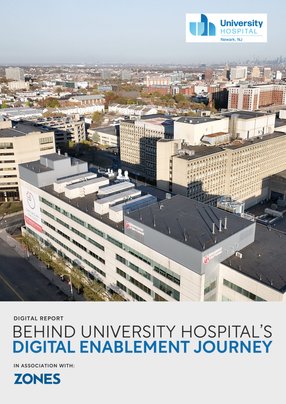
Behind University Hospital’s Digital Enablement Journey
As New Jersey’s only public, academic medical centre, University Hospital serves a diverse and often underserved urban population while also acting as a Level 1 Trauma Centre and principal teaching hospital for several Rutgers institutions. It is one of the only hospitals in the state to be awarded Gold Plus recognition by the American Heart Association and the American Stroke Association for Heart Failure and Stroke. The hospital maintains 24-hour in-house coverage by general surgeons and prompt availability of care in specialties such as orthopedic surgery, neurosurgery, internal medicine, plastic surgery and pediatrics.
To continue its exceptional quality of care, University Hospital’s Vice President of Enterprise Infrastructure, Shane Froebel, is leading the institution’s digital enablement journey. Shane sits at the intersection of healthcare and technology, propelling the facility’s quality of care for both patients and practitioners.
“Like all hospitals, our primary goal is to provide exceptional care,” Shane explains. “But also, as a safety net hospital, we take great pride in caring for people who have challenges accessing high quality healthcare. And, as an academic medical centre, we ensure the next generation of doctors and nurses are prepared to provide healthcare across the country and the world.”
How technology underpins University Hospital
University Hospital has made significant investments to modernise its healthcare infrastructure across its Newark Campus — and this is where Shane and his team come in. Shane plays a lead role on the planning team responsible for these investments to make sure technology is factored into these plans.
“Our IT team has made significant strides in transforming its approach—from reactive problem-solving to proactive planning that anticipates future needs.,” he shares. “We’re measuring this progress in less downtime, outages, faster service and increased end user satisfaction.”
Motivated by this progress, Shane is helping University Hospital improve its digital capabilities. Like many health organisations, Shane’s vision for University Hospital’s IT is to ensure it is made up of easy to use, easy to understand technology so end users are willing to adapt it. This, he says, ultimately improves University Hospital’s patient care.
Shane says: “This includes making sure our tools are supported by a robust infrastructure to be able to use those tools. For example, we’ve moved our Electronic Medical Record system to the cloud and we continually expand our underlying physical infrastructure.”
As well as this, Shane is leading an initiative to optimise how University Hospital processes requests by adopting new software and workflows that better align with the rapidly changing pace of emerging technologies like AI, automation and data analysis.
And although patient experience and care are always front of mind, Shane’s approach to technology deployments aim to support its clinical teams — and the benefits are already showing.
“Doctors and nurses are telling us they are working more efficiently which makes them less stressed – and that, of course, results in increased patient satisfaction,” Shane details. “We’re also seeing an uptick in patient visits. Another quality measure is that, for the first time, University Hospital was included as one of the 150 Top Places to Work in Healthcare by Becker’s Healthcare.
“Large organisations like ours rely on a number of business partners to achieve our goals, from simple projects to more complex ones. One of the most important things I've realised over the years is establishing relationships with multiple vendors that help us solve problems faster and keep fresh ideas on the table. As an academic medical centre specifically, we must provide access to information and data to our doctors, students and research teams. Thus, technology plays a major role in ensuring our patients can easily communicate with our doctors and also our research staff.”
Serving the community
As a hospital embedded within an urban, underserved community with complex needs, University Hospital treats patients who live in Newark as well as the wider region.
To ensure this demographic is served to the best of University Hospital’s ability from a technology perspective, it relies on a number of business partners to achieve its goals — whether simple projects or more complex ones.
“We are embedded in the community here in Newark,” Shane explains. “Being the Level 1 Trauma Centre in northern New Jersey, we get all kinds of patients from the furthest reaches of the state.
“Because we also dispatch our EMS services, we don’t cater to any one hospital. When we are dispatching, we’re making sure that patients are being delivered to the right trauma centre or the right healthcare selection based on their needs.
One partnership that University Hospital heavily relies on, particularly to support patients with complex requirements, is Epic. The electronic health record (EHR) system is widely used by healthcare organisations, including hospitals and clinics like University Hospital, to manage patient information.
“Epic is probably one of our biggest and significant business partners due to its depth and breadth of capturing and communicating important information between our patients and our providers,” Shane says.
University Hospital also works with and relies on smaller partners, like Zones, to find niche solutions to assist with our goals and projects.
Zones is a global provider of comprehensive IT services and solutions across more than 100 countries. Specialising in digital workplace, cloud and data centre, networking, security, and managed/professional/staffing services, Zones’ technology solutions support healthcare organisations by addressing challenges like managing increased patient volume, enabling virtual care and ensuring data security.
“It depends on what the issue is, but Zones is a good example of a small partner that can bring that level of service,” he adds. “I value partnerships with companies that prioritise open, transparent communication and are committed to achieving successful outcomes. I want them to deliver high-quality, sustainable solutions. A great partner will take the time to understand our clinical, operational and technical environments, before jumping into solutions. This is especially important in delivering quality healthcare.”
University Hospital’s future technology outlook
Shane says that, with technology not often designed specifically with healthcare in mind, University Hospital is working to ensure the solutions it uses are safe and appropriate.
“Our patient information is the most secure information that we have as a medical institution and we have to make sure that the software solutions and the technology that we’re adapting are the correct ones, rather than just applying and implementing,” Shane says. “It’s important that we remain focused and intentional in our efforts.
In the next two years, Shane will lead efforts to significantly modernise University Hospital’s core infrastructure — from its data centre network to implementing a digital phone system to ensure more timely appointment scheduling and call routing.
“Our IT team is expanding so we can support these major changes and improve processes as we look to what future trends in technology and healthcare will look like,” he concludes. “And I can't talk about the future without talking about AI. The healthcare sector has been a late adopter, namely because of patient privacy laws like HIPAA. In academic medicine, we have executives, physicians and researchers who understand its advantages. My hope is that my team and I get to build a bridge to adopt of AI in a way that both protects our patients’ privacy but also improves their health.”
Company portals

Executives

Shane Froebel
Vice President of Enterprise Infrastructure