
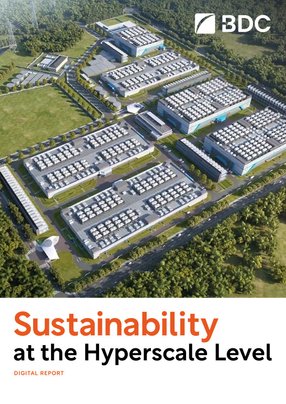
Bridge Data Centres: Sustainability at the Hyperscale Level
Eric Fan arrived in the data centre sector four years ago, after building his career in engineering and executive roles at Honeywell, Dow Chemical and Saint-Gobain.
Now, as CEO of Bridge Data Centres (BDC), he leads a business that has grown from under 100MW of capacity to five or six times that size across Asia-Pacific (APAC) in the past three years.
BDC operates as part of Bain Capital's infrastructure portfolio, functioning as the private equity firm's APAC platform. The company is headquartered in Singapore and operates facilities in Malaysia, Thailand, India and other APAC markets.
The company is positioning itself as a next-generation infrastructure provider built for the era of AI-driven computing.
With hyperscale demand accelerating across APAC and the wider region, it is doubling down on ESG-aligned operational efficiency, proprietary cooling innovation and rapid deployment models. The mission is to convert electricity into reliable, low-carbon computing power at scale – delivered through standardised, modular and highly engineered facilities capable of supporting AI and liquid-cooling workloads.
The company’s drive is strategic and BDC aims to set a new industry benchmark for sustainable hyperscale growth, while ensuring APAC’s digital ecosystem has an inexhaustible foundation of computing power.
"I think, overall, the industry is at a very exciting moment," says Eric Fan, CEO of BDC. "The beauty of the industry is that it's making a lot of progress with new technology, innovative advancements and the changing dynamics of the AI trend. So you get a feeling that you're at the core of this evolution of the AI world."
Bridge Data Centres was founded in 2017 and is backed by Bain Capital. The company is headquartered in Singapore and began expanding its regional footprint soon after its establishment.
In 2018, BDC acquired two data centre facilities in Cyberjaya with a combined IT load of about 20MW, marking one of its first major operating assets in Asia. These early developments laid the foundation for the larger hyperscale campuses the company is building today.
BDC’s business model and regional scope have changed significantly since then.
Pioneering a hyperscaler campus model in Malaysia
BDC developed the first hyperscale-focused campuses in Malaysia and was the first operator to establish capacity in Johor, a region in Southern Malaysia that has become a regional data centre hub.
Eric describes the early work as involving considerable groundwork and infrastructure development.
"We were actually the first data centre company in the region," says Eric. "There was a lot of heavy lifting in that process because we were the pioneers – we had to lay all the groundwork, build all the infrastructure."
The shift from enterprise customers to hyperscaler clients came as cloud service providers from US and China increased their presence in the region.
BDC now works exclusively with a targeted number of hyperscale customers rather than pursuing retail or enterprise business.
"We are laser-focusing on the hyperscale model, which means we have only a handful of big customers," says Eric. "We work very closely with them in terms of our technology stack, solution designs and our site selection strategy."
This focus requires a different operational approach compared to retail-oriented data centre operators.
The business develops technology solutions and selects sites in close consultation with its hyperscale clients, working to anticipate their future capacity requirements.
Adopting liquid cooling and immersion technologies
BDC has implemented both direct-to-chip liquid cooling and immersion cooling technologies at its Malaysian campus. Eric positions these deployments as part of the company's response to the evolution from air-cooled to liquid-cooled infrastructure.
"We are leading the way in driving these technology evolutions in the AI wave for APAC," he says. “Within our campus in Malaysia, not only do we have the direct-to-chip liquid cooling technologies, but we're also implementing at scale immersion cooling technologies."
The development of cooling solutions involves collaboration with equipment vendors, solution providers and customers.
Eric describes the process as requiring coordination across multiple parties to address technical details, including water quality and integration with server design.
The company reports achieving power usage effectiveness (PUE) below 1.2. In Southeast Asian countries, where subtropical climate conditions make efficiency targets harder to reach, Eric notes that the regional average for PUE hovers around 1.5. BDC also reports a water usage effectiveness of 1.6.
Targeting net zero by 2040
The company has set a target to reach net-zero carbon emissions by 2040. More than 50% of energy at one of its main Malaysian campuses now comes from solar power generation.
Eric identifies BDC as the first operator in the region to adopt renewable energy at this scale.
"We're actually the first data centre players in this region massively adopting renewable and solar energies," he continues. “Within one of the main campuses we have in Malaysia, we already have over 50% of the energy coming from solar power generation. So, that is a real example that we are advancing a sustainable energy mix."
However, water availability has become a constraint for data centre development in the region. In light of this, BDC has developed a municipal wastewater recycling project in Malaysia, channelling municipal water to its campus and operating a water treatment plant to upgrade the water to data centre standards.
"We're not competing for water usage with the local communities," adds Eric. "We are setting up examples to the industry locally that as a company we have the long-term vision to be water neutral in this process."
The company monitors PUE and WUE in real time and evaluates different technology options for new projects, assessing the balance between economic returns and environmental performance.
A vertically-integrated delivery model
Speed has become a determining factor in the data centre sector as demand for AI infrastructure has accelerated.
Eric references recent industry discussions where data centre capacity is presented as an operational bottleneck rather than GPU chipset supply.
"The customers have enough supply of the GPU chipset," says Eric. "It's more about where they can house those GPUs in a timely manner. That really is driving the need for faster delivery and deployment of data centres – especially in this region."
BDC maintains in-house teams across site selection, design, supply chain management and construction.
Eric contrasts this with competitors who work through multiple layers of subcontractors: "If you do this in-house, then you are much quicker, less reliant on external organisations. In the process, you lose a lot of information and time working with a lot of layers of subcontractors just securing all the necessary support you need.
"At BDC, we're end-to-end integrated. That allows us to really do things a lot faster than competitors."
The company has adopted modularised design and delivery methods, consolidating construction work in factories rather than on-site. This approach reduces the time required for on-site work, which varies in duration across different countries due to local regulations and conditions.
Site selection requires evaluating when power, water and connectivity infrastructure will be available at specific locations. Eric identifies this knowledge as another factor in accelerating project timelines.
Beyond Asia-Pacific
BDC expects to more than double its capacity in APAC over the next 12 to 18 months. The firm is also exploring opportunities in Japan and Australia, with plans to expand beyond the APAC region.
"It's going to be a very exciting journey,” Eric enthuses. “We anticipate Bridge Data Centres growing into more of a pan-APAC position – or even beyond APAC – in the next one or two years.
“It’s a thrilling prospect, I would say, in terms of the growth trajectory we foresee.”
Ultimately, Eric describes the company's business model as converting electricity into computing power. In the context of AI workloads, this means converting energy efficiently into tokens, the unit of measurement for AI processing capacity.
Eric explains: "For data centre operators like us, our mission is how we can reach the right places, secure energy quickly and then transform that power in the most efficient way. We need to minimise loss, try to tap into all the power we have and convert that to computing capabilities for our customers."
Company portals

Executives

Eric Fan
CEO