
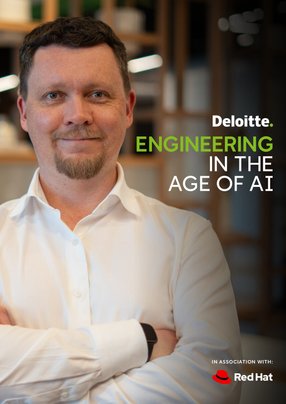
In the crowded world of AI hype, Rob Valk has an unusual vantage point.
As Principal and Engineering CTO at Deloitte Australia, he focuses his expertise on navigating the gap between what AI promises and what businesses can actually use.
His background – 16 years in IT consulting and six years in education IT – taught him something valuable: technology only matters if it genuinely improves people’s lives.
That perspective now shapes how he thinks about AI transformation – and he’s noticed something unexpected about where companies struggle most.
“I’m having a lot fewer technical conversations about AI because the biggest questions that our clients have are around adoption, around safety, compliance and data privacy,” he explains.
This shift in conversation indicates something important: that the hard problems in Enterprise AI aren’t about making the technology work, but about making it work within the complex reality of modern business.
Charting AI’s rapid growth in capability and reliability
The current state of AI is both impressive and transformative.
Rob points to research from METR that tracks how well Gen AI handles extended tasks on its own.
The latest frontier models can tackle work that would take a human over two and a half hours, but with a success rate of about 50%. For 80% reliability, this time drops to under 30 minutes.
“If we think about the quality and consistency we expect of people in our organisations – would we accept having to check in on them every two and a half hours and they still get it wrong half the time? That is where today’s most advanced general-purpose AI models are starting from which is why the right checks and balances are so important,” he says.
What makes this interesting is that capability doubles every seven months. For Rob and his teams, this creates constant tension between what’s technically possible and what makes business sense right now. Yet the evolution of Gen AI tools is constantly changing that equation, letting teams achieve more with the same resources.
Behind the shift from coding to managing AI
Few professions face bigger disruption from AI than software engineering.
Rob quotes Kent Beck, inventor of the JUnit testing framework: “The value of 90% of my skills dropped to zero – and the leverage for the remaining 10% went up 1000 times,” he says.
That shift runs deeper than individual productivity. At Deloitte, technical skills are spreading across the organisation.
Teams from financial advisory and banking recently worked on blockchain payment technologies – domain experts doing deeply technical work.
“The thing with the productive potential of advanced agentic software engineering tools is that even seeing is not quite believing,” Rob says.
“You have to actually kick the tyres; you have to use these tools and deliver real outcomes to truly appreciate the productivity gains that are on the table.”
But AI can’t work miracles on its own.
“AI amplifies what you know and what you can do, but if you don’t know anything and you can’t do anything, then there’s nothing to amplify,” he says.
This changes which skills matter most. Management capabilities – clear communication, effective delegation, structured work – are becoming increasingly critical as engineers evolve from writing code to managing AI agents that write code.
Which partnerships solve AI’s operational challenges
As AI moves from experimental to mission-critical, the right infrastructure partnerships matter more than ever.
Rob points to Deloitte’s work with Dynatrace and Red Hat as examples of how strategic alliances address the practical challenges of deploying AI at scale.
With Dynatrace, Deloitte helps clients move beyond simple alerting to what Rob calls “true AI ops” – using predictive AI to correlate millions of observability signals in real time and automatically detect problems.
“We’ve built an agentic Site Reliability Engineering capability that plugs directly into Dynatrace products,” he says.
“In many cases, an engineer doesn’t need to be involved in the resolution process at all.”
Meanwhile, Red Hat’s OpenShift platform addresses a different challenge: running AI workloads across hybrid and edge environments.
“Red Hat technologies let us take AI into places that we couldn't reach with any other platform,” Rob explains.
The platform unifies machine learning operations with application delivery, bringing common tools and developer experience across the entire AI lifecycle – particularly valuable for running agents on embedded systems in cars, drone and disconnected defence logistics.
For mission-critical applications in public sector, healthcare and finance, Rob says that Red Hat becomes a leading option.
“When it comes to the highest levels of security and trust, it’s a simple choice,” he says.
Why countries need their own AI infrastructure
For Australia and similar markets, AI raises questions about sovereignty and control that go beyond economics.
Rob sees this as critical national infrastructure, especially for defence, healthcare and financial systems.
“Our privacy and our intellectual property landscape is quite different to the nations like the US and China where the most active AI development is happening today,” he says. “So we live in a very different environment.”
Through Deloitte’s “silicon to service” offering, his team helps clients plan, build and operate their own AI infrastructure – the leading edge of technology infrastructure at the moment.
The economics push in this direction too.
Deloitte recommends organisations consider hybrid cloud deployment when cloud costs hit 70% of self-hosting expenses.
Rob frames this as “retail AI” versus “wholesale AI” – renting capacity for experiments and smaller applications versus capital investment in owned infrastructure for enterprise-scale work.
How agentic AI brings new challenges that technology can’t solve
First-generation chatbots and copilot assistants are now ticket-to-play capabilities.
Real innovation happens in Agentic AI – systems that autonomously execute valuable work. As these systems handle more critical business functions, they hit challenges that technology alone can’t solve.
“Scaling and productionising agentic systems, getting closer and closer to the heart of the business, becoming more and more mission critical – that means dealing with compliance, with reliability, with safety and with explainability,” Rob says.
“We are finding a lot more success for organisations that really consider all of those production implementation and operationalisation requirements.”
The importance of human-led AI
Rob returns repeatedly to one theme: humans need to stay at the centre of transformation decisions.
Deloitte’s framework for “human-led, tech-enabled transformation” treats technology as catalyst and enabler, not the goal itself.
“When we think about customer experience, human-centred design, operational models, teaming, training, change enablement – these are all vital aspects of transformation,” Rob says.
He paraphrases a quote that circulated from when AI image and music generation tools first appeared: “We want AI to clean our dishes and fold our washing for us so that we can create art and literature. We don’t want AI to create our art and our literature for us so that we can spend more time doing the dishes.”
The sentiment captures something essential about successful AI deployment.
Technology should enhance human capability and free people for higher-value work, not simply automate the parts of work people find meaningful.
The future of Enterprise AI
Rob highlights several developments worth watching: small language models that run on mobile devices or edge systems; new AI architectures beyond transformer models; and sophisticated ‘evals’ and other quality engineering techniques for agentic systems.
For Australia, he sees particular opportunity in addressing the productivity challenge.
“The biggest threat to our way of life in Australia is stagnant productivity,” he says. “The ability to supercharge productivity improvements and achieve global competitiveness in our areas of differentiation – that is a fantastic answer to the productivity challenges that we face.”
He also points to AI’s potential role in accelerating clean energy investment, given the technology’s massive power requirements: “Perhaps this is the kick we need to make the investments to transition to net zero,” he says.
Rob’s message to business leaders comes down to pragmatism.
AI isn’t the solution to every problem or a threat to be feared, it’s a powerful tool that needs thoughtful implementation, rigorous governance and constant focus on human outcomes.
“It’s on all of us,” he says.
For organisations willing to take that seriously, the opportunities are real.
Company portals

Executives

Robert Valk
Engineering CTO