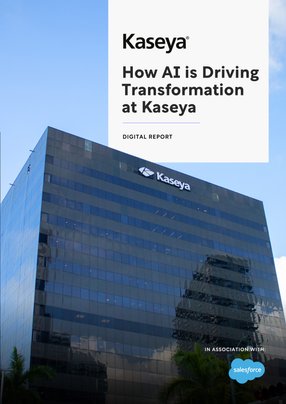
When it comes to managed services, few companies are positioning themselves quite as boldly for the future as Kaseya.
The global firm, with headquarters in Miami, serves more than half a million IT professionals, who collectively manage more than 300 million endpoints worldwide, is going all in on AI.
At the heart of this push towards modernity is Damon Venger, Chief Digital Officer & Chief Information Officer at Kaseya. Since joining in December 2023, he has helped to orchestrate a comprehensive digital transformation at the company, placing AI at the centre of everything his team does.
At Kaseya, Damon’s mission is to go above and beyond traditional IT leadership. His uniquely two-sided role, in which he heads both the firm’s technology function and its revenue operations, allows him to oversee and influence the firm’s sales, its renewals, its deal desk pricing and its data analysis, along with the underlying systems and infrastructure that influence the entire global company’s corporate operations.
"One of the most exciting parts of my role is really knowing what hat to wear at any given point," he explains. "Wearing them both can be very powerful in ensuring value for our internal business and our customers."
This dual responsibility gives Damon an overview that most executives don’t possess, especially at an organisation the size of Kaseya.
He can see how technology is impacting his business operations – a perspective that has proven invaluable throughout Kaseya's recent transformation.
Inside Kaseya
Kaseya is the leading global provider of AI-powered IT management and cybersecurity software. The company employs 5,000 people across 20-plus countries.
The firm’s competitive edge lies in its integrated approach. Rather than forcing customers to juggle multiple vendor solutions, Kaseya delivers endpoint management, back-up, cybersecurity, compliance and automation through one single platform.
"Our competition still struggles with this," Damon says. "The vendor fatigue created by having so many different solutions and operational challenges, as well as the higher costs that their customers see, is a big reason for our success."
Since joining, Damon has helped to oversee a transformational, rather than incremental improvement, in how Kaseya operates, in part due to a focus on technology. Moving from a more conservative approach to IT procurement and strategy to what Damon describes as an “AI-first” approach has been key to this.
The agentic AI revolution
The centrepiece of Kaseya's recent evolution centres on agentic AI – perhaps the sector’s most talked about technology of 2025.
Agentic AI systems are those which can take actions completely independently of human oversight and input, rather than simply responding to prompts, like Gen AI. Essentially, AI agents are a fundamental departure from the way businesses have used AI thus far, promising greater efficiency, productivity and flexibility.
"We are not just saying it," Damon explains. "Six months ago, a year ago, our products were there, but for me on the corporate side, they weren’t heavily used. Now they’re at the forefront of everything we're doing."
Kaseya has created safe spaces for what Damon calls "citizen development," enabling employees across the organisation to experiment with AI tools regardless of their technical background. In a sense, this approach can democratise the development of AI, removing barriers and encouraging engagement.
Kaseya uses several AI tools across its ecosystems, moving beyond simple chatbots to systems that can analyse, learn and grow on the job. Then there’s Salesforce. Kaseya is currently using Agentforce across its operations and has found success by applying the tech in its customer support and go-to market operations.
The way it works is rather simple in theory. The AI agents perform real-time analytics and then take actions based on their analysis – a process of reasoning that we as people follow. It’s a big evolution from the prompt-based systems you’ll find in models like ChatGPT.
"This is where it evolves on its own and actually tells you what it's doing," Damon says. "It's been really exciting and inspiring to be at the forefront of that. We recently held a hack-a-thon in Miami in partnership with Salesforce; it was very successful with many agents from the event being deployed and used by our internal business and partners within days.
One of Damon’s priorities has been making AI a matter of enterprise IT, using it across every part of the business rather than using tools sporadically. Kaseya already has plans for more company-wide hackathons focusing on agentic AI as the organisation tries to stimulate ideas and assess their strengths and areas for improvement.
"This is vibe coding,” he says. “The best ideas and agents could come from someone that has little-to-no IT experience.”
Kaseya’s partnerships
Kaseya's partnership with Salesforce is a shining example of how strategic vendor relationships can help kickstart a digital transformation. As a high-velocity Software-as-a-Service business, Kaseya relies on Salesforce as its primary CRM platform.
This partnership has deepened a lot since Damon joined the company in 2023. Now, Kaseya is re-implementing Salesforce, incorporating its newly powered-up Revenue Cloud platform and shifting billing operations from back-office to front-office systems.
Agentforce has been a huge part of this process. Unlike some other AI programs that require third-party involvement, Agentforce is built directly into the Salesforce platform which helps to reduce complexity and speed things up.
Kaseya has deployed its first set of agents in August and is preparing to deploy multiple more agents within a matter of weeks. The company expects to have its first cohort of more complex agents operational by the end of this month. "We're going from zero to a hundred quick," Damon says.
Resource sharing and collaboration are another important facet of Kaseya’s work with Salesforce. The latter is providing dedicated support to the former, making sure that the deployment of agents is a success. In this relationship, both parties are evidently very important to one another.
Deloitte has also been a key partner for Kaseya recently. Deloitte has been instrumental in helping define and set the foundation for the Enterprise Transformation programme, including Global Design and Build for Oracle Financials & Supply Chain as well as the broader Lead to Cash Transformation anchored by Salesforce Sales, RCA, Commerce, and Service Cloud.
Deloitte has helped guide Kaseya to streamline master data, rationalise product SKUs and simplify processes for more efficient operations and an improved customer experience.
Damon’s approach to partnerships is strategic, but also very pragmatic. His selection of partners like Salesforce shows the importance of choosing platforms that can drop in quickly and make an impact, working together with existing systems while also allowing some room for expansion.
A new era for cybersecurity
The cybersecurity component of Kaseya's transformation reflects Damon’s philosophy that effective security must enable rather than hinder business operations. This approach proves essential for organisations operating in hybrid or remote environments.
"Modernising cybersecurity is definitely not just about defence," he suggests. "It's about enabling growth, trust and operational continuity, while providing the best defence possible to secure our corporation and customers.”
Kaseya operates offices in 20+ countries, requiring sophisticated security measures that enhance rather than constrain productivity. The company operates across multiple time zones with employees working from numerous locations, making traditional perimeter-based security models inadequate.
AI plays a crucial role in this security modernisation. The volume of security data has grown beyond human analytical capabilities, making AI-powered analysis essential for effective threat protection, detection and response.
"There's too much data at this point not to leverage AI," Damon explains. "On top of that, the bad actors are all leveraging AI. So I don't think there's a world anymore where you can properly defend or enable your workforce without AI."
AI-powered security information and event management systems can analyse millions of data points and petabytes of information, identifying threats that would otherwise escape human detection. These systems operate continuously, providing real-time threat analysis and response capabilities.
A look at Kaseya’s roadmap
Kaseya's broader transformation encompasses multiple technology platforms and business processes. The company is replacing core corporate functions with modern, integrated solutions designed to support rapid growth and global operations.
Oracle forms the foundation for human resources and financial operations. Kaseya is implementing Oracle's Software-as-a-Service solutions for global HR management and core financial processes, with deployment scheduled for the third and fourth quarters of this year. Meanwhile Salesforce, along with many key boundary applications, are the foundation for our Lead to Cash Go-To-Market processes.
"The big focus on enterprise transformation is modernising our tech stacks, empowering our business partners and driving business and customer value," explains Damon.
The true measure of Kaseya's strategy will, of course, come through business outcomes. To this end, Damon has set his team some clear metrics for success, focusing on operational efficiency, customer satisfaction and competitive positioning.
At the end of the day, Kaseya expects significant improvements in operational speed and accuracy – all powered by investments in AI. Traditional manual processes that required human intervention are being redesigned to operate autonomously, freeing employees to focus on higher-value activities.
Customer experience will be another KPI that Kaseya will be keeping a close eye on. By modernising its billing systems, support processes and self-service technologies, the firm is hoping to improve its levels of customer satisfaction while also reducing its operational costs.
The future of enterprise AI
For Damon, agentic AI is the most significant technological shift to happen in a generation. “I truly believe it's something that we haven't seen in the industry in decades,” he says. “I think this could really change how we operate in our professional lives.”
One key aspect to this is the democratisation of development that agentic AI promises – making low-code or no-code employees capable of shaping the technological future of the business.
The challenge for leaders like Damon lies in establishing the right governance frameworks, giving AI enough freedom to make a positive impact while also maintaining high levels of security and compliance.
In the industry more broadly, Damon expects to see a rapid adoption of the technology, driven by its lower barriers to entry. Unlike traditional enterprise software implementations that require extensive project timelines, AI agents can be deployed far, far more quickly.
As Kaseya continues to transform, Damon remains focused on the fundamental goal of empowering people and teams to achieve more than they thought possible.
“The barrier to entry for agentic AI in the workplace is notably lower than in personal settings or with broader technologies. For the first time – maybe ever – employees may find that the tools they use at work are more intuitive, more effective, and less complex than those in their personal lives.
“This shift represents a true inflection point in how we deliver exponential value to customers.”
Company portals
Executives
Damon Venger
Chief Digital & Information Officer (CDIO)