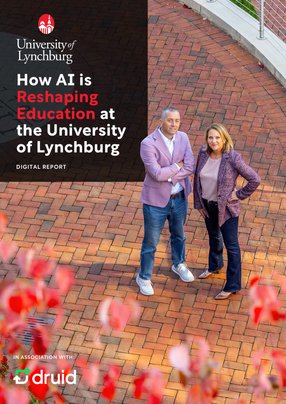
How AI is Reshaping Education at the University Of Lynchburg
At a small liberal arts university nestled in a quiet corner of Virginia, something significant is brewing.
The University of Lynchburg has a proud history that traces its roots back to the very beginning of the 20th century.
Located in a leafy suburb, its peaceful landscape and colonial-style architecture present a very traditional image of American higher education.
But speak to any member of the university’s faculty or student body and you will quickly realise that all is not quite what it seems on campus.
For the past few years, the University of Lynchburg has put a real emphasis on digital transformation. This mission, spearheaded by Charley Butcher, the university’s Chief Educational Technology & AI Officer and Sandra Perez, the Senior Director of Academic Initiatives & Human Resources, has been nothing short of a technological upheaval.
The 120-year-old university has made AI literacy a core component of nearly every course it offers. This, according to Charley and Sandra, is not only streamlining everything from administration to teaching, but it is also giving students a head start in an increasingly competitive job market in which AI skills are in high demand.
The story of the University of Lynchburg’s modernisation
This has been a long time in the making; both Charley and Sandra have spent years modernising life on campus.
Charley has been with the university for 13 years and is considered something of a maverick. He previously spent 18 years teaching science and math in K-12 education and his unconventional teaching style translated perfectly to a role in higher education. "I was organised chaos in the classroom," he explains.
Sandra joined the university eight years ago. After graduating from the university as a non-traditional student, she was quickly offered an administrative position by the provost and has rapidly advanced to more pivotal senior leadership roles as the years have passed. Sandra has been instrumental in digitising campus processes. "I automated about 90% of our processes," she says. As a result, most of a student’s responsibilities can now be fulfilled online.
The partnership between Charley and Sandra is a dynamic one and they are constantly strategising ways in which they can make university life better for faculty, staff and students alike. "We're really good at bouncing ideas off of each other," Charley says. Their complementary skills have accelerated the university's technological transformation.
The institution, which is home to fewer than 3,000 students, faces many of the same challenges as other American universities, with enrollment cliffs and budget constraints threatening growth and development. But Lynchburg's embrace of technology is becoming a differentiator. "We really do have to set ourselves apart," Sandra explains.
That does not mean that the university is discarding all the academic rigour and traditional educational values that have characterised its past, though. Instead, the university is looking to enhance its offering by bringing AI to the classroom. "It's not really changing our core vision, it's just changing the tools," Charley says.
The pandemic accelerated this transformation dramatically. In his own words, Charley went from being a radical outsider to being one of the most popular people on campus. "I was helping them change how they taught because we had to move online," he recalls. Since then, use of Lynchburg’s online learning management system has jumped from 12% to 99%.
Teaching responsible AI use
While the wholehearted introduction of AI might garner some scepticism or cynicism from other educational institutions, one key thing that Charley and Sandra understand is that they are simply moving with the tide rather than pushing against it.
For a few years now, students have been ahead of the curve. Sandra’s son, who is a senior at the university, confirmed what educators around the world suspect. "Every student is using AI," he told his mother. In this light, the question isn't whether to use AI but how to encourage using it responsibly and constructively.
At Lynchburg, professors encourage a transparent approach to the use of AI in coursework. Students must submit their prompts, the AI-generated feedback, and their final work, showing the entire journey of a project in a reflexive manner. It is a radical departure from traditional assessment methods.
According to Charley, one professor has flipped the process entirely. Students write papers using AI first, then rewrite them manually, which teaches them to evaluate the output of chatbots critically. "They're able to find those different things that were incorrect, and then correct them," Sandra explains.
It is plain to see that this method can equip students with some crucial skills. They analyse tone, persona and accuracy in AI-generated content, which is exactly what professors want them to learn when it comes to critiquing any form of writing. "It's just through a whole different process," Charley explains.
The Druid partnership
In March, the university began a partnership with Druid, an AI chatbot platform provider, after Sandra saw a conference presentation by Georgia Southern University in which the presenters raved about the impact the technology had had on their work. “On our way back from the conference I just could not stop talking about it,” she remembers.
Since then, Lynchburg and Druid have teamed up to create a tailormade chatbot which they have named Dell, after the university’s mascot. Dell is able to answer questions about admissions, courses, athletics, technology support – basically anything Lynchburg-related.
What’s more, the implementation of the system required very little effort from the team at the university, with Druid taking a very active role in the corporate relationship. Every week, Charley and Sandra meet with Druid to discuss and analyse how the system is performing and where it could improve. "They're updating us on what they're doing to help us," says Charley.
This kind of customer service has been a huge bonus for the duo. "I don't think I've ever worked with a company that was as responsive," Sandra says. Faculty and staff testing the system were impressed immediately, with the accuracy and ease of use surprising everyone. “Charley and I look like rock stars, even though Druid did most of the heavy lifting,” Sandra grins.
Phase Two of Druid’s implementation, which is imminent, will integrate AI with the university’s academic systems. The idea is that students will sign in with credentials to access personalised information, where Dell will help them schedule classes and plan academic pathways. "This is a work in progress, but Druid's going to be instrumental," says Charley.
The effect on research and administration
For the more mature academics at the University of Lynchburg, AI is transforming research without fundamentally changing its nature, speeding up processes that previously took hours or days. "You can put in one prompt and hit one tool button," Charley explains. Processing huge datasets has never been quite so easy.
According to Charley, one faculty member is currently using AI to analyse local K-12 school board meetings. He records different boards addressing various issues and inputs them into AI tools. The system identifies trends and themes across multiple meetings. "He says it's amazing," Charley reports. “This used to take us hours, days, weeks, months – now it’s taking minutes.”
The university's administrative processes have also been expedited thanks to AI. Staff members input agreements, guidelines and regulations into AI systems to create proposals and ensure compliance. "Things that would have taken hours before to read through," Sandra says. With these time-intensive tasks now automated, staff are encouraged to focus on innovation and strategic thinking.
The team at Lynchburg is intentional that the use of AI should be carried out with safeguards, though, promoting the use of closed AI models when they are sharing the kind of sensitive information found in policies or contracts. "It needs to be a closed model where it's not training the model for other people," Charley stresses. “It’s not data that’s being released into the world.”
Preparing students for AI-powered careers
It is no secret that the corporate world has been in the throes of AI fever for the past few years. Naturally, the job market has already started to favour people with AI literacy. At the University of Lynchburg, the team’s job is to prepare students for that reality. "AI is not taking people's jobs. People with AI skills are taking people's jobs," Charley says.
Employers now routinely ask about AI skills in job interviews. The question isn't whether candidates have technical abilities, it's whether they've learned to use AI effectively. As a result, students graduating without these skills may risk being left behind.
The university wants to give students the tools they need from a modern education right from the first day. Lynchburg’s eLevate programme, which launches next autumn, will see every new freshman receive a MacBook Air. After four years, the entire student body will have standardised devices. "Our students will actually be graded on what they can do, not the technology that they have," Charley says.
Resistance to change – and how to overcome it
Although the benefits of new technology are already beginning to show, change can still be a difficult and drawn-out process. "A lot of people are afraid of change, but change is necessary," says Charley. “We wouldn't be driving cars if we didn't change. We wouldn't have cell phones if we didn't change.”
The university has a strategic approach to encouraging evolution, with champions on campus trying new tools first and, when their peers see positive student responses, they quickly become interested too. "Next thing you know, Sandra's door is being knocked on, or my door's being knocked on," Charley explains.
Still, changing people’s minds isn’t an easy process. Initially, one of Charley’s colleagues argued that societies have functioned without AI for thousands of years. She made this point during a Google Meet call and the irony wasn't lost on Charley. "She couldn't have done that a thousand years ago – or even 5 years ago!"
But most faculty and staff are eager to learn. The relative novelty of AI creates fear of being left behind. "People want to know about these things," says Sandra. “Faculty want to know how to better their courses or their teaching, and students want to better themselves academically.”
Looking ahead
The pace of development makes long-term planning challenging when it comes to AI – tools released in March look completely different now. "I think everyone has to almost live week to week," Charley says.
Charley and Sandra feel reassured in their partnership with Druid, though, as the firm continues developing new features for its platform. Butcher and Perez will learn about upcoming releases at a November conference, where they are attending as panellists to share their experiences with the technology. The rapid evolution keeps everyone adapting constantly.
“We haven’t had a major shift in the way we teach since the late 1800s. We’re now finally seeing some disruption in that, and AI is the key disruptor,” Charley explains.
When it comes to digital transformation, the university's small size works in its favour. Whereas traditional liberal arts institutions typically resist change, Lynchburg's embrace of AI – and the speed at which it has been able to change – sets it apart from its competitors.
But, most importantly, the students stand to benefit hugely from this transformation. "I get out of bed in the morning and come to work for our students and I think Sandra would tell you the same thing," says Charley. “We are here for the students, and the crazy, creative things that they do really inspire us.”
Company portals

Executives
Charley Butcher
Chief Educational Technology and AI Officer
Sandra Perez
Senior Director of Academic Initiatives and Human Resources