
ZincFive is a global developer of patented nickel-zinc (NiZn) battery technology, focused on immediate power solutions for mission-critical infrastructure, including data centres and intelligent transportation systems.
Over the past decade, the company has commercialised its technology across a growing range of critical infrastructure applications, with approximately 2GW of nickel-zinc battery systems shipped or contracted worldwide.
Its systems are built around a chemistry based on nickel and zinc rather than the lead-acid or lithium-ion chemistries that have traditionally dominated back-up power applications. This approach enables ZincFive batteries to deliver extremely high power in short bursts, making them well suited to environments where electrical loads fluctuate rapidly and reliability is paramount.
Instead of prioritising long-duration energy storage, ZincFive’s technology platform is engineered for rapid response, repeatable cycling and high-power density. The firm refers to this category as Immediate Power Solutions (IPS) – systems designed to inject or absorb large amounts of energy in milliseconds rather than sustain discharge for hours at a time, a capability that is becoming increasingly important in AI-driven computing environments.
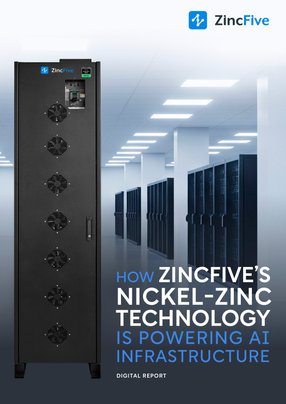
The physical design of the systems reflects this focus. ZincFive UPS battery cabinets are compact and lightweight relative to conventional alternatives, allowing operators to reclaim valuable floor space within power rooms and increase usable compute capacity without expanding their facilities.
Technologically, nickel-zinc batteries offer a combination of safety, sustainability and performance characteristics that can be difficult to achieve simultaneously with legacy chemistries. The chemistry operates using a water-based electrolyte and, unlike lithium-ion systems, does not undergo thermal runaway at the cell level – an increasingly important consideration for operators managing high-density electrical infrastructure.
Sustainability has also become a key factor in battery selection, particularly in Europe where regulatory frameworks and corporate sustainability targets are reshaping procurement decisions. ZincFive’s nickel-zinc systems are designed with circularity in mind: more than 90% of the base materials used in the firm’s BC 2 battery cabinets are recyclable, and over 600 kilograms of material per cabinet can be directed into recycling streams through the company’s take-back programme. In addition, 100% of the nickel and zinc contained in the batteries can be recovered and reused in other industrial applications, including precursor cathode active materials used in battery manufacturing. Through end-of-life recycling alone, each BC 2 cabinet is estimated to offset roughly two metric tonnes of CO₂-equivalent emissions.
Lifecycle assessments conducted by independent third parties indicate that NiZn batteries can produce 25–50% fewer greenhouse gas emissions over their lifecycle compared with alternative battery chemistries such as lithium-ion or lead.
These characteristics are becoming increasingly relevant as the rapid expansion of AI infrastructure begins to reshape power requirements inside data centres. Modern GPU-based computing clusters can generate sudden and extreme spikes in electricity demand, placing significant stress on conventional back-up power systems originally designed for far more predictable electrical loads.
Meet Brandon Smith, ZincFive’s Vice President of Global Sales and Product
Brandon Smith did not originally set out to build a career in data centre power. Trained as an engineer, he began his career in the broader energy sector, drawn by a fascination with the systems that quietly keep modern infrastructure running.
What ultimately pulled him toward critical power systems was the realisation that some of the most important technology in the digital economy operates largely out of sight. Early in his career, Brandon worked directly with battery systems and uninterruptible power supplies (UPS), maintaining and supporting the equipment that keeps hospitals, transport networks and data centres running when the grid fails.
That hands-on experience sparked a lasting interest in the technologies behind reliable power infrastructure. Over the years he worked across multiple battery chemistries, including lead-acid, lithium-ion and advanced monitoring systems, building a practical understanding of how different technologies perform in mission-critical environments.
“When you spend time around these systems, you realise very quickly that the chemistry matters,” Brandon says. “Different batteries behave very differently when the power environment becomes volatile – and that’s where the engineering becomes really interesting.”
Today, as Vice President of Global Sales and Product at ZincFive, Brandon sits at the intersection of product strategy, partner collaboration and customer demand. His role focuses on shaping the company’s nickel-zinc battery solutions for the rapidly evolving power requirements of modern data centres.
What ZincFive does
ZincFive has spent more than fifteen years developing and refining its NiZn battery technology, advancing both the chemistry and the manufacturing processes behind its systems. Over that time, the firm has built a substantial intellectual property portfolio, with more than 80 patents covering its battery chemistry and manufacturing technologies.
Today, the company occupies a very specific position within the power infrastructure landscape. It is not, Brandon is quick to point out, an energy storage company in the traditional sense. Energy storage typically refers to long-duration systems designed to hold power for hours at a time. ZincFive’s focus is something quite different.
“Energy is long duration – think a marathon,” Brandon explains. “Immediate power is a sprint. It’s about delivering very high power for a very short period of time, exactly when the system needs it.”
This distinction sits at the heart of ZincFive’s Immediate Power Solutions approach. Rather than storing large amounts of energy for extended discharge, nickel-zinc systems are engineered to deliver repeated bursts of high power in rapid succession while maintaining stable operating temperatures and long service life.
Part of the answer lies in the chemistry itself. NiZn batteries have very low internal resistance, allowing them to release large amounts of power extremely quickly without generating the levels of heat typically associated with other battery technologies.
That electrical profile makes nickel-zinc well suited to applications where high power is required in short bursts. One example is industrial engine starting, where large diesel engines must be cranked reliably in demanding environments. Through partnerships such as its collaboration with Stored Energy Systems (SENS), ZincFive’s NiZn technology is already deployed in commercial engine-starting systems used in critical infrastructure.
As it turns out, that same capability – delivering repeated high-power bursts quickly and reliably – maps closely onto the emerging electrical behaviour of modern AI-driven data centres.
The moment the industry changed
For much of the past decade, data centres evolved cautiously. Operators favoured established technologies, optimising infrastructure incrementally and introducing major changes only over long planning cycles.
That pace has shifted dramatically with the rapid rise of AI workloads and the GPU-based computing architectures that support them.
Unlike traditional server environments, AI systems do not draw electricity in a smooth and predictable pattern. Instead, they generate sudden and highly variable bursts of demand – what engineers increasingly describe as dynamic power events.
These spikes can occur in milliseconds as processors ramp from idle to full computational load, placing significant stress on power infrastructure that was originally designed for far more stable electrical behaviour.
“What AI is doing to data centre power systems is fundamentally different from anything we’ve seen before,” Brandon says. “These workloads create sudden, high-intensity power spikes that traditional infrastructure was never designed to handle.”
For infrastructure designers and product developers alike, this shift represents both a challenge and an opportunity. Systems optimised primarily for energy capacity must now respond to rapid, high-power fluctuations that occur thousands of times during normal operation.
Why battery chemistry matters in the age of AI
Traditional back-up power systems were designed for a very different electrical environment. For decades, valve-regulated lead-acid batteries dominated data-centre UPS installations, providing several minutes of energy while diesel generators started and synchronised with facility loads.
Lithium-ion batteries have more recently entered the market, offering higher energy density and longer service life in certain applications. However, both chemistries were developed with relatively stable electrical loads in mind.
AI infrastructure is introducing a new demand profile.
When clusters of GPUs ramp rapidly between idle and full utilisation, they create sharp power spikes that can occur repeatedly throughout normal operation. These dynamic power events place new stress on battery systems designed primarily for energy capacity rather than repeated high-power cycling.
Lithium-ion batteries, for example, excel at storing large amounts of energy relative to their size. But repeated high-power discharge cycles can generate heat that accelerates degradation and reduces long-term performance. In practice, operators often compensate by oversizing battery installations to maintain reliability and lifespan.
This overbuild not only increases capital costs but also consumes valuable floor space inside data-centre power rooms – a growing concern as facilities push toward higher rack densities and more compact infrastructure designs.
Nickel-zinc behaves differently.
Because NiZn cells have inherently low internal resistance, they can deliver very high power quickly while maintaining stable operating temperatures.
“One of the advantages of nickel-zinc is that we don’t have to choose between traditional back-up power and AI performance,” Brandon says. “The same system can handle both.”
BC 2 AI UPS battery cabinet
To address the changing power behaviour of AI-driven infrastructure, ZincFive has developed the BC 2 AI UPS battery cabinet, a product designed to support both traditional backup power requirements and the rapid fluctuations introduced by modern compute workloads.
In conventional data-centre power architectures, batteries provide energy during a grid failure while generators start and synchronise with the facility’s electrical load. AI workloads introduce an additional challenge: highly dynamic power demand that can place new stress on electrical infrastructure.
The BC 2 AI cabinet is designed to handle both.
Installed close to the UPS and critical power path, the system can absorb short, high-intensity power spikes while still retaining sufficient energy capacity to bridge the gap between a utility outage and generator start-up.
“With nickel-zinc you don’t have to compromise,” Brandon says. “You get the safety, reliability and footprint required for UPS back-up while still handling the dynamic power behaviour of AI workloads.”
Because NiZn batteries can deliver high power efficiently without generating the same level of heat as other chemistries, the BC 2 AI cabinet can perform both roles within a single battery infrastructure, reducing the need for oversizing and helping operators preserve valuable data centre floor space.
Protecting the grid as well as the server
The implications of AI-driven power volatility extend beyond the walls of the data centre itself. When clusters of GPUs ramp rapidly between idle and full computational load, the resulting spikes in electricity demand can ripple through the entire electrical chain – from the rack and UPS to facility distribution systems and, ultimately, the utility grid.
Utilities are typically designed to operate within relatively stable demand ranges. Rapid, millisecond-scale fluctuations can introduce instability that affects not only the data centre but other infrastructure connected to the same section of the grid.
This is where immediate power infrastructure begins to play an important role.
By absorbing short-duration power spikes close to the source – at the rack, UPS or facility level – Immediate Power Solutions can act as a buffer between volatile compute workloads and the rest of the electrical system.
“The opportunity for immediate power is to solve those pulses as close to the load as possible,” Brandon explains. “If you stabilise the power profile inside the data centre, everything upstream – the UPS, the distribution equipment and even the grid – operates more smoothly.”
Looking ahead: power infrastructure in the AI era
As the data-centre industry adapts to the growing influence of AI, infrastructure designers are rethinking long-established assumptions about power systems.
Rack densities that once ranged between 10 and 30KW are now climbing rapidly, with some AI deployments pushing toward megawatt-scale power consumption at the rack level.
Supporting this level of compute performance requires a different approach to electrical infrastructure – one capable of responding to both higher overall demand and far more dynamic power behaviour.
For ZincFive, this changing landscape reinforces the importance of immediate power solutions. The company works closely with UPS manufacturers, system integrators and infrastructure providers to integrate its nickel-zinc battery technology into modern power architectures, partnering with leading industry players such as ABB, Vertiv and others across the data-centre power ecosystem.
But the industry itself is still learning how to adapt.
“Right now, the entire sector is learning in real time,” Brandon says. “We’re seeing infrastructure evolve much faster than it has in the past as operators experiment with new architectures and power strategies.”
Over the next several years, those lessons will shape the next generation of data centre power systems.
“AI changed the power profile,” Brandon says. “But it didn’t change the need for reliable back-up.”
Company portals

Executives

Brandon Smith
Vice President of Global Sales and Product Management