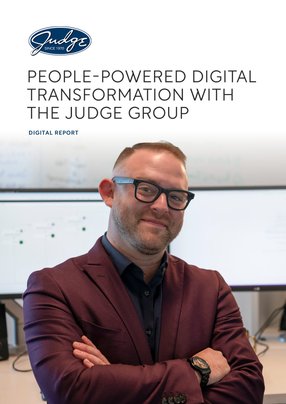
People-Powered Digital Transformation with The Judge Group
Matt Campana’s journey into the world of technology was a rather unconventional one.
In his early years, he studied to be a composer at Drexel University and Berklee College of music. There, he learned how to write music for an entire orchestra (something he still does to this day).
Now, in 2025, he orchestrates things in a different sort of way. As Vice President of Digital Transformation at The Judge Group (Judge), Matt is tasked with modernising a vast growing business, conducting the company’s evolution like a symphony.
While it wasn’t his first love, Matt was always interested in technology and became a Microsoft Certified Professional when he was 14. He took his first job in the sector to fund his music, digitising the electronic healthcare systems at Will’s Eye Hospital in Philadelphia, PA and converting Sunoco from Mainframe to cloud.
Quickly, though, he realised he was enjoying this new “side hustle” – IT.
"I decided, let's go into the field of technology, be able to fund that music, and have fun with it," Matt explains. That decision launched a career spanning healthcare, energy and enterprise automation, all of which led him to Judge.
The Judge Group is a global professional services firm that specialises in workforce, business and technology solutions that currently serves much of the Fortune 500 – a client list that any company would be envious of.
The organisation operates across almost every sector, including life sciences, healthcare, technology and telecommunications, aerospace, banking and financial services, government, manufacturing and engineering, and more.
Matt joined Judge in 2016 and initially set his focus on modernising its financial systems. Nine years later he has been an integral part in a period of rapid transformation, in which the firm has grown to three times its size in less than a decade.
Today, Judge employs approximately 4,000 contractors across its various divisions annually.
"Specifically at Judge, we pay thousands of contractors, and I think about each and every person," Matt says. "That's their day-to-day, that's their groceries, that's their mortgage, that's their vacation. What we do directly impacts the lives of thousands of people!"
This human-centric approach is what sets Judge apart from the crowd. The company's slogan is ‘People-Powered Business Solutions,’ which reflects its commitment to maintaining human interaction in an increasingly automated business world. Account representatives work directly with clients to understand their specific staffing and services needs.
But while the company’s focus on people is firm, it always has one eye on the latest technology. The company structures deals that allow businesses to outsource employment staffing needs, payroll processing and benefits administration, and Matt's role centres on creating technology solutions that streamline these complex processes.
Managing so many employees can be incredibly challenging, with all manner of technological hurdles to vault. By overseeing enterprise automation using platforms such as ServiceNow, Box and Microsoft Azure, Matt has made that task simple, helping companies to integrate all their CRM, ERP, HRIS and automation needs, amongst much more.
"One of the things I love about what I do is I get to help people," Matt reveals. "We create meaningful, actual solutions that help people do more meaningful work in their day to day."
Starting with clean data
Data governance is right at the foundation of Judge’s digital transformation strategy. As the company has grown in stature in recent years, disparate data entry practices across systems have created some significant challenges when it comes to automation.
In 2025, the whole business world is awake to the fact that AI can help to solve issues with data, but Matt knows that even with all the AI and automation tools in the world, a company’s workflow cannot function properly without clean, standardised data.
"You can't deploy proper AI and automation tools on top of your systems unless your data's clean," Matt states. "That's the foundational step to successful AI and automation deployment."
To address these fundamental issues, Judge has implemented a comprehensive data governance programme, standardising vendor records, customer records and potential client information across the applicant tracking system, customer relationship management platform and payroll systems. The company has also established clear data lineage protocols.
Data lineage identifies the "gold record" for each piece of information. This means knowing which system contains the authoritative version of any data point. Matt's team has developed an internal middleware platform called the J-Hub. This system allows different applications to communicate through a standardised middle layer.
Judge has transitioned to cloud-based infrastructure, supporting the company's growth while also reducing the technical debt associated with maintaining on-premises systems.
Human-centred AI implementation
As a tech-forward, yet people-centric business, it is natural that Judge’s approach to AI is all about augmentation, rather than replacement of human workers. As such, Matt is a strong advocate for "human in the middle" implementations, where AI handles routine tasks while experts review outputs and make final decisions as they continue to dial in the AI accuracy thresholds.
The company uses Box, a cloud content management platform which has an AI Agent studio, for handling unstructured data including millions of documents, PDFs and media, and turning it into meaningful enterprise automation information in the form of usable data to help the enterprise make actionable decisions about its people processes and profits. Box's AI capabilities allow Judge to conduct metadata extraction and intelligent document analysis with its Box Extract metadata tool, while the system can also review requests for proposals and automatically extract key information such as contract start dates, client names and jurisdictions.
"Contract review can go from two to six hours down to 20 minutes," Matt explains. However, he stresses that subject matter experts must still review AI outputs, adding that "to just blindly trust AI at this point is not prudent."
Judge also deploys AI to identify discrepancies in timesheets across multiple client systems – sometimes as many as 65 different systems. When the AI detects inconsistencies, it generates incident requests in ServiceNow for human review. This approach maintains accuracy whilst dramatically increasing processing speed.
Matt's philosophy centres on starting small with AI implementations. He recommends identifying specific, repeatable processes where AI can deliver clear value. Once the system achieves approximately 90% accuracy, human spot-checking can be reduced proportionally.
"The biggest win for your organisation is going to be starting small and getting a win that is repeatable over and over and over again," says Matt.
Empowering workers through automation
Matt's personal experiences inform his empathetic approach to the implementation of tech. He has walked approximately 8,000 miles since the pandemic began, using these quiet moments to reflect on human behaviour and how to change things for the better.
"I truly believe that if we extend grace to people and try to understand what actually happened that caused something to be incorrect, we can understand how to work with those same people to create meaningful and lasting solutions," Matt says. For him, resistance to technological changes can often stem from employees being “buried under a mountain of work” rather than unwillingness to adapt.
In an effort to bring all its employees along with it for this transformation, Judge has established a Digital Change Champion programme. This initiative identifies employees below department owner level who understand daily operational realities. These champions provide input on technology designs and solutions, ensuring implementations meet actual user needs.
"Sometimes there's a disconnect where you get a group of technologists with a new licence, and they are excited to implement something new. The mindset is ‘we can do anything and everything’," Matt says. "I always ask: ‘Should we? What is the problem we're trying to solve?’."
This approach has proven particularly valuable in recruitment operations. Judge maintains over one million resumes in its systems. AI helps recruiters screen candidates more efficiently by rewriting resumes using Box Doc Gen for easy job order submission, but human expertise remains essential. The technology enables recruiters to submit 10 candidates in the time previously required for two.
Building rather than buying applications
Matt advocates against the common tech sector impulse to build custom applications for every problem. He states that “the moment an organisation creates an application, it inherits a form of technical debt. Within weeks, that application requires maintenance, upgrades and ongoing support.
“Not every problem needs a new app," Matt states. Instead, Judge leverages low-code and no-code capabilities within enterprise platforms like ServiceNow and Box to ensure ease of operation for the businesses it serves.
These platforms can allow the company to build lightweight applications without having to maintain the underlying infrastructure, freeing team members up to focus on the requirements and tasks that are truly unique to them. For routine automation needs, platform-native tools provide faster, more sustainable solutions.
Matt draws an analogy to music composition and says that the best orchestral works often emerge from limiting the instrumental palette. "Making sure you have the right tools in the stack is critical," he explains.
Overcoming the challenges of implementation
Matt is completely aware that implementing new, enterprise-wide technology systems carries a significant risk. He cites research showing 68% of enterprise resource planning implementations fail outright. Judge tries to mitigate these risks through rapid prototyping and minimum viable product development, all of which is built into the firm’s standard B2B collaboration strategy.
Weekly check-ins focus not just on project timelines but on team wellbeing and realistic goal-setting. "The feel is actually very important," Matt says. When teams overcommit and miss deadlines, momentum suffers.
Matt recalls a particularly challenging payroll integration where the legacy system's first entry dated from 1999. The system contained more than 300 customisations and numerous data integrations. The team worked tirelessly for six months, sometimes sleeping in hotels during critical cutover periods.
"We successfully balanced down to the penny at the end of that," Matt recalls. Despite the success, he emphasises the importance of emotional equilibrium and suggests that success in one project doesn't guarantee success in the next. We must always be innovating.
“I heard Hans Zimmer, the great composer, received an Oscar for one of his soundtracks,” Matt says by way of comparison, “but the very next morning he had one of his scores thrown out by a producer.”
Strategic partnerships
Judge’s transformation relies heavily on strategic partnerships with technology vendors. The company works extensively with AHEAD, a technology solution provider that offers expertise across multiple IT verticals.
"Going to the experts on how something should work when you don't have the in-house expertise is critical," Matt explains. Partners help avoid common pitfalls and accelerate implementations.
“I cannot tell you how many times, outside of our group, I have inherited a system that was implemented poorly and we are re-implementing that system. It's very, very critical to have the right partners, because they can steer you clear of pitfalls, bad design mistakes and they also offer incredible access to key resources when stakes are high,” Matt says.
When Judge first started using ServiceNow, it had no internal practitioners. AHEAD provided the expertise needed to implement the platform whilst training internal staff. This "learn it well enough to teach it" approach has been absolutely essential for the group’s adoption of technologies.
Judge also maintains strategic relationships with Microsoft for Azure services and Box for content management and AI capabilities, which makes a mutual success plan for adjacent firms like Judge and AHEAD. These partnerships provide access to cutting-edge features and discussions while ensuring that all can benefit from joint success plans and collaborative roadmaps.
The AI hype cycle
Matt acknowledges that AI suffers from significant overhyping. The technology has become a buzzword attached to every product under the sun. “Even my toothbrush has AI in it,” Matt jokes. He predicts the current bubble will eventually burst, as historical technology bubbles have done.
However, he believes AI can deliver on its promises when implemented thoughtfully with human oversight. For Matt, organisations that adopt a "crawl, walk, run" approach will ultimately succeed. This means starting with data cleansing even before purchasing AI tools.
That is certainly the case at Judge, where the internal enthusiasm for AI is growing all the time. Employees from contracts and legal departments now approach him with suggestions for AI tools. For Matt, encouraging creativity is hugely important, but maintaining governance around security and data privacy is equally integral.
Looking ahead
Over the next 12 to 18 months, Judge will focus on leveraging its internal AI and automation experience to serve clients.
"If we can fix these complex automation challenges for ourselves and adapt for ourselves and grow for ourselves, we can turn around and do that right for our customers," Matt explains. Continuing to build on internal data provides the experience needed to guide client implementations.
Matt's broader philosophy extends beyond technology. He believes businesses should focus on creating new opportunities rather than competing for existing market share. "I don't want my slice of the pie, I want to bake more pies," he says. For Matt, it isn’t about competition, it’s about creation. He hopes more leaders embrace that mindset and encourage it at every level of their organisations.