
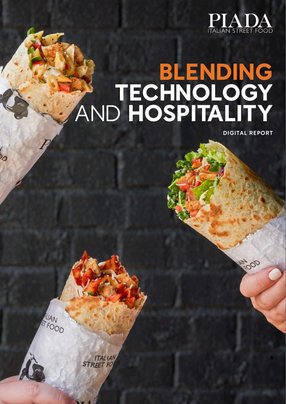
Piada Italian Street Food may be a fast-but-casual take on Italian restaurant dining, but casual is the last adjective its Vice President of Technology, Jason Profitt, would associate with its approach to technology.
For Piada, technology is not just about efficiency – it’s about enabling sustainable growth. Founded in 2010, the company now operates 60 locations across seven states in the US, following what Jason describes as a “controlled growth strategy.”
Piada’s menu centres on pastas, salads and its namesake piada – a rolled flatbread inspired by Italian street food.
Jason’s team has their “hands in just about everything” at Piada. The technology function works closely with marketing, culinary, finance and operations departments, as Jason works to power the business from a data analytics perspective.
Technology at Piada
Data integration is central to Piada’s operations. The technology team supports analytics for both internal and external reporting, linking systems such as point of sale, payroll and finance.
“While we’re not the champions of those products, we are involved with them,” Jason explains. “We’re part of the foundation.”
And as AI is increasingly shaping the restaurant industry, Piada is embracing the technology to boost both customer experience and operational efficiency.
Jason says that while many outside the industry may only associate restaurant technology with online ordering or mobile apps, the reality is far more complex and layered.
“We’ve come in and seen a space to put technology solutions in for either the guest or our teams where initially maybe we didn’t initially realise something was possible,” Jason says. “This is fun for me as problem solving is something that I really enjoy. There’s a lot of space at Piada to do that. We’re always thinking about how we drive value to our guests with technology.
“For the technology team, our focus is – and going forward will be – very heavily directed toward guest engagement. How can we invite the guests back through personalised communications? Through tailor-made offerings? Through anything that’s going to be valuable to that specific guest?”
Because of this drive – as well as the value of AI in making the most of Piada’s wealth of data – the company is focusing on building out a data lake and a data warehouse. Piada, historically, operated with a data warehouse model, where data from different systems – such as point of sale, HR and finance – was structured and integrated for specific analytics and reporting needs.
This approach, he notes, is valuable for producing consistent, reliable reports and supporting business operations.
However, Jason reveals that Piada is now moving toward a more flexible data lake approach. With this model, raw and unstructured data from various sources is collected in a central repository, enabling the company to store much larger volumes of information and to analyse it in new ways. This allows Piada to be more agile in how it uses data, supporting advanced analytics, AI and ML initiatives, laying a foundation to enable it to harness the full potential of its data as it continues to scale and innovate.
“Data analytics is going to be a key focus of ours,” Jason adds. “By working on our deployment of a data lake and a data warehouse built on AWS, we’ll be able to query data sets. We already have an analytics dashboard that we’ve built internally that provides a lot of really great insights, but what we’re looking for in the future is ways to query data and surface things that we didn't know to ask.
“This is where, I think, AI is going to really come into play for us in the future. I see our AI strategy as integral to helping us out – as an assistant in some areas and then the bulk of it channelled into data analytics.”
People, people, people
Despite Piada’s and Jason’s obvious focus on technology, Jason is quick to emphasise the importance of people. For Piada, it’s important that its technology strategy compliments the human elements of its business – with tech like AI not replacing jobs but instead the people that are already part of its workforce.
Jason explains: “Whenever we're trying to solve a problem, I like to tell people to focus on the solution and then see what we can do with technology. Tech comes second to the solution because it is rare that tech can get you all the way there. By thinking this way, you’re inherently thinking about the people and not the technologies. It’s about what the technology can do and how that will be helpful to people.”
One way Piada enhances the power of its people is by nurturing long-standing and strong relationships with partners. It has an ecosystem of upwards of 40 partners, showing that partnerships are not just important, but an integral part of its business model.
“It’s having the time to do everything I want to do or finding partners who have the capabilities for all the things we want to do,” he says.
Olo, for example, is a platform that helps restaurants drive profitable traffic through its fully-integrated catering solution. Piada uses Olo Rails, which connects third-party marketplaces to the company’s digital platform, making order management slicker for Piada’s staff and customers.
“We partnered with Olo through its dispatch platform to be able to do first-party offerings fulfilled by third-party delivery. In technology, there’s always the desire to want to build everything in-house and make it yourself. But, when we partnered with Olo, it offered a good platform where it gave us the ability to build our own online ordering experience while using their platform to handle payment, point of sale, order injection, menu management – a lot of the guts that go into online ordering, not just the pretty thing you see up front. Olo’s back-end offering allowed us to make the pretty thing you see upfront early on using its ordering API from the onset.
“We started working with Olo back in 2014 and we were one of the first brands to adopt their ordering API. We’ve been involved with them on roadmap development through feedback and feature requests. We’ve had a very good and open relationship with them where they are comfortable with reaching out to us saying ‘Hey, we’re thinking about rolling out features this way, would you give us your input?’.
“From my end, that means we can suggest a feature that we think would be great –and not just for us. It’s examples like this that show we’re not just looking for vendors, we’re looking for true partners – people who see that Piada’s success is also their success.”
Creating moments of happiness
For Jason, the biggest challenge is balancing ambition with reality. Motivated by Piada’s mission to create moments of happiness, Jason works to innovate at a sustainable pace, ensuring that new technologies are integrated thoughtfully and that teams are prepared for change.
With technology as a means to an end – improving guest experience, supporting employees and enabling growth – Jason is optimistic about Piada’s future from a technology perspective.
He says: “We’re seeing the trend as being: ‘How do you bring value to somebody in ways that aren’t just discounts and value meals?’. With our technology allowing our brand to provide value to a guest – whether through convenience or moments of delight – it makes it personalised. In the last few years, personalisation has really been the driving factor. Now, it’s kind of expected. Our job, because we have our customers’ data, is about getting value from all of this. That’s where it will continue to be. It’s all about value.”
With steadfast customer centricity, engagement is next on Jason’s priority list.
“If you really want to get somebody to interact with your brand, you have to find ways to engage them that are personalised and specific to them,” he concludes, “and that’s what we're going to be working on for our guests.”
To do this, Jason’s focus will be on building out Piada’s data lake and data warehouse – underpinning the value of using AI and layering it with the company’s wealth of data.
“It just shows that technology is such a big piece of the puzzle here at Piada.”