
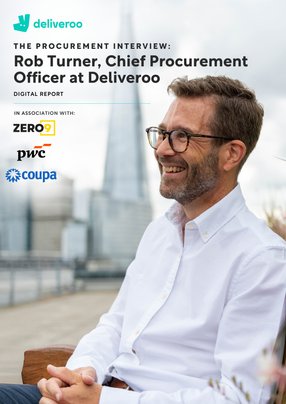
When Rob Turner joined Deliveroo as Chief Procurement Officer, the procurement function was failing to deliver the expected value. The multinational delivery company strives to connect consumers with restaurants and merchants through a hyperlocal marketplace for quick, convenient delivery.
Rob brings 30 years of procurement and operations experience, having worked in manufacturing operations before moving into procurement in 2001 with PepsiCo. His first CPO role with Tarmac gave him the platform to lead procurement and supply chain, including M&A activity during a joint venture with Lafarge. This path led him to become one of the youngest CPOs in the FTSE 250 of the time. Later, he led procurement transformation at John Lewis, including a full-scale digital and operating model change with Coupa, before later building the procurement capability of the Amazon Fresh store programme.
Now, he applies his procurement expertise and transformation experience in a fast-paced environment at Deliveroo. Here, Rob spearheaded a rapid, full-scale cost and digital procurement transformation that included implementing Coupa’s source-to-pay (S2P) system and a company-wide risk management platform in just 13 months.
This transformation contributed to a wider improvement within the business, resulting in an 8% increase in revenue and adjusted EBITDA climbing 46% to £96m (US$130m). With major initiatives already in motion and the business on a strong growth trajectory, 2026 is set to be a pivotal year for Rob – a chance to fully realise the benefits of his work.
Transforming digital procurement
Over two-and-a-half years, Rob worked hard to redefine Deliveroo’s procurement role to one that delivers better value for both Deliveroo and its suppliers.
“Principally, it was all about understanding business needs and business requirements,” he recalls. “Procurement, when I joined, was not the trusted partner the business needed it to be.
“My journey has been to almost rebuild from scratch, to reinvent, to build a reputation as a problem solver and to deliver flawlessly.”
The programme addressed third party costs, governance, process redesign and digital enablement of source-to-pay.
With PwC’s support, a diagnostic phase validated hypothesised savings opportunities and built a credible business case, allowing procurement to move from fixing tactical issues to enabling growth.
Focus on early wins helped build trust, enabling early involvement in shaping commercial outcomes. The team surpassed its initial £26m (US$35.1m) target in seven months and is on track to deliver a cumulative £53m (US$67.6m) in validated savings - all within 18 months of beginning the cost transformation.
“Procurement at Deliveroo is now involved earlier, trusted more widely and actively shaping commercial outcomes,” explains Rob.
A significant element of this transformation was the implementation of Coupa within the business. Deliveroo’s 13-month global Coupa deployment evolved into a full reset.
Called Project Penne, it aimed to embed policy and governance into the S2P platform. Using “adopt best practice, adapt Deliveroo,” the team’s processes were simplified, compliance became embedded and manual checks were reduced.
Deliveroo adopted an “out-of-the-box” Coupa configuration for 94% of the build, which, Rob explains, was part of a strategy to “embrace simpler, more scalable ways of working”.
The discipline needed to execute such a project, on a fixed deadline and with a limited budget is a testament to Rob’s approach: “In the very early stages, the transformation had principally been viewed as a technology upgrade”. He also brought in a trusted former colleague, Paras Sood, who knows Rob’s ways of working, to help drive programme performance and act as his voice when pressure on time was high.
“However,” he explains “it quickly became clear there was an opportunity to go much further – a full reset of our source-to-pay operating model.”
Coupa now delivers a single source of truth, lifecycle transparency and readiness for new developments, something that was key for Rob.
“This now forms the core platform foundation that we can build on – adding supplier risk monitoring, better onboarding, contract discovery, SaaS licence management… all in one environment,” he adds.
This enables a more rapid route to maturity, and to industry-leading practices such as the development of a virtual helpdesk and AI driven intake - both of which will significantly improve the user experience.
“We wanted to use the deployment as a forcing function to improve how we operate. That meant adopting Coupa’s best-practice configuration wherever possible and adapting our business to the system – not the reverse.”
The project was beyond successful, finishing on time and on budget, leaving behind a lean, guided workflow designed to improve adoption rates and reduce complexity – ensuring future upgrades will be rolled out more quickly and less costly.
The importance of change management
Preparing, equipping and supporting employees to successfully adapt to change was vital to the project’s success.
Rob explains: “The biggest opportunity was cultural, not technical.”
From the outset, risk and compliance were embedded in the transformation. For example, intake processes now include risk profiling, ensuring sourcing or legal workflows drive efficiency in the latter elements of commercial processes.
“The result is a system that drives compliance by design, not by enforcement,” Rob says.
Running Coupa while delivering an accelerated cost-out programme required shared leadership, in addition to the utilisation of both internal and external resources for scalability.
“Clarity of purpose was critical…we kept messaging tight, made quick decisions and managed risk proactively.”
This approach to adoption required overturning some outdated perceptions of procurement. To do this, “Coupa Experience” sessions were developed and delivered – 78 in total – as well as superuser networks and gamified training.
“You don’t just switch on something like this,” he advises. “Some practices are cultural and systems alone don’t change culture.”
Rob’s expertise and care in this area ensured those in the procurement team and beyond could focus on the “why” behind the change.
Building a digital ecosystem
Speaking with other CPOs, Rob sees varied readiness levels across different sectors. It’s clear many procurement professionals lack end-to-end technical understanding of S2P and that many organisations don’t leverage procurement’s position within the business.
“Too often, procurement professionals work in silos,” he explains "some focus only on sourcing, others only on contract management. But with modern, integrated systems, you can’t afford to see these areas in isolation. Decisions made upstream – in sourcing, contracting or data entry – directly shape downstream outcomes like efficiency, automation, and the buying experience.”
He stresses that a digital ecosystem must solve defined business problems.
“Procurement sits across the organisation. We are in a unique position to join those dots.”
“Don’t just go get technology for technology’s sake,” he warns. “If that’s not aligned to what your business needs, then you're unlikely to be solving the right problem.”
He continues: “The knock-on impact is that, without clear purpose, adoption is likely to be even more challenging.”
A true digital ecosystem, in his eyes, is “a principle‑led, problem‑focused architecture… built to solve real business challenges, with every component working in unison, strengthening the whole”.
The importance of change management
Preparing, equipping and supporting employees to successfully adapt to change was vital to the project’s success.
Rob explains: “The biggest opportunity was cultural, not technical.”
From the outset, risk and compliance were embedded in the transformation. For example, intake processes now include risk profiling, ensuring sourcing or legal workflows drive efficiency in the latter elements of commercial processes.
“The result is a system that drives compliance by design, not by enforcement,” Rob says.
Running Coupa while delivering an accelerated cost-out programme required shared leadership, in addition to the utilisation of both internal and external resources for scalability.
“Clarity of purpose was critical…we kept messaging tight, made quick decisions and managed risk proactively.”
This approach to adoption required overturning some outdated perceptions of procurement. To do this, “Coupa Experience” sessions were developed and delivered – 78 in total – as well as superuser networks and gamified training.
“You don’t just switch on something like this,” he advises. “Some practices are cultural and systems alone don’t change culture.”
Rob’s expertise and care in this area ensured those in the procurement team and beyond could focus on the “why” behind the change.
Building a digital ecosystem
Speaking with other CPOs, Rob sees varied readiness levels across different sectors. It’s clear many procurement professionals lack end-to-end technical understanding of S2P and that many organisations don’t leverage procurement’s position within the business.
“Too often, procurement professionals work in silos,” he explains "some focus only on sourcing, others only on contract management. But with modern, integrated systems, you can’t afford to see these areas in isolation. Decisions made upstream – in sourcing, contracting or data entry – directly shape downstream outcomes like efficiency, automation, and the buying experience.”
He stresses that a digital ecosystem must solve defined business problems.
“Procurement sits across the organisation. We are in a unique position to join those dots.”
“Don’t just go get technology for technology’s sake,” he warns. “If that’s not aligned to what your business needs, then you're unlikely to be solving the right problem.”
He continues: “The knock-on impact is that, without clear purpose, adoption is likely to be even more challenging.”
A true digital ecosystem, in his eyes, is “a principle‑led, problem‑focused architecture… built to solve real business challenges, with every component working in unison, strengthening the whole”.
The future of procurement
Procurement is entering a phase of optimisation, focusing on continuous improvement, data enrichment and simplification. By building team capability, more time is spent in other areas of the business, driving wider value.
At the same time, future value will be driven by partnerships for innovation and new commercial models, just as Deliveroo’s integrated digital ecosystem spans intake, sourcing, contracts, onboarding, P2P, payments, analytics and document processing. This enables real-time risk, cost and compliance management.
“Without that, you’re stuck in manual mode,” emphasises Rob. “Procurement needs to evolve from enforcing policy to designing, deploying and using technology that drives better outcomes by default.”
Looking ahead, he sees a shift from “transactional automation to intelligent orchestration” as predictive analytics, real-time risk sensing and AI-assisted negotiations take a more central role, but technology must be paired with mindset change.
For Deliveroo, the next 18 months are about embedding change, unlocking ecosystem potential and building the capabilities to lead in intelligent spend management.
Company portals

Executives

Rob Turner
Chief Procurement Officer