
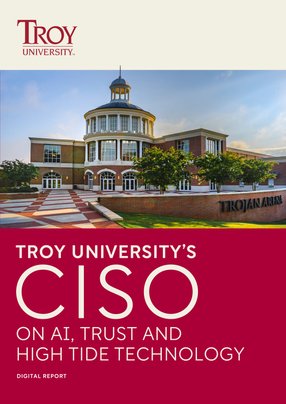
Troy University's CISO on AI, Trust and High Tide Technology
Troy University (TROY) was founded in 1887 as a small teacher-training college in rural Alabama. Today, it is home to more than 22,000 enrolled students, while around 70,000 use its digital platforms each year.
It is a transformation that would be impossible to explain without understanding the man who has guided its technology strategy for the better part of three decades.
Dr. William Greg Price is the Vice Chancellor and Chief Information Security Officer (CISO) at TROY.
Greg, as he prefers to be known, has led Troy University’s technology strategy for more than 25 years, having first joined the institution in the 90s as a student.
After graduating, he worked in IT-based roles across manufacturing and government agencies but he returned to his roots to build his professional life at the college.
"When I had an opportunity to return and play a pivotal role in moving the technology environment forward in the mid-1990s, it was a wonderful opportunity," he says. "A return-to-home type proposition."
That sense of belonging has translated into a tenure marked by relentless institutional ambition.
When he arrived, TROY was a regional university with a handful of physical locations and a technology infrastructure he describes as dated and clunky – one that "essentially existed for a handful of data processing needs".
Things have certainly changed since then.
From education to orbit
Digital transformation in the education sector came quickly, and Troy University’s team was determined to be at the forefront of that shift.
In 1995, the university launched its first fully online courses, making it one of the earliest institutions in the world to offer a complete online educational experience.
Greg and two of his colleagues who remain in the department today were central to developing the technologies that made those initial steps possible.
"We led the way in the online educational market," he explains. "One of our slogans many years ago was 'anytime, anywhere', and we've certainly realised that."
That motto would have been ambitious in the 90s, promising the kind of connectivity and flexibility that organisations are still looking for today.
It was more than just words, though. TROY serves a large contingent of active military students, some of whom take courses while deployed in forward locations around the world.
Greg recalls a time when one of TROY’s students took exams while orbiting the planet as an astronaut. "It's been a wild experience," he says, "from the extent and the scope of the technologies that we've deployed at TROY."
The university's digital reach now serves students ranging from dual-enrolled high schoolers to adult learners and military personnel.
Its mission, as Greg frames it, is both simple and ambitious: to provide a quality educational product to anyone, anywhere, at any time. "From my perspective," he says, "that is a comment predicated heavily on technology."
The power of being invisible
Ask Greg what success looks like from his perspective, and his answer is disarming in its clarity. The best outcome, he says, is one in which nobody notices his team at all.
"If everything is working perfectly from an IT perspective, no one knows anything about what we have going on, or who we are," he explains. "It simply works, and that's our biggest endeavour. We want things to work, and the technology to not be a nuisance or a hindrance, rather than an enabler."
It is the kind of philosophy that speaks to a culture of trust. TROY’s student body is unusually diverse – spanning teenagers in dual-enrolment programmes to veterans studying on deployment – and all of them entrust the college with sensitive personal and academic data.
"The trust that the institution and the students have in our ability to deliver is substantial," Greg says.
He is candid about the personal quality that has helped him maintain that trust over a long career. "I’m extraordinarily stubborn," he admits. "In the technology world, things do not always go perfectly smoothly, and the best creative plans are often a wasted effort. Simply being stubborn – not quitting, not giving in, seeing what the end result is and moving towards it – that has been quite a utility in the technology environment."
That stubbornness is tempered by a lesson he absorbed from a mentor early in his career, a technologist with 50 years of experience across large public companies and the US Government. The advice has stayed with him ever since.
"What he would tell me is: don't lose sight of the end user. Just because you can do something does not mean you should do something," he recalls.
"We want the technology to improve, foster, and facilitate a more appropriate environment for our users. Once it becomes an impediment or too disruptive, it's simply a nuisance."
Building global infrastructure
One of the more instructive episodes from TROY’s technological history involves what is now considered a fairly mundane innovation: email.
When Greg’s team rolled out student email accounts in the 1990s, they encountered something they did not expect.
Many of TROY’s faculty members and students had never used email before, and community meetings were needed to explain and reassure.
"I quickly learned that collaboration and substantial awareness campaigns were core parts of technology adoption and being able to yield meaningful use from those technologies," Greg says.
"When I talk to people nowadays about having to have training sessions to convince people to use email, they often giggle. But those were foundational learning experiences for me and the team."
The lessons from those early days inform how TROY approaches the adoption of tech today. The process is deliberate and collaborative. Greg’s IT department works closely with the university’s academic, administrative and research units, drawing on input from external employers and advisory groups as well as internal stakeholders.
One guiding principle is to resist what he calls "shiny object syndrome". "When something new and vibrant appears on the scene, it's easy to become overwhelmed and perhaps excited about it," he says. "We try to address shiny object syndrome and be more pragmatic and practical about how we adopt technologies."
The cybersecurity-first mindset
Greg’s background is in cybersecurity, and it influences a great many decisions he makes at TROY. He describes the university as a "security-first and security-forward institution", meaning that no new technology or activity is considered without first weighing its security and privacy implications.
"I have always professionally possessed a substantial degree of paranoia," he says. "And a professional desire to do the right thing from a governance and a privacy perspective with the information that we manage."
Cybersecurity has been embedded in TROY's operations since before Greg arrived. He notes that the university deployed its first AI tools as far back as 1998, initially for analysing large data sets. The proliferation of consumer-facing AI tools in recent years has, however, introduced a new raft of challenges.
"Prior to recent years, being able to utilise AI tools required a fair amount of capital and knowledge. It wasn’t a trivial activity," he explains. "But the availability and access barriers have been greatly reduced, and it has become a consumer-driven environment, a commodity."
The risk is not that staff or students use AI, but that they might inadvertently use it with TROY’s protected data. The college’s response is largely one of awareness rather than prohibition.
Greg believes that the core data governance principles – do not misuse data, do not damage it, do not use it in an inappropriate fashion – apply to AI just as they apply to any other tool. The challenge is helping people understand that familiarity with a tool does not make it automatically safe to use with sensitive information.
"We are pushing a large awareness campaign to our students and our employees on how the practices they have been following very well for many years align with this new technology," he says.
AI as a force for student success
Beyond governance, Greg says that AI is actively improving the experience of students at TROY. The university uses AI-driven analysis of student behaviour and performance data to identify those who may be at risk of falling behind. From there, they can intervene early before problems become crises.
"Through the use of AI, those tools assist us in quickly discerning if a student needs additional assistance," Greg explains. "From a student retention and support perspective, AI has allowed us to be far more proactive instead of reactive."
Having served on a local school board for more than a quarter of a century, Greg is deeply invested in making the experience of students as good as it can be.
"Education is a big passion for me," he says, "and I want to be able to see people succeed through their educational endeavours. If we're able to use technology tools such as AI and the abundance of data that we have to identify at-risk students and facilitate their success, that's a win for everyone."
The same principle applies in cybersecurity. AI has given TROY's security team the opportunity to work through vast volumes of transactional data and identify anomalous or questionable activity before it escalates into a full incident.
"We're not reacting to activity," Greg explains. "We're able to observe things that perhaps are questionable well before an incident, and address it in a proper fashion."
The advantages of hybrid cloud technology
TROY's infrastructure is a testament to patient, pragmatic evolution. Before commercial cloud computing became widely available, the university had, in effect, built its own private cloud.
It maintained data centres in geographically diverse locations to reduce latency, which improved access for international students and gave the college greater resilience in the event of a failure at any one site.
"We built the ability to be very agile," Greg says. "If need be, we could pull one data centre down and move operations to another."
As commercial cloud platforms matured and became less expensive, TROY began migrating its workloads. The result today is a hybrid cloud model – a blend of private on-premises infrastructure and commercial cloud services – that Greg believes is the perfect combination.
For systems that require close control or are intrinsic to daily operations, TROY has its own data centres. For workloads where scale matters more than uniqueness, commercial cloud platforms are available.
"By running a hybrid cloud environment, we have kind of the best of both worlds," he says. "We can still control our destiny on some products that are local. In the larger environments where scale is more important, we have absolutely embraced cloud, and it has worked extraordinarily well for us."
The High Tide Technology partnership
Central to TROY's cybersecurity posture is its long-standing relationship with High Tide Technology, a cybersecurity firm that has partnered with the university for nearly two decades now. High Tide specialises in data governance, data security, regulatory compliance and formal security auditing.
"We have a very keen relationship with them," Greg says. "Their experience in the higher education world, and TROY in particular, allows them to take an extraordinarily forward-leaning position."
What distinguishes the partnership, in his view, is the balance it strikes between rigorous security and usability. "We develop and deploy tools with High Tide Technology that protect our infrastructure without being intrusive," he explains.
"We never want to create an environment where our tools keep users from being able to use their environments properly, where they're imbued as an impediment or they create an opportunity for distrust among our user base."
The importance of trust in corporate relationships is a recurring theme for Greg. For him, higher education institutions tend to operate with tighter budgets than commercial counterparts, which makes it all the more important to identify partners whose interests are genuinely aligned with shared success.
"We need meaningful relationships with our vendors, not just a buyer-seller type arrangement," he says. "If it's an opportunity simply to make a few dollars and increase the bottom line, we try to avoid that as much as possible."
Looking to the future
Greg is optimistic about where education’s relationship with technology is headed. He anticipates that barriers to access will continue to fall, bringing more people into the digital economy and forcing the technology industry to create simpler, more agile computing environments. He also expects the continued proliferation of AI tools, and the expanded reach of consumer technology, to transform the experience of education.
Above all, though, he believes that education is the most important thing. "My sincere desire is that along the way, we restore faith in this notion of higher education, and that people do not trivialise the importance of furthering their educational opportunities," he says.
"We will see things like credentialling and micro-credentialling – shorter-term opportunities whereby students can achieve a meaningful credential outside of the typical window associated with higher education, where it's measured in years."
For Greg, the road ahead is shaped by the same question that has guided his career since the mid-1990s: how do you make technology work so well that the people it serves never even have to think about it?
"With a global student population," he posits, "our technology needs to be resilient, it needs to be redundant, but more importantly, it simply needs to work."
Company portals

Executives
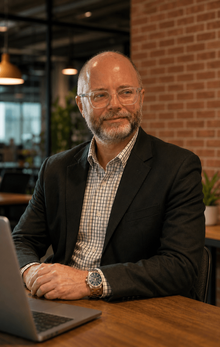
Dr. William Greg Price
Vice Chancellor and Chief Information Security Officer