
How Data Centre Water Efficiency is Boosted with Nvidia Tech
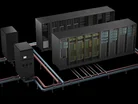
Nvidia's implementation of cutting-edge liquid cooling technology in its GB200 and GB300 NVL72 systems is setting a new benchmark in AI infrastructure.
This innovation has enabled hyperscale data centres to achieve significant cost savings of US$4m annually, while dramatically boosting water efficiency in systems consuming 50MW of power.
Alongside the need to adapt existing infrastructure to meet the rising demands of artificial intelligence (AI), taking action has never been more critical.
As AI applications require exponential growth in processing power, data centres are pushed to their limits, necessitating a profound transformation in how they manage heat and energy.Whereas data centres once operated at 20 kW per rack, hyperscale facilities now support 135 kW per rack. This power density increase makes heat management a central concern for operators planning infrastructure upgrades to support AI workloads.
Nvidia's strategic pivot towards direct liquid cooling solutions represents a vital development in accommodating dense compute environments.
The GB200 NVL72 systems are specifically designed to tackle the thermal challenges that conventional air-cooling methodologies cannot meet.
“As compute density rises and AI workloads drive unprecedented thermal loads, data centres and AI factories must rethink how they remove heat from their infrastructure,” Nvidia says.
“The traditional methods of heat rejection that supported predictable CPU-based scaling are no longer sufficient on their own. Today, there are multiple options for moving heat outside the facility, but four major categories dominate current and emerging deployments.”
The heat rejection evolution
Direct liquid cooling is at the forefront of this transformation, employing a coolant distribution mechanism that circulates through a liquid-to-liquid heat exchanger, adeptly moving heat from high-density processors.
This innovation allows for operation at higher water temperatures, reducing dependency on energy-intensive mechanical chillers.
- 40x higher revenue potential
- 30x higher throughput
- 25x more energy efficiency
- 300x more water efficiency compared to air-cooled architectures
For hyperscale data centre operators, who face annual expenses between estimated US$1.9-2.8m per MW, the adoption of liquid-cooled GB200 NVL72 systems offers up to 25 times cost savings.
This is a significant development for enterprises focused on reducing operational expenses and enhancing environmental sustainability.
The methodologies for data centre cooling have diversified into four primary categories, each with distinct advantages and challenges:
Mechanical chillers are renowned for their reliability across diverse climates but are energy-intensive, contributing to higher operational costs and elevated carbon emissions, especially in large-scale AI facilities.

Evaporative cooling systems utilise water evaporation for heat removal and, although they are more energy-efficient than traditional chillers, they require substantial water resources, which can be a drawback in water-scarce environments.
Dry coolers are effective in transferring heat from closed liquid circuits to the surrounding air, eliminating water usage, thus making them suitable for arid regions. However, their efficiency depends on ambient temperatures.
Pumped refrigerant systems efficiently channel heat externally with minimal internal compression needs, proving to be an advantageous solution for edge deployments and regions with limited water availability.
Enabling high-performance GPUs for AI workloads
Nvidia continues to make headway in supporting AI workloads with the roll-out of advanced technologies at GTC 2025, aiming to retrofit existing compute facilities into what are termed 'AI factories'.
These facilities are destined to fuel the next era of AI innovations, particularly in AI reasoning and autonomous AI agents.
Supporting what Nvidia refers to as ‘AI factories’, the company’s announcements are designed to power the next wave of AI applications — particularly those that are focused on AI reasoning and agentic AI.
“AI has made a giant leap — reasoning and agentic AI demand orders of magnitude more computing performance,” says Jensen Huang, Founder and CEO of Nvidia.The synergy between Nvidia and its industry partners has resulted in specially tailored liquid cooling solutions for Nvidia's high-density AI systems.
- Vertiv’s reference architecture for NVIDIA GB200 NVL72 servers reduces annual energy consumption by 25%, cuts rack space requirements by 75% and shrinks the power footprint by 30%
- Schneider Electric’s liquid-cooling infrastructure supports up to 132 kW per rack, improving energy efficiency, scalability and overall performance for GB200 NVL72 AI data centres
- CoolIT Systems’ high-density CHx2000 liquid-to-liquid coolant distribution units provide 2MW cooling capacity at 5°C approach temperature, ensuring reliable thermal management for GB300 NVL72 deployments
- Boyd’s advanced liquid-cooling solutions include coolant distribution units, liquid-cooling loops and cold plates to further maximise energy efficiency and system reliability for high-density AI workloads
A testament to Nvidia's innovative spirit is its collaboration with the COOLERCHIPS programme, backed by the US Department of Energy.
This initiative aims to establish modular data centres that leverage next-generation cooling systems, promising to enhance efficiency by 20% while reducing costs by 5% compared to legacy air-cooled configurations.
The company said: “By embracing high-density architectures and advanced liquid cooling, the industry is paving the way for a more efficient AI-powered future.”
Looking ahead, Nvidia's ambitions align with building a robust AI-driven future, characterised by enhanced efficiency and strategic collaborations.
By partnering with titans like TSMC and Foxconn, Nvidia is laying the foundation for US-based AI supercomputer manufacturing.
Explore the latest edition of Technology Magazine and be part of the conversation at our global conference series, Tech & AI LIVE.
Discover all our upcoming events and secure your tickets today.
Technology Magazine is a BizClik brand
