
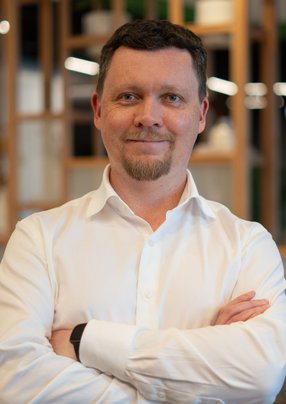
Rob Valk
Engineering CTO at Deloitte Australia

The importance of human-led AI
Rob Valk occupies an unusual position in the world of AI.
As Principal and Engineering Chief Technology Officer at Deloitte Australia, he bridges the divide between AI’s potential and its practical application in business – and he’s observed a shift in what clients actually worry about.
“I’m having a lot less technical conversations about AI because the biggest questions that our clients have are around adoption, around safety, compliance, data privacy,” he explains.
This suggests that enterprise AI’s toughest problems aren’t technological, but organisational and regulatory.
Why today’s AI only succeeds half the time
The latest AI capabilities tell a story of remarkable progress with significant limitations.
Rob references research from METR showing frontier models can handle tasks requiring over two and a half hours of human work – but succeed only 50% of the time.
“If we think about the quality and consistency we expect of people in our organisations – would we accept having to check in on them every two and a half hours and they still get it wrong half the time? That is where today’s most advanced general-purpose AI models are starting from which is why the right checks and balances are so important,” he says.
The twist is that this capability doubles every seven months, meaning organisations are constantly recalibrating ROI and unlocking new use cases.
Why engineers are becoming managers of AI systems
Software engineering faces perhaps the most dramatic transformation.
Rob references Kent Beck, creator of the JUnit testing framework who said: “The value of 90% of my skills dropped to zero and the leverage for the remaining 10% went up 1000 times.”
Rob explains: “You have to actually kick the tyres, you have to use these agentic engineering tools and deliver a real outcome to truly appreciate the productivity gains that are on the table.”
Yet there’s a crucial limitation.
“AI amplifies what you know and what you can do, but if you don’t know anything and you can’t do anything, then there’s nothing to amplify,” he says.
This means that architecture and management capabilities – communicating clearly, delegating effectively, structuring work properly – matter more as engineers transition from writing code to directing AI agents.
Why scaling agentic AI requires more than technology
The cutting edge isn’t chatbots and copilots, but agentic systems that work autonomously.
As these take on business-critical functions, they encounter obstacles that technology alone can’t fix.
“Scaling and productionising agentic systems, getting closer and closer to the heart of the business, becoming more and more mission critical – that means dealing with compliance, with reliability, with safety, with explainability,” he says.
This is where Deloitte’s traditional expertise becomes unexpectedly relevant.
“That heritage of professional scepticism and really understanding what the capabilities and the limitations of any concept are is really, really important.”
The benefits of keeping humans central
One principle comes up repeatedly: human judgment must drive AI adoption.
Deloitte’s “human-led, tech-enabled transformation” approach positions technology as enabler, never the objective.
He shares a quote that resonated when AI-generated art first emerged: “We want AI to clean our dishes and fold our washing for us so that we can create art and literature.
“We don’t want AI to create our art and our literature for us so that we can spend more time doing the dishes.”
Rob’s stance is pragmatic.
That AI isn’t a universal solution or existential threat, it’s a potent tool requiring careful implementation, strong governance – and unwavering focus on human outcomes.
Company portals
Executives

Robert Valk
Engineering CTO