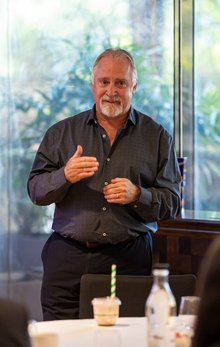
Geoff Wenborn
CIO

Geoff Wenborn is spearheading one of Australia’s most ambitious community bank digital transformations as Chief Information Officer at Bank of Sydney.
The technology leader, who describes himself as a “serial CIO,” joined the organisation specifically to modernise its technology infrastructure whilst preserving the relationship-focused culture that defines the institution.
Bank of Sydney had operated for 25 years with fragmented technology systems, some predating the mobile phone era. When Geoff arrived, the bank faced significant operational challenges.
Manual processes dominated workflows, preventing staff from focusing on customer experience. Disconnected systems created delays as customer applications moved between platforms, hampering the bank's ability to compete effectively.
“The challenge is really there to do better for our customers, do better for our employees and really support our shareholders,” Geoff explains. “We need to implement a better technology environment that is more competitive.”
Strategic partnerships drive transformation
His solution involves replacing decades of accumulated technology debt with an integrated, cloud-first platform. The approach represents a fundamental shift from the bank's previous capital expenditure model to operational expenditure through software-as-a-service partnerships.
Geoff has orchestrated strategic partnerships with global technology providers to deliver this transformation. Bank of Sydney has partnered with Infosys for its new core banking platform, whilst Nucleus Software provides lending capabilities. The bank is implementing Salesforce as its primary customer relationship management platform, with MuleSoft handling integration between systems.
“We’re leveraging integration through MuleSoft to provide fantastic integration capability,” Geoff says, “making sure that we can integrate all our business processes end-to-end in a very seamless manner.”
The transformation extends beyond technology to fundamentally change how people work. Results are already visible across different customer segments, with staff able to focus more on customer interactions rather than administrative tasks that previously consumed their time.
“We’re able to focus some of our bankers much more on the customer rather than doing admin and back-office activity that was built into their roles,” Geoff reveals. “That prevented them from getting out and speaking to our customers enough.”
Geoff recognises the competitive pressures facing community banks in Australia’s concentrated market. His strategy acknowledges these constraints whilst establishing foundations for future growth.
“It is a very competitive environment, the world moves on so it doesn’t wait for us to catch up,” he explains. “We’re constrained in terms of how much we can invest and the time it takes to really drive real change.”
Building for future competitiveness
The bank has also strengthened its relationship with IT services provider Hexaware Technologies, expanding their four-year partnership to support the broader transformation.
“We are not necessarily an organisation that can afford the top-end service partners, so Hexaware is really a nice mid-market play for us,” Geoff explains.
His transformation strategy follows a “catch up, keep up, get ahead” philosophy: an approach which acknowledges Bank of Sydney’s current technology position while positioning the institution for future competitiveness.
The implementation timeline extends through the first half of next year, with core banking completion and customer experience enhancements planned. Geoff expects the bank will move to the next version of the Nucleus platform around the same timeframe.
“We’ve got to bet a lot of that down in the first half of next year and then hopefully we’ll have it all singing, all dancing by about the end of that period,” he continues.
Looking ahead, Geoff anticipates transitioning from project-based transformation to continuous improvement once foundational systems are operational. The cloud-based platform will enable regular updates from partners without requiring major internal projects.
“From there we can move to a continuous improvement model which gives us the best chance of growth,” Geoff concludes.