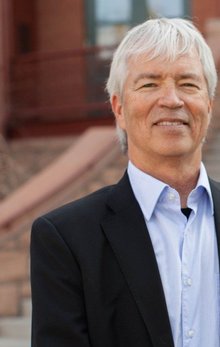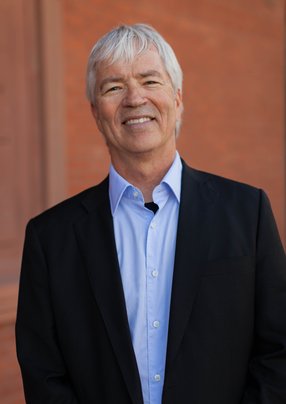
Gregory Raupp
Foundation Professor and Director of the Zimin Institute

Despite their individuality and uniqueness, cities also naturally share challenges and aspirations. Urban areas, while often not developed with sustainability in mind, present ample opportunities for sustainable development and innovation.
Smart and sustainable urban development is at the heart of Arizona State University’s (ASU) Zimin Institute for Smart and Sustainable Cities.
Zimin Institute’s sustainability leadership
Gregory Raupp, Foundation Professor and Director of the Zimin Institute, has an academic and leadership journey at ASU that spans over four decades, during which time he has witnessed and contributed to transformational changes across technology and urban development disciplines.
He originally trained in classical chemical engineering and entered ASU focusing on synthetic fuels in the 1980s – an era when this was a hot topic globally.
However, ASU’s location in Phoenix, a region lacking traditional chemical industries but rich in high-tech and defense sectors, shifted his focus to microelectronics and emerging materials.
This path led Gregory to conceive and establish the Flexible Display Center (FDC) at ASU, a US$100m industry-academia-government collaboration supported by the Army Research Labs. While flexible displays were the FDC’s flagship technology, Gregory was particularly intrigued by the potential of flexible sensor arrays for applications in wearable health and human performance technologies and for ubiquitous sensors embedded throughout urban environments.
The traditional concept of smart cities envisioned urban areas as “self-aware” systems monitored by centralised technologies making intelligent decisions. “The original thinking was a city that had everything sensed and some central intelligence making decisions and taking actions to make it a better place to live,” Gregory says.
However, the Zimin Institute's approach evolved towards being more citizen-centric, focusing on the lived experience of residents where technology enhances daily life without being intrusive. “We want to create solutions that are seamless, where the inhabitants don’t really know the technology is there – it just makes life safer, healthier and more sustainable,” Gregory explains.
“We want to get lab technologies out into the real world, making cities better places to live, work and play.”
Zimin Institute’s origin and vision
The founding of the Zimin Institute at ASU was funded by the philanthropic Zimin Foundation, established by the late Dr. Dmitry Borisovich Zimin, a radio scientist, entrepreneur and telecom businessman and his son Boris Zimin. With the aim of advancing science and education for the benefit of humanity, the foundation’s flagship initiative includes several institutes worldwide, with ASU hosting the first and only US-based institute.
“They were looking to support scientific solutions with real-life impact,” Gregory says. “Science is the foundation, but impact comes from innovating those ideas out into the real world.”
ASU was chosen for its philosophical alignment with these goals, its status as the most innovative university in the United States for 11 years running and its comprehensive engineering programmes embedded in a dynamic community. Phoenix’s rapid urban growth and commitment to smart and sustainable city initiatives make it an ideal ‘living lab’ or ‘testbed’ for the Institute’s projects.
The Phoenix metropolitan area is comprised of more than 20 cities and towns, including major cities like Phoenix, Mesa, Tempe, Scottsdale, Gilbert and Chandler. With a vision to build the nation’s most connected, collaborative and innovative smart region, the municipalities have formed “The Connective”: an alliance committed to sharing resources and best practices for sustainable urban development. “Instead of having dozens of different unconnected initiatives, it becomes a coordinated, powerful effort,” Gregory says. This community collaboration enables the Zimin Institute to run effective field tests and pilot projects in a given partner city while facilitating sharing and broader impact.
Read the full story HERE.
Company portals
Executives
Gregory Raupp
Director Partnerships & Innovation