
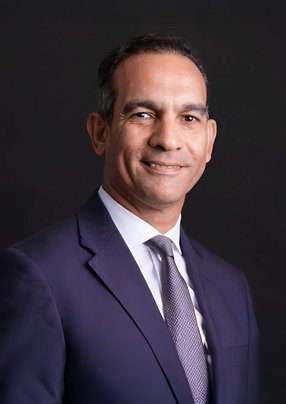
Wadii El Karkouri
Executive Vice President, Imaging & Technology

TGS’ Executive Vice President of Imaging & Technology Wadii El Karkouri brings a unique perspective to both the energy and technology industries.
Sitting at their intersection, his career has spanned early neural network research at French energy giant TotalEnergies and executive roles at Schlumberger, the world's largest oilfield services company. He subsequently joined AWS as a global sales director.
This diverse background has given him insights into both the technical possibilities and commercial realities of digital transformation in energy. At AWS, he was responsible for translating the language of oil and gas companies to cloud technologists, helping major energy firms adopt new technologies.
His appointment at TGS in 2024 represents a strategic bet on the convergence of energy expertise and digital innovation. Here, he brings together his decades of experience across traditional oil and gas operations, cutting-edge cloud computing and AI. His appointment also reflects TGS’ commitment to evolving from a seismic company enabled by technology into “a technology company enabled by seismic data”.
Leading the way at TGS
At TGS – the world's largest energy data company – Wadii oversees both the global seismic imaging business and the company’s broader technology portfolio across all business units. This dual responsibility allows him to integrate commercial operations with technological innovation, ensuring digital advances translate into tangible business value.
His role involves managing TGS’ extensive seismic data library – also the world’s largest – and leveraging it to develop next-generation AI applications like seismic foundation models. These systems aim to democratise geological expertise by making sophisticated subsurface insights available through AI.
Wadii’s aspirations extend beyond TGS to encompass the entire energy industry. He envisions helping oil and gas companies achieve the same digital sophistication seen in other sectors, creating what he calls a new generation of energy professionals who are “born on the cloud”.
His approach recognises the industry’s unique challenges, including increasingly frequent economic cycles demanding faster returns on technology investments. Central to his vision is the belief that all energy sources – oil, gas, wind, solar and hydrogen – will be needed to meet growing global demand while addressing climate concerns.
He advocates for a balanced approach using technology and data to optimise investment decisions and minimise carbon footprints across the entire energy portfolio.
Vision for the future
Wadii’s aspirations extend beyond TGS to encompass the entire energy industry transformation.
“I would love, for the rest of my career, to be able to help the oil and gas industry where I grew up take on the latest, greatest digital technologies,” he says.
“I want to transform the way we produce oil and gas and the way we manage the whole value chain as it’s still not at the level it needs to be when you compare it to the finance, pharma, media or sports industries.”
His goal is creating what he describes as professionals who are “born on the cloud” – a new generation thinking digitally from the outset.
His approach recognises the industry's evolving challenges.
“The economic cycles of the industry have become much more frequent than they used to be,” he notes.
“The return on investment of R&D and technology is not the five to seven years that it was when I joined the industry. It’s now more like 12 to 18 months.”
Central to his vision is an inclusive energy philosophy.
“The world population today is around eight billion people and that number is going to continue to grow," Wadii observes. “There’s a billion people that are still living in what we call energy poverty.
“We need all sources of energy to contribute to this energy portfolio – whether it’s oil and gas, wind, solar or hydrogen. There are a lot of other things that are still in research that will be able to enable this energy for the future of society. We need technology and data so we can invest the right amount of money in the right places and get the best return – all with minimal carbon footprint.”
Company portals
Executives
Wadii El Karkouri
Executive Vice President - Imaging & Technology