
Algorand’s Low-Energy Path to Scalable, Secure Blockchain

As blockchains scale, their environmental and social costs can rise sharply.
Algorand stands out for consuming minimal energy even under heavy network load while delivering instant finality, 100% uptime, high throughput and consistently low fees.
For Algorand, a sustainable blockchain blends security and scale with the smallest possible footprint – minimising energy use while upholding user rights and transparency through resilient governance.
The Algorand Foundation steers ecosystem growth: maintaining core infrastructure and technical standards, providing a best-in-class developer environment, supporting entrepreneurs and enabling decentralised governance. The mission extends to high-impact applications such as supply-chain traceability, carbon markets and tokenised renewables.
Launched in 2019 by Turing Award–winning cryptographer Silvio Micali, Algorand has grown into a vibrant community of developers, entrepreneurs and enterprise adopters.
Millions of users benefit from low fees and instant finality, with builders able to code in familiar languages like Python.
In this Q&A for Technology Magazine, Marc Vanlerberghe, Chief Strategy and Marketing Officer – who helped launch Android at Google – and Matt Keller, Head of Impact and Inclusion – formerly with the UN World Food Programme, One Laptop per Child and the Global Learning XPRIZE – share how Algorand is scaling sustainable, transparent and future‑ready blockchain solutions across industries.
How is Algorand helping companies prove their sustainability?
Marc: Having verifiable, trusted sustainability programmes is key – and not just because many companies are under pressure from regulators and consumers to prove their sustainability claims.
Algorand helps by giving them a way to record data about their sustainability – from product origins to the supply chain’s footprint – on the blockchain, so their efforts are immutable, transparent and verifiable.
Supply chains can be fragmented and prone to fraud, making it hard to verify sustainability claims without a trusted digital infrastructure.
Algorand addresses that gap, ensuring data integrity – tamper-proof, time-stamped records – and giving consumers and regulators confidence that claims are accurate.
Algorand’s high throughput and reliability allow it to handle complex, high-volume supply chains on a global scale.
Because Algorand itself is carbon neutral, businesses can rely on a platform that aligns with their sustainability commitments and ESG goals.
Matt: Some of the companies building on Algorand include Wholechain, which uses Algorand to provide end-to-end traceability for supply chains in industries like seafood and personal care.
Every step of a product’s journey is immutably recorded, helping prove ethical sourcing, authenticity and sustainability.
Another one is Finboot, which works with major enterprises, including those in the oil and gas industry, to integrate blockchain into their supply chain management.
This helps track raw materials and processes, providing a verifiable record of sustainability practices across industrial sectors.
Can Algorand help with carbon reduction projects?
Marc: Transparent carbon monitoring – and transparent carbon markets – are one piece of the puzzle to reducing carbon emissions, but many existing systems are siloed.
Algorand helps companies record verified emissions data in real time on the blockchain.
And by combining blockchain with Internet of Things (IoT) devices and AI, projects can automate monitoring, reduce costs and make verification more reliable.
This creates opportunities for both enterprises and households – usually excluded from these markets – to participate in carbon markets, turning emission reductions into credits that can be applied toward income or energy payments.
Algorand's speed, low fees and efficiency make it possible to scale these kinds of carbon markets.
The Algorand Foundation also shows this in practice by offsetting its own footprint every year through ClimateTrade, a marketplace built on Algorand.
An impressive example of this is Ureca, which uses Algorand with IoT and machine learning to verify carbon reduction projects.
Emissions data is collected and logged on Algorand in real time, creating trusted records for investors, regulators and communities.
The platform enables households and enterprises to measure emissions, generate credits and apply them to bills or income.

Can Algorand help people access renewable energy?
Marc: Absolutely.
The tokenisation of renewables is what makes them more accessible to everyone, no matter where they live.
Many people cannot, for example, install rooftop solar because they live in apartments or in restricted buildings.
Tokenisation on Algorand makes renewable energy accessible to them – meaning they can benefit from renewable energy projects – without having the direct infrastructure.
Tokenisation allows you to create a fungible or non-fungible token version of an asset. These tokens then represent fractional ownership of an asset like solar or wind farms.
This model creates inclusion in the green transition and makes clean energy more widely available.
Enel, one of the largest energy utilities in the world, partnered with Conio to launch the EBITTS project on the Algorand blockchain.
The project tokenises Enel’s renewable assets, allowing consumers to purchase Energy Utility Tokens representing fractional ownership in solar and wind plants.
Token holders can receive bill discounts tied to the energy their share produces and track usage through a mobile app.
This model provides millions of people in apartments or shared housing with a direct opportunity to benefit from renewable energy.
Enel launched in Italy, but we expect it will be replicated globally.
What is Algorand doing to be a sustainable company and reduce its own emissions?
Marc: Algorand was designed as an environmentally friendly blockchain from the start, with sustainability built into the technology itself.
Our consensus mechanism, Pure Proof-of-Stake (PPoS), uses far less energy than other PoS systems – and running a node on our blockchain also requires minimal hardware, meaning our blockchain is easier to scale without massive data centres.
Matt: We’re proud that the Crypto Carbon Ratings Institute (CCRI) acknowledged us for this, with our annualised CO₂ use being seven times lower than Ethereum.
And we offset our existing minimal footprint every year through projects purchased on ClimateTrade, with all offsets recorded transparently on-chain.
How is blockchain becoming more environmentally conscious?
Matt: Blockchain has been questioned for its environmental impact, especially the early Proof of Work systems that required immense amounts of energy to run computations.
This is one reason why the industry is moving toward greener models – and also why we see companies migrating to Algorand.
Marc: Other chains are also progressing on this front, but one obstacle remains: how well these other blockchains can scale.
As they get more traffic and add more computers to their network, that means more compute power – and electricity – is required.
One way blockchain can continue to be more conscious is to make its hardware requirements lighter, like that of Algorand, and to take actions like purchasing offsets, so any existing carbon footprint is managed.
Company portals

Executives
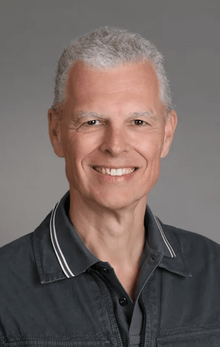
Marc Vanlerberghe
Chief Strategy & Marketing Officer

Matt Keller
Director of Impact and Inclusion