How Siemens and Humanoid Shape the Future of Automation
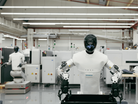
Siemens and UK-based robotics company Humanoid have successfully trialled human-like robots at the Siemens Electronics Factory in Erlangen, Germany.
This is a major step towards automating repetitive industrial tasks.
Working in collaboration with Humanoid, Siemens completed a pilot programme demonstrating how humanoid robots can handle production logistics in a real manufacturing environment.
Siemens says the initiative represents the opening stage of a broader partnership exploring how humanoid robots can be deployed safely and effectively across real-world operations.
Stephan Schlauß, Global Head of Manufacturing Motion Control at Siemens, says: “As Siemens' customer zero, the Electronics Factory Erlangen is excited to partner with the Humanoid team.
“We're tackling production automation, discovering new opportunities for Siemens and are eager to advance this promising technology across our factory network to deliver customer value.”
Automating repetitive tasks
The proof of concept (POC) unfolded in two phases.
The first focused on development and internal demonstration, during which Humanoid’s team created a physical twin of the system to support rapid testing, optimisation and iteration processes.
The second phase involved a two-week live deployment at the Siemens Electronics Factory, where the robots were tested in active production.
The task was destacking within Siemens’ logistics flow – autonomously collecting totes from a stacked pile, transporting them to a conveyor and placing them at a pickup station for human operators.
This sequence continued until each stack was fully cleared.
Measuring autonomous success
Siemens reports that the POC evaluated both the performance and reliability of the robots under autonomous operation.
The trial met all performance targets, including throughput of 60 tote moves per hour, handling of two tote sizes and sustained autonomous function for more than 30 minutes.
Additional success metrics included overall and autonomous pick-and-place success rates, each surpassing 90%.
Artem Sokolov, Founder and CEO of Humanoid, says: “At Humanoid, we are a commercially driven company.
“Our focus is on creating robots that deliver measurable value in real-world settings.
“Working closely with industrial and technology partners allows us to validate our systems against real operational requirements and understand which use cases matter outside the lab.
“This joint POC with Siemens showed clear potential for practical deployment of humanoid robots.
“We see them move steadily toward the real world, and partnerships like this one help accelerate that transition.”
About Humanoid’s robotics
Headquartered in the UK, Humanoid is developing scalable and safe humanoid robots for industrial applications.
Artem says: “Our team is developing robots designed to seamlessly integrate into various industries, tackling tasks deemed hazardous or monotonous.
“This isn’t about replacing human workers but rather about augmenting our capabilities and freeing individuals to pursue more fulfilling endeavours.”

The HMND 01 ALPHA BIPEDAL features 29° of freedom and incorporates cutting-edge technologies, including RGB cameras, depth sensors and 6D F/T sensors.
It also leverages end-to-end reasoning and skills powered by NVIDIA processing.
Humanoid’s HMND 01 ALPHA WHEELED model features a humanoid upper body mounted on a wheeled base rather than legs, designed for tasks requiring movement across flat factory floors.
The model was tested in a POC with Schaeffler to autonomously pick metallic bearing rings in near-production conditions.
“At Humanoid, early POCs are one of our key priorities because they allow us to iterate faster – to go into the real world as early as possible and learn what our future customers truly need,” Artem explains.
“This project proved that even at the pre-alpha stage, our platform can deliver tangible value in operational settings.
“We see high potential for more operational applications with humanoids at Schaeffler’s factories.”


Executives
Artem Sokolov
Founder
Stephan Schlauß
Head Of Manufacturing