How Google’s Data-Driven AI Could Redefine Conservation
The rapid ascent of AI brings with it significant environmental concerns but also sparks a distinctly science fiction-style sense of climate optimism.
While it’s unrealistic to think any single technology could solve the climate crisis, many experts believe AI could shift global efforts towards sustainability more effectively than almost any other tool available.
One area where AI is already driving tangible progress is wildlife conservation.
A new report from Google and the World Resources Institute (WRI) highlights how its potential in this field continues to expand.
For the study, Google and WRI spoke with 22 experts working at the intersection of AI and conservation to understand their insights and experiences.
Their findings reveal a major challenge: fewer than a quarter of all countries currently have defined targets aligned with the Kunming-Montreal Global Biodiversity Framework, largely due to existing gaps in environmental data and reporting.
- The Kunming-Montreal Global Biodiversity Framework is an international agreement that was adopted in December 2022 at the UN Biodiversity Conference that centres on halting and reversing global biodiversity loss by 2030. It includes 23 time-bound targets for 2030, focusing on actions like protecting land and sea, restoring ecosystems, reducing pollution and waste and increasing funding for biodiversity conservation.
For technology leaders such as Google, the expectation is that AI can play a pivotal role in addressing the challenge – from setting meaningful goals to driving concrete action.
"From the air we breathe to the food we eat, a healthy planet matters to every single one of us," says Kate Brandt, Chief Sustainability Officer at Google.
"For over 10 years, Google and the World Resources Institute have used the latest technology to protect our planet. But we need to do more, faster."
Current applications showing promise
The report highlights several initiatives already demonstrating best practice in the use of AI in conservation work.
Among them is Wildlife Insights, a collaboration between Google and a coalition of conservation organisations, which has built the world’s largest publicly accessible database of camera trap images – 253 million photos capturing 4,292 species across 112 countries.
This extensive database offers a detailed look at the natural behaviours of flora and fauna, enabling researchers to study ecosystems with unprecedented precision.
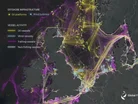
Another standout example is Global Fishing Watch, a project using AI to track and analyse vessel movements.
By mapping these data patterns, it helps experts detect potential illegal activities such as fishing in areas designated for protection.
In 2024, authorities in Chile used the platform to enforce the shutdown of several toothfish fisheries after detecting illegal operations.
The action resulted in fines for 21 vessels and helped raise overall compliance levels.
Another example is iNaturalist, a citizen science platform that enables anyone to record biodiversity observations with their smartphones and share them globally.
Over time, it has grown into a community of more than 400,000 contributors who have collectively provided more than 100 million research-grade observations to the Global Biodiversity Information Facility.
"The report highlights real-world examples of people using this technology as we speak to protect and restore nature around the globe," Kate says.
"Governments using satellites to monitor the seas and prevent illegal fishing. Researchers using AI to help identify, map and protect endangered species. Indigenous communities equipped with real-time alerts to stop illicit logging on their land."
Three pillars for progress
The report outlines three priority areas where investment is essential to unlock AI’s full potential in nature conservation.
The first is a major expansion of primary biodiversity data collection worldwide, supported by robust data infrastructure that enables open access through initiatives like the Global Biodiversity Information Facility.
The second focuses on building open and transparent AI systems capable of rapidly addressing information gaps in species and ecosystem monitoring, ultimately strengthening policy development, enforcement efforts and funding decisions.

Third, it highlights the importance of building capacity and promoting knowledge exchange to ensure conservation practitioners can make full use of existing AI tools, while encouraging developers to integrate insights and feedback from those on the front lines of conservation work.
"People spend a lot of time trying to sell models [but] models are only as good as the data," says Sara Beery, Assistant Professor of AI and Decision-Making at MIT.
"Data is never a bad investment, and data that can be open-sourced and have mutual and diverse downstream uses; that is the no-regret investment."
Addressing inherent risks
The report recognises several risks that need to be managed for AI to deliver meaningful benefits to nature conservation.
One major concern is the concentration of AI expertise and infrastructure within a small number of countries, potentially widening inequalities and restricting local participation.
Another challenge lies in the environmental impact of AI systems themselves, with data centres currently responsible for around 1.5% of global electricity consumption – a figure the International Energy Agency expects to double by 2030.
The report further warns of biases in training data, which may hinder AI’s effectiveness in identifying species in regions beyond North America and Europe, where most open-access biodiversity observations are collected.
Stephanie O'Donnell, Senior Technology Specialist at the World Bank's Global Wildlife Program, says: "Finding the right people and helping them collaborate, build capacity to problem solve and work together is way more important than the technology applications."
The report estimates that global funding for nature must rise by around US$500bn annually to meet international objectives on nature and climate, as outlined in the SDGs and the Kunming-Montreal Global Biodiversity Framework.
What remains evident is that achieving these goals will require collective commitment and coordinated action from all sectors to sustain momentum.
Kate says: "Partnership is key to meeting this opportunity."
Company portals



Executives
Kate Brandt
Member Board of Trustees
Stephanie O'Donnell
Senior Technology Specialist at the World Bank's Global Wildlife Program