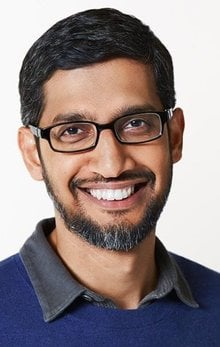
Google's CEO: Why No Tech Firm is Immune to the AI Bubble

The AI industry has seen a surge of investment in recent months, driving valuations to heights reminiscent of the late 1990s dotcom boom.
Now, a leading executive from one of the sector’s biggest firms has cautioned that no company will be untouched if the bubble eventually bursts.
Sundar Pichai, CEO of Alphabet – Google’s parent company – admits that even his organisation would feel the impact of any potential market correction, no matter its size or resources.
In a conversation with BBC News at Google’s California headquarters, Sundar describes the present as an “extraordinary” time but warned that signs of “irrationality” are emerging within what he still views as a fundamentally rational period of growth.
“I think no company is going to be immune, including us,” he said when asked if Google could withstand a possible downturn.
Inside Alphabet’s AI chips developed to rival Nvidia
The admission is striking given Alphabet’s current position.
- Alphabet’s market capitalisation: US$3.44tn in November 2025
- Alphabet’s share price doubled in seven months
- Alphabet invested £5bn ($6.58bn) in UK AI in 2025
- OpenAI-related deals: US$1.4tn, with revenues under 0.1% of that
- AI consumed 1.5% of global electricity in 2024
- Alphabet aims for net zero by 2030, but progress may slow
Alphabet’s market cap now stands at US$3.5tn after its share price doubled over just seven months, a rally fuelled by investor faith in the company’s ability to withstand competition from OpenAI, the developer behind ChatGPT.
Much of this confidence springs from Alphabet’s strategic move into purpose-built superchips for AI workloads, a development that places it in direct competition with Nvidia, the semiconductor titan.
Helmed by CEO Jensen Huang, Nvidia recently became the first company to surpass a US$5 trillion valuation.
These advanced chips now serve as the computational core of AI operations, powering the immense calculations needed for ML and training models.
Still, concerns about the market’s long-term stability persist.
Industry analysts have questioned the logic of roughly US$1.4tn in deals concentrated around OpenAI, especially since the company’s revenue this year is projected to represent less than one thousandth of that cumulative investment.
Alphabet’s CEO has likened this feeling to the internet age, recalling Federal Reserve Chairman Alan Greenspan’s famous warning of “irrational exuberance” in 1996 – four years before the dotcom collapse.
“Given the potential of this technology, the excitement is very rational,” he says.

“It’s also true when we go through these investment cycles, there are moments we overshoot collectively as an industry.
“We can look back at the internet right now. There was clearly a lot of excess investment, but none of us would question whether the internet was profound or did it drive a lot of impact.
“It’s fundamentally changed how we work digitally as a society. I expect AI to be the same. So I think it’s both rational and there are elements of irrationality through a moment like this.”
Jamie Dimon, CEO of US investment bank JP Morgan, voiced comparable reservations last month, telling the BBC that although investment in AI will ultimately yield returns, a portion of the capital funnelled into the sector would “probably be lost”.
Why Google commits billions to the UK’s AI expansion
Sundar Pichai points to Alphabet’s integrated strategy as a potential cushion against market volatility.
The company maintains control over what he calls a “full stack” of technologies, covering everything from chip design and data assets – including the video platform YouTube – to AI models and research through its London-based DeepMind unit.
This UK footprint is poised for significant expansion.
In September, Alphabet announced a £5bn (US$6.58bn) investment in British AI infrastructure and research over two years, with Sundar revealing plans to nurture “state of the art” research efforts in the region.

He states that Google will “over time” conduct AI model training in the UK, a process that entails leveraging large datasets to build the pattern recognition systems essential for AI applications.
UK government officials see these commitments as reinforcing the nation’s status as the third largest AI hub globally, following the United States and China.
“We are committed to investing in the UK in a pretty significant way,” the CEO says.
The energy issue
The energy requirements of AI represent a significant challenge.
According to the International Energy Agency (IEA), AI accounted for roughly 1.5% of global electricity consumption in 2024, with no indication that this demand is slowing.
Sundar Pichai describes these needs as “immense” and stresses the urgency of developing new energy sources and expanding infrastructure to support AI growth.
“You don’t want to constrain an economy based on energy and I think that will have consequences,” he says.
These energy demands have already pressured Alphabet’s climate ambitions.
While the company remains committed to reaching net zero emissions by 2030, Sundar acknowledges there will be some delay, saying: “The rate at which we were hoping to make progress will be impacted.”
On the topic of employment, he characterises AI as “the most profound technology” humanity has ever worked on, one that will necessitate society to manage “societal disruptions” while also creating fresh opportunities.
“It will evolve and transition certain jobs and people will need to adapt,” he says, adding that those who embrace the technology “will do better”.
“It doesn’t matter whether you want to be a teacher [or] a doctor. All those professions will be around, but the people who will do well in each of those professions are people who learn how to use these tools.”