
Is Microsoft Building the World's Most Powerful Data Centre?
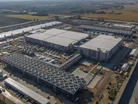
In Mount Pleasant, Wisconsin, Microsoft is nearing completion of Fairwater, described by the tech giant as the world’s most powerful AI data centre.
The project is now in its final stages, with operations set to begin in early 2026.
Representing an investment of US$3.3bn, the site is already recruiting full-time staff to oversee and manage operations once the facility comes online.
In addition, Microsoft has announced a further US$4bn commitment to construct a second facility of comparable scale in Wisconsin, bringing the company’s total regional investment to more than US$7bn.
Engineered for AI at scale
The Mount Pleasant site is purpose-built to train frontier AI models, equipped with hundreds of thousands of NVIDIA graphics processing units (GPUs) arranged in clustered formations.
These GPUs are designed to accelerate complex AI workloads, running vast calculations in parallel to significantly speed up model training.
The clusters are linked by fibre optic cabling long enough to circle the globe four times, delivering unrivalled connectivity and throughput.
Microsoft says the facility will deliver performance levels ten times greater than today’s fastest supercomputers.
Engineered as a platform for discovery, the site will enable researchers and engineers to build and scale next-generation models, while testing new ideas with unprecedented efficiency.
Microsoft positions Fairwater as a catalyst for innovation, with breakthroughs in science and medicine expected to stem from workloads trained in Wisconsin.
The company is also emphasising local value, from construction and long-term technology careers to new educational pathways.
In partnership with Gateway Technical College, Microsoft has launched Wisconsin’s first ‘Datacenter Academy’, designed to equip students with the skills needed for future roles in data centre operations.
Sustainability at the core of design
Sustainability remains a central focus for the project, with more than 90% of the facility supported by a closed-loop liquid cooling system.
This system is filled once during construction and then continuously recirculates, minimising water consumption.
The remainder of the site employs outside air cooling, drawing on water only during peak heat events.
Despite the extensive fibre and hardware infrastructure, overall water demand is forecast to remain modest – comparable to a single restaurant’s yearly consumption or the usage of an 18-hole golf course over just one summer week.
Microsoft also emphasises its approach to energy management, committing to meet its requirements without adding cost pressures to local communities.
The company is pre-paying for its energy and infrastructure consumption to keep prices stable for residents, while pledging to match every kilowatt hour of fossil-fuel-based energy with carbon-free generation supplied back to the grid.

This commitment extends to a new 250MW solar development in Portage County, now under construction to directly support the facility’s energy needs.
Microsoft is also collaborating with WE Energies to oversee transmission, generation and consumption through transparent tariff structures aimed at safeguarding grid reliability.
Alongside its energy initiatives, the company is funding ecological restoration efforts across Racine and Kenosha counties in partnership with the Root-Pike Watershed Initiative Network.
Projects include habitat restoration at Cliffside Park, Lamparek Creek, Kirkorian Park and the Shagbark Restoration Area, reinforcing Microsoft’s wider environmental stewardship in the region.
“What sets Microsoft’s infrastructure apart is the relentless pursuit of innovation and sustainability,” says Noelle Walsh, President for Cloud Operations + Innovation at Microsoft, writing on LinkedIn.
“Our data centres use advanced closed-loop liquid cooling systems – integrated pipes circulate cold liquid directly into servers, extracting heat efficiently and ensuring zero water waste."
“Nearly 90% of our data centre capacity uses this system, requiring water only once during construction and continually reusing it with no evaporation losses. This breakthrough enables higher rack density and supports the most demanding AI workloads, while dramatically reducing environmental impact.
“Globally, Microsoft has contracted over 34 gigawatts (GW) of carbon-free (renewable) electricity across 24 countries. In Wisconsin, we will match our energy consumption with renewable energy onto the grid.
“To protect customers from future cost increases due to data centre operations, Microsoft is pre-paying for the energy and electrical infrastructure used by the Wisconsin data centre."
Local investment and workforce development
At peak construction, the project is engaging more than 3,000 workers across a wide range of trades, from electricians and plumbers to iron, steel and concrete specialists.
Once operational, the first data centre is expected to employ around 500 full-time staff, with the workforce expanding to approximately 800 as the second facility comes online.
Microsoft is deepening its investment in education and skills development through the Datacenter Academy, where more than 1,000 students are expected to be trained within the next five years.
Working with Gateway Technical College, the University of Wisconsin and additional partners, the company has already helped train 114,000 people in AI skills across the state, including 1,400 residents in Racine County.
The company also backs the nation’s first manufacturing-focused AI Co-Innovation Lab at the University of Wisconsin-Milwaukee.
This initiative supports regional manufacturers such as Regal Rexnord, Renaissant and BW Converting in developing AI-powered solutions, with local firms like Wiscon Products also benefiting.
Beyond training, Microsoft is advancing digital equity through broadband expansion.
o date, the company has extended internet access to more than 9,300 rural residents and has connected 1,200 homes and businesses in Sturtevant with faster, more reliable services.
“As someone who spent almost five years as a kid going to school and delivering the morning newspaper by bicycle in Mount Pleasant, this moment means more than just personal nostalgia,” he says.
“It shows that Wisconsin has not just a longstanding and proud industrial past – it’s helping define the future of American innovation.
“Mount Pleasant isn’t just becoming a hub for AI – it’s becoming a blueprint for how innovation can serve everyone. We’re not just investing in an AI data centre; we are investing in a community.
"And we are investing in a powerful idea: that innovation is for everyone, and that we can build the future together – with care for people, place and planet.”

