
How is Google's AI Weather Model Helping 38 Million Farmers?
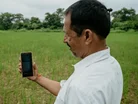
Monsoon forecasting has long stood among agriculture’s toughest challenges – with the livelihoods of hundreds of millions in tropical regions tied to the timing of seasonal rains .
Now, Google Research’s AI weather model is reaching 38 million farmers in India through a partnership with the University of Chicago – delivering forecasts that shape planting decisions worth billions to the nation’s agricultural economy .
Unlike conventional prediction systems that require supercomputers, the model achieves comparable accuracy while running on a single laptop.
How does Google’s AI model work?
The initiative leverages NeuralGCM, a machine learning (ML) model created by Google Research, which fuses conventional physics-driven weather modelling with artificial intelligence.
Olivia Graham, Product Manager at Google Research, and Stephan Hoyer, Engineer at Google Research, write in a Google blogpost: “For years, weather and climate models have been costly and complex, often requiring a supercomputer to run.
“Our teams at Google Research wanted to see if we could build these models more efficiently and more accurately, leading to the creation of NeuralGCM.”
The model also overcomes the computational complexity and cost barriers that have historically restricted accessibility to advanced weather forecasting.
Traditional weather models rely on hard-coded physics equations, while NeuralGCM trains on decades of historical weather data to identify patterns and learn from past events.
How AI validates forecasting accuracy
The University of Chicago team evaluated several AI weather models before choosing NeuralGCM for their Indian monsoon forecasting system.
By integrating NeuralGCM with other models, including the European Centre for Medium-Range Weather Forecasts’ Artificial Intelligence/Integrated Forecasting System and historical data, the team achieved accurate predictions of monsoon onset up to a month ahead.
In testing, the blended model successfully identified an unusual dry spell during the monsoon, highlighting its capability to forecast atypical weather events that critically affect agricultural planning.
Research from the University of Chicago shows that delivering accurate forecasts about one month ahead helps farmers align their decisions with upcoming weather conditions.
Its studies reveal that access to these advance forecasts nearly doubles the annual income of participating farmers .
The role of collaboration
The University of Chicago joined forces with India’s Ministry of Agriculture and Farmers’ Welfare to provide tailored forecasts directly to farmers via SMS messaging.
The ministry is responsible for agricultural policy and support programmes across India’s farming sector, which employs nearly half of the country’s workforce.

The collaboration delivered forecasts to 38 million farmers during the summer growing season, aiding their adaptation to an unusually delayed monsoon.
The SMS system also offered actionable insights on planting timing, allowing farmers to adjust strategies according to predicted weather patterns.
NeuralGCM’s open-source development allowed the University of Chicago to integrate it with existing forecasting systems without licensing barriers.
This successful deployment demonstrates AI’s potential to tackle climate adaptation challenges in agricultural communities.
Olivia and Stephen say that this represents “a powerful example of how foundational AI technology, born from research, can serve real-world use cases, ultimately helping communities around the world build climate resilience”.