How are Huawei’s SuperPoDs Reshaping AI Infrastructure?
Huawei is leveraging its annual HUAWEI CONNECT 2025 event in Shanghai to unveil large-scale computing solutions built to accelerate the next wave of AI.
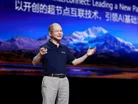
Eric Xu, Huawei's Deputy Chairman of the Board and Rotating Chairman, delivers a keynote called Groundbreaking SuperPoD Interconnect: Leading a New Paradigm for AI Infrastructure, announcing the debut of the Atlas SuperPoD and SuperCluster portfolio.

"Computing power is – and will continue to be – key to AI. This is especially true in China," Eric tells the audience.
“Chips are the building blocks of computing power. And at Huawei, Ascend chips are the foundation of our AI computing strategy.”
He explains that Huawei’s goal is to develop SuperPoDs and SuperClusters using semiconductor process nodes accessible within the Chinese mainland, securing a sustainable long-term supply of computing power for data centre environments.
The scale of SuperPoDs and SuperClusters
A SuperPoD functions as a single logical machine, composed of multiple physical systems that operate in unison to learn, process, and reason as one.

At the event, Huawei introduces the Atlas 950 SuperPoD, with 8,192 Ascend Neural Processing Units (NPUs), and the Atlas 960 SuperPoD, with 15,488 Ascend NPUs.
NPUs are specialised processors designed to accelerate AI workloads such as machine learning and deep learning.
These SuperPoDs provide high levels of computing performance across four critical metrics: number of NPUs, total computing power, memory capacity and interconnect bandwidth.
Eric explains that, based on publicly available product roadmaps from other companies, the Atlas 950 and 960 SuperPoDs are the most powerful systems of their kind globally and will retain that position for years to come.
The company also launches the Atlas 950 SuperCluster, with more than 500,000 Ascend NPUs and the Atlas 960 SuperCluster, with more than one million Ascend NPUs.
A SuperCluster is a large-scale computing system made up of multiple SuperPoDs, enabling exponential increases in scale and performance.
Eric highlights that these clusters are set to outperform all other available computing clusters in the market, making them highly relevant for hyperscale data centres.
"With the world's most powerful SuperPoDs and SuperClusters," says Xu, "Huawei has what it takes to provide abundant computing power for ongoing, rapid advancements in AI, both now and in the future."
Expanding into general-purpose computing
Alongside AI-optimised systems, Huawei has unveiled the TaiShan 950 SuperPoD, the world’s first general-purpose computing SuperPoD.
Unlike AI-focused architectures, general-purpose systems are built to support diverse workloads such as enterprise databases and transactional applications.
The TaiShan 950 SuperPoD integrates with Huawei’s distributed GaussDB database and presents a potential alternative to conventional mainframes, mid-range servers and Oracle’s Exadata platforms.
This establishes the TaiShan 950 as a versatile choice for data centres needing both AI performance and enterprise-grade computing.
Overcoming interconnect bottlenecks
One of the key challenges in scaling AI infrastructure lies in interconnect technology. Traditional optical and copper cabling face inherent physical limits when connecting vast numbers of chips and SuperPoDs across long distances while sustaining high-speed, low-latency performance.
Drawing on over three decades of expertise in connectivity, Huawei tackles this bottleneck by pairing its networking experience with system-level innovation to create a new interconnect protocol: UnifiedBus.
This protocol powers the performance of the latest SuperPoDs, ensuring reliable and scalable communication throughout the infrastructure.
At the event, Eric also unveils the technical specifications of UnifiedBus 2.0 and encourages industry partners to support adoption, with the goal of building an open ecosystem where a broader range of vendors can design products and components that seamlessly integrate with the protocol.
"SuperPoDs and SuperClusters powered by UnifiedBus are our answer to surging demand for computing, both today and tomorrow," concludes Eric. "Our goal is to keep pushing advancements in AI to create greater value."