How VW and AWS Transformed Global Automotive Manufacturing
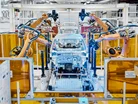
Volkswagen Group’s Poznań plant in Poland cut energy costs by 12% last year through a single AI application that optimises electricity consumption. Multiply that across 1,200 AI systems now running throughout the German manufacturer’s operations, and the scale of technological transformation becomes clear.
The company has extended its Amazon Web Services partnership for five years, building on a Digital Production Platform that connects 43 factories across three continents. This infrastructure underpins what Volkswagen describes as the automotive industry’s largest industrial AI deployment, spanning facilities from Europe to North and South America.
AWS cloud infrastructure enables production-critical AI systems across VW manufacturing network
Volkswagen’s technical strategy centres on eliminating the isolated systems that traditionally characterise automotive manufacturing. The Digital Production Platform creates uniform IT deployment capability across connected factories, with standardised solutions now operating across Volkswagen, Audi and Volkswagen Commercial Vehicles brands.

Manufacturing downtime costs automotive companies thousands of pounds per minute, making system reliability a primary consideration for AI implementations. AWS infrastructure provides the high availability and scalability requirements that production-critical systems demand, whilst enabling Volkswagen to avoid investing in on-premises GPU clusters at each location.
The “Guided Vehicle Completion” system is one example of this approach, optimising coordination in vehicle assembly across 13 plants. Modern automotive manufacturing requires thousands of components to align with individual vehicle specifications during production, creating coordination challenges that AI systems can address more effectively than manual processes.
Amazon SageMaker supports machine learning model development and training across Volkswagen’s operations. The cloud-based approach reduces both capital expenditure and technical complexity, allowing the company to scale AI development without managing distributed computing infrastructure internally.
Real-time image analysis systems operate at German facilities including Wolfsburg and Ingolstadt, processing thousands of images hourly to verify component placement during assembly. These computer vision applications detect configuration mismatches between vehicles and specifications before errors reach customers, addressing quality control challenges that manual inspection cannot consistently manage.
“Our ambition is to become the global automotive tech driver. To achieve this, we are consistently digitalising and connecting all areas of our company,” says Hauke Stars, Member of the Board of Management for IT at the Volkswagen Group. “The Digital Production Platform plays a key role in this: it is the digital nervous system of our factories – and the key to a future of AI-powered production.”
Predictive maintenance and supply chain optimisation represent major AI application areas
Beyond quality control, Volkswagen’s AI implementations target operational challenges that directly impact manufacturing efficiency. Predictive maintenance systems analyse sensor data from production equipment to identify potential failures before they cause line stoppages, addressing one of the highest-cost scenarios in automotive manufacturing.

The ‘KI4UPS’ system demonstrates practical AI deployment in complex manufacturing environments. Assembly line workers at 13 facilities now rely on AI-powered diagnostics that identify electronic faults in seconds, eliminating the manual troubleshooting processes that previously consumed hours of production time.
VW prepares Digital Production Platform for software-defined vehicle manufacturing
The automotive industry’s shift toward software-defined vehicles creates new technical requirements for manufacturing AI systems. Modern vehicles contain millions of lines of code across dozens of electronic control units, demanding AI capabilities that can manage software configuration and testing during assembly processes.
Volkswagen’s partnership with Rivian Automotive develops next-generation vehicle software and electronics architecture, creating additional AI development capabilities that integrate with existing manufacturing operations. The Digital Production Platform will support software deployment directly on production lines, connecting vehicle software development with manufacturing execution.
Existing AI solutions including KI4UPS can adapt to evolving electronics architectures, allowing operational continuity whilst incorporating advancing technologies. This flexibility addresses the challenge of implementing AI in environments where underlying systems continue to develop.
Industry standards such as Catena-X promote data exchange across automotive supply chains, enabling AI applications that span multiple companies. Volkswagen’s platform architecture maintains compatibility with these standards, positioning participation in industry-wide AI initiatives.
Machine learning applications must integrate with manufacturing execution systems, enterprise resource planning software and quality management systems. This integration complexity requires sustained technical investment and partnerships with cloud providers capable of supporting industrial-scale deployments.
“Our high-performance vehicle production is a key driver of success for the Volkswagen Group and its brands,” says Christian Vollmer, Member of the Brand Board of Management of Volkswagen for Production and Logistics and Member of the Extended Group Executive Committee. “By more closely integrating development and manufacturing through a shared, AI-capable data structure, we are creating the conditions to bring our vehicles to customers even faster.”
- Volkswagen operates 1,200 AI applications across 43 connected factories spanning Europe, North and South America
- The partnership has generated cost savings in the double-digit millions through standardised IT systems deployment
- AI system 'KI4UPS' now assists assembly teams at 13 plants, reducing electronic fault diagnosis time from hours to seconds
Long-term partnership reflects manufacturing AI deployment complexity
The five-year AWS partnership timeline acknowledges the extended planning requirements for enterprise AI deployment in manufacturing environments. Unlike software companies that implement AI applications within weeks, automotive manufacturers must consider product lifecycles spanning years and regulatory requirements varying across global markets.
Technical implementation challenges extend beyond initial AI system deployment. The Digital Production Platform must continuously develop applications tailored to specific manufacturing processes whilst maintaining compatibility with evolving industry standards and emerging technologies.
Volkswagen operates 114 production facilities worldwide, with 43 currently connected to the Digital Production Platform. The company's medium to long-term objective involves representing substantial portions of its production system through the platform, requiring sustained development investment and technical partnership.
“Volkswagen Group is setting new standards for smart manufacturing,” says Kathrin Renz, Vice President of AWS Industries. “Our five-year extended collaboration combines AWS’s cloud infrastructure and purpose-built IoT and machine learning services with Volkswagen’s manufacturing expertise. Together, we’re fast-tracking AI solutions that will help unlock new levels of innovation throughout Volkswagen Group's manufacturing operations.”