
HP’s Sustainability Report Reveals Big Tech’s Green Goals
Operating across more than 180 countries with a workforce exceeding 55,000 employees, HP is a name unfamiliar to none.
The tech giant develops devices, software, services and subscription models, all well-designed to support business expansion.
The company’s 2025 Sustainability Progress Report reveals a greener tack to the technology firm, which met or exceeded all of its sustainability targets set for 2025.
It documents progress across three strategic pillars: Empower Customer Sustainability, Transform HP’s Value Chain and Advance Societal Impact.
Technology design for circularity
HP launched its Designed for Circularity initiative in 1992.
The framework establishes principles that inform product development and engineering decisions across the company’s hardware portfolio.
The initiative uses modular design architecture in products to increase upgradeability and enable disassembly for repair, refurbishment and recycling at end of life.
According to the report, 96% of HP’s home and office printers, desktops, notebooks, displays and workstations contained recycled content in 2025.
The company also eliminated 72% of single-use plastic packaging compared to 2018 baseline measurements.
During manufacturing processes, HP increased the use of recycled materials and transitioned to fibre-based packaging for product shipments.
The company recycled 1.21 million tonnes of hardware and supplies by 2025, measured from the beginning of 2016.
AI-era operations and infrastructure
Bruce Broussard, Interim CEO of HP, says: “We embed sustainability into how we design, source, manufacture and deliver our products and in how we show up in our work and communities.”
He added: “Using sustainability as a guide to the choices we make on materials, energy and water, and how we think about expanding access to technology and skilling drives greater economic opportunity for HP and for our stakeholders.
“At its core, sustainability helps us make smarter decisions that build long-term value.”
Bruce continued: “Building on our progress and recognising where we need to move faster, we are helping redefine the Future of Work for the AI era through technology that drives business growth and professional fulfilment.”
Business technology solutions
HP reduced Scope 1 and 2 emissions from global operations by 69% by 2025, compared to 2015 levels.
The company reached 66% renewable electricity across its operations and achieved 100% renewable electricity in the US.
At global sites, HP implemented energy consumption reduction through optimisation and efficiency projects.
The company increased off-site renewable energy partnerships and on-site renewable electricity generation.
HP also transitioned service and logistics fleets to electric vehicles. The company worked with suppliers and partners to commit to using 100% renewable electricity for HP production by 2040.
The technology firm exceeded its target of helping suppliers cut 2m tonnes of CO₂e emissions between 2010 and 2024.
According to the report, suppliers reached 2.47 million tonnes in emission reductions.
Long-term technology targets
HP refreshed its long-term targets in response to changing stakeholder expectations and regulatory requirements.
The company aims to reduce value chain emissions by 50% by 2030.
HP set a net zero target for 2040.
The company also aims to achieve 100% renewable electricity in its global operations by 2040.
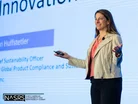
Jen Huffstetler, Chief Sustainability Officer at HP, says on LinkedIn: “This week, we published HP’s FY25 Sustainability Progress Report – marking an important milestone in how we continue to advance sustainability as a driver of long-term business value.
“This year’s report reflects strong progress across our environmental and societal priorities, while also evolving how we communicate – ensuring our disclosures are clear, transparent and aligned with a rapidly changing regulatory and business landscape in the AI era.”
She added: “At HP, we are redefining the Future of Work through technology. Sustainability is built into how we innovate and operate, helping organisations grow, creating opportunities for individuals and communities and supporting a more resilient future.”
Company portals

Executives

Bruce Broussard
Interim CEO

Jen Huffstetler
Chief Sustainability Officer