Huawei Cloud Tops Carrier Hybrid Cloud Rankings in Africa
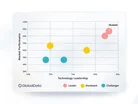
Huawei Cloud has been named the leading carrier-grade hybrid cloud vendor in Sub-Saharan Africa, according to research published during the AfricaCom event on 11 November.
The technology intelligence firm GlobalData conducted research across 13 Sub-Saharan countries, interviewing 25 telecom carriers between August and October 2025. The study assessed vendors against both technology leadership and market performance metrics, with Huawei Cloud securing the top position ahead of Microsoft, which was ranked second.
The Sub-Saharan Africa hybrid cloud market reached US$803m in 2024 and is projected to grow at a compound annual growth rate of 9.73% through 2029. South Africa represents 50% of the market, followed by Nigeria at 29% and Kenya at 11%.
GlobalData evaluated vendors across three market performance metrics: market presence, market differentiation and telco expertise. Huawei Cloud scored 87% in market performance, compared to Microsoft’s 80%. The research positioned Google and AWS as dominant players, while VMware and Oracle were classified as challengers.
Huawei Cloud outperforms competitors in strategic partnership and professional services
The study assessed technology leadership across seven categories: strategic partnership, performance and reliability, full stack infrastructure, platform and control, professional services, big data and warehouse and AI. Huawei Cloud achieved the highest aggregate score at 83%, followed by Microsoft at 82%.
In the strategic partnership category, 54% of respondents using Huawei’s solution rated the vendor as their primary cloud provider, while 92% positioned Huawei as one of their top three vendors. Microsoft Azure secured 40% of respondents rating it as the primary provider.
Huawei Cloud received the highest rating for professional services at 4.3 out of 5, based on planning and design, implementation and support services. Microsoft and Oracle tied for second place with a rating of 4. The research noted that Huawei maintains in-house professional services capabilities, while competitors typically work with partners to deliver these services.
The company’s professional services encompass three areas: build, which includes consulting, planning and deployment; scale, covering development support integration enablement and migration; and manage, addressing operations and maintenance, operations and training.
Microsoft Azure leads performance metrics while Huawei Cloud dominates platform control
Microsoft Azure received the highest rating for performance and reliability at 4.4 out of 5, with Huawei Cloud scoring 4.1. The research observed that operators using both Microsoft Azure and Huawei Cloud primarily operate private cloud or hybrid environments, whereas AWS and Google Cloud users show higher percentages of public cloud service adoption.
Carrier-grade services typically demand 99.999% availability, as disruptions can affect millions of users and emergency communications. Microsoft also scored highest in the full stack infrastructure category at 4.6 out of 5, with Huawei Cloud at 4.2.
Huawei Cloud Stack provides customers with flexibility for workload hosting, including on-premise data centres. The platform offers dedicated cloud configurations to ensure data, operation, and technology sovereignty while allowing customers to access the same services across public and private cloud environments.

In platform and control, Huawei Cloud scored highest at 4.2 out of 5, with Microsoft at 4.1. Huawei’s ManageOne offers unified management across physical machines, virtualised instances, private cloud and public cloud, with features including a service centre for self-service capabilities, operation centre for resource management and command centre for executive dashboards.
Data security drives cloud infrastructure decisions across Sub-Saharan Africa
The GlobalData survey identified data security and legal compliance as the most significant consideration when choosing cloud infrastructure, cited by 48% of respondents. Improving user experience ranked second at 40%, followed by increasing revenue from new segments at 36%.
Operators deploy hybrid cloud across multiple use cases, with 79% using the technology for enterprise services, 63% for internal deployments and 54% for consumer services. Within private cloud environments, 76% of respondents use the infrastructure for backup and disaster recovery, while 68% employ it for sensitive data storage.
The research found that 70% of carriers expect a unified cloud experience integrating public and private cloud infrastructure to support AI. Some 61% require these environments to provide pre-built tools and frameworks for AI applications, while 57% view compliance support as a determining factor in architecture decisions.
In the AI category, Microsoft Azure received the highest rating at 4.4 out of 5, with Huawei Cloud and AWS tied at 4.1. Microsoft has emphasised AI development through its Copilot assistant and partnership with OpenAI, offering capabilities including Azure AI Foundry and Azure AI Studio.
Huawei has developed AI capabilities including its Pangu Models but maintains model-agnostic support for third-party models such as Llama, DALL-E and BLOOM. It has created solutions for software development, AI model training and data management.
Monthly mobile data usage is projected to triple across most markets between 2024 and 2029, with South Africa leading at an increase from 6.5GB in 2024 to 18.2GB in 2029. Fixed broadband penetration is expanding, with South Africa projected to reach 75% of all connections by 2029, supported by investments in undersea cables including 2Africa and Equiano.
The research notes that 76% of respondents own and operate their own data centres, either on-premises or at separate dedicated sites. Senior IT leaders interviewed for the research work across network and operations (28%), IT and software (32%), business and strategy (20%), security and risk management (8%) and sales and enterprise solutions (12%).