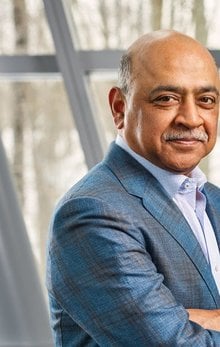
IBM CEO Questions US$8tn AI Data Centre Spend

The race towards advanced AI has prompted technology companies to invest billions in data centres, but the financial returns are being called into question.
According to IBM CEO Arvind Krishna, the current level of spending on data centres is unsustainable.
He calculates that global commitments for computing power could reach a staggering US$8tn, a figure he believes cannot generate a viable profit.
During a discussion on the Decoder podcast, Krishna explained his reasoning: “There’s no way you’re going to get a return on that in my view because eight trillion of capex means you need roughly 800 billion of profit just to pay for the interest.”
His calculations are based on present-day costs, which he deems more reliable than future speculation.

The financials of AI infrastructure
Breaking down the numbers further, Krishna estimates that equipping a 1GW data centre costs approximately US$80bn. With some individual companies committing to 20GW to 30GW, this translates to a capital expenditure of US$1.5tn for a single entity.
The rapid depreciation of AI chips adds another layer of financial pressure.
“You’ve got to use it all in five years because at that point you’ve got to throw it away and refill it,” he added.
Considering global announcements in the pursuit of Artificial General Intelligence (AGI), Krishna sees a total commitment of around 100GW. Multiplying this by his US$80bn per gigawatt figure leads to the US$8tn total.
When asked if he had shared this perspective with OpenAI CEO Sam Altman, Krishna acknowledged the differing viewpoints in the industry. He suggested that the belief in profitability hinges on the idea that one company will dominate the entire market.
“It’s a belief that one company is going to be the only company that gets the entire market. That’s a belief. That’s what some people like to chase. And I understand it from their perspective. That’s different from [what] I agree with,” Krishna says.
The path to AGI
Beyond the financial arguments, Krishna also shared his scepticism about achieving AGI with the technologies available today.
AGI represents the next theoretical stage of AI, where a system would possess human-like cognitive functions, including reasoning, common sense and continuous learning.
While some in the industry see it as an imminent breakthrough, Krishna is less certain.
He proposes that fusing knowledge with large language models (LLMs) might be a potential path forward, but concedes, “I’m not like 100%”.
He believes that without another major technological innovation, the probability of reaching AGI is from 0% to 1%.
Despite his reservations about AGI’s immediate feasibility, Krishna sees immense value in current AI developments, suggesting a focus on practical enterprise applications.
On the podcast, he said: “I think it’s going to unlock trillions of dollars of productivity in the enterprise, just to be absolutely clear.”
Contrasting visions for data centre expansion
Other tech leaders are forging ahead with substantial data centre investments.
On the “Google AI: Release Notes” podcast, Google CEO Sundar Pichai discussed space-based data centres.
While admitting the idea seems “crazy” now, Sundar argued that future computing demands could make it a necessity.
“When you truly step back and envision the amount of compute we’re going to need, it starts making sense, and it’s a matter of time,” he explained.
This vision is part of Google’s Project Suncatcher, an initiative exploring solar-powered satellite constellations for machine learning.
Google research indicates that falling space launch costs could make space data centres as cost-effective as terrestrial ones by the mid-2030s.
Meanwhile, Meta is also increasing its investment in physical infrastructure.
In its Q3 2025 earnings call, Meta, led by CEO Mark Zuckerberg, outlined an aggressive spending strategy on data centres to support its AI ambitions.
Meta increased its full-year 2025 capex guidance to between US$70bn and US$72bn, warning that spending in 2026 would be “notably larger,” due to AI infrastructure needs.
This demonstrates a clear commitment from some of the industry's largest players to continue expanding their data centre footprint, despite the financial questions raised by Krishna.