CES 2026: Jensen Huang on What Nvidia's AI Future Looks Like
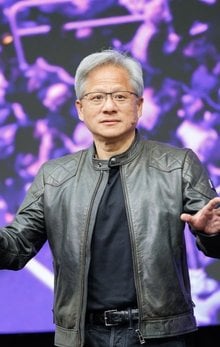
When Jensen Huang, Nvidia’s CEO, took the stage at the Consumer Electronics Show (CES) in Las Vegas on 5 January, his message couldn’t have been clearer: AI is entering a new era – driven by faster, more specialised chips.
At the centre of Nvidia’s announcement was confirmation that its next generation of AI processors is already in “full production,” Jensen said.
Addressing the CES audience, he revealed that the company’s upcoming chips – set to launch later in 2026 – will deliver “five times the artificial intelligence computing” power of the previous generation for tasks such as running chatbots and other advanced AI applications.
Executives told Reuters that these new processors are currently being tested in Nvidia’s labs by leading AI firms, even as competitors and major partners race to develop their own alternatives.

A new generation of development
At the centre of the announcement sat the Vera Rubin platform – named in honour of the pioneering US astronomer – which is expected to ship to customers such as Amazon and Microsoft in the latter half of 2026.
Comprising six Nvidia chips, each server will house 72 of the company’s graphics processing units alongside 36 of its new central processors.
Jensen demonstrated how these systems can be scaled by linking them into “pods” containing more than 1,000 Rubin chips – dramatically expanding the capacity at which AI models can be trained and deployed.
According to the CEO, Rubin’s performance gains aren’t just a product of raw power but stem from a proprietary form of data architecture that Nvidia aims to see adopted more broadly across the industry.
He said: “This is how we were able to deliver such a gigantic step up in performance, even though we have 1.6 times the number of transistors.”
A major focus of Jensen’s keynote was on so-called inference – the process of delivering AI-generated responses to millions of users in real time.
While Nvidia continues to dominate the training of large AI models, it now faces tougher competition in this space from the likes of AMD, Intel and other firms that emerged as key contenders during 2025.
To meet this challenge, Nvidia introduced a new storage layer known as “context memory storage,” engineered to help chatbots deliver faster, more coherent responses during extended conversations and complex queries.
From AI to driverless cars
Beyond AI chips, Jensen also used CES to showcase Nvidia’s growing ambitions in autonomous driving.
He announced the broader release of Alpamayo – a new AI model for self-driving cars that had previously been demonstrated only as a research project.
Jensen added that Alpamayo will be released alongside the data used to train it, enabling automakers to fully assess its performance and potential for integration into their own systems.
He said to the audience: “Not only do we open-source the models, we also open-source the data that we use to train those models, because only in that way can you truly trust how the models came to be.”
The CEO also described Alpamayo as the “world’s first thinking, reasoning autonomous vehicle” system with AI that “can teach the car how to drive”.
He added: “Not only does it take sensor input and activate the steering wheel, brakes and acceleration, it also reasons about what action it is about to take.”
According to The New York Times, Mercedes-Benz is set to begin shipping vehicles equipped with Nvidia’s self-driving technology in 2026.
Jensen positioned these developments as part of a broader AI-driven economic transformation, stating that “the computer industry is being reinvented” and that “some US$10tn or so of the last decade of computing is now being modernised to this new way of doing computing”.
As CES unfolded, Jensen’s message extended well beyond Nvidia.
With rivals such as Intel and AMD readying their own announcements, his keynote highlighted the breathtaking pace of evolution in AI hardware and software – and reaffirmed Nvidia’s intent to remain at the centre of that change.
Company portals




Executives
Jensen Huang
Founder and CEO