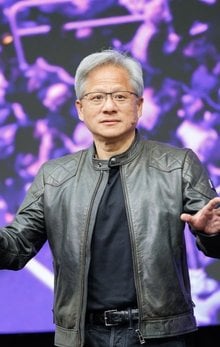
What did King Charles’ Letter to Nvidia’s CEO Say About AI?
The pioneers behind today’s cutting-edge AI infrastructure rarely gain acclaim beyond tech communities, yet a recent event has shifted that narrative by combining tribute with a sharp reminder of AI’s complex impact.
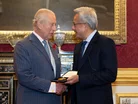
Nvidia Founder and CEO Jensen Huang and Chief Scientist Bill Dally were honoured with the 2025 Queen Elizabeth Prize for Engineering by His Majesty King Charles III, recognising their pioneering work in advancing modern machine learning (ML).
The event gained deeper significance when the King personally presented Jensen with a letter expressing his reflections on the trajectory of AI development.
What was in King Charles’ letter to Nvidia’s CEO?
“He said, there’s something I want to talk to you about. And he handed me a letter,” Jensen tells the BBC.
“It was his speech on AI safety. He obviously cares very deeply about AI safety.”
The letter includes a copy of an address King Charles delivered in 2023 at the world’s first AI Summit, where he emphasised that the risks of AI must be addressed with “a sense of urgency, unity and collective strength”.
He describes the rise of advanced AI as “no less important than the discovery of electricity”.
The CEO noted that the King’s message strikes a careful balance between optimism and caution.

“He wrote in his speech that he believed in the incredible capability of the technology to transform the UK and the world,” Jensen says.
“But he also wants to remind us that the technology could be used for good and for evil and so to make sure we do everything we can to advance AI safety.”
The award simultaneously acknowledges Jensen and Bill's pioneering contributions to accelerated computing, which the citation credits with driving a fundamental transformation across the entire computing industry.
This breakthrough is now reshaping every technological layer, from chips and systems to algorithms and applications.
“To be recognised among the pioneers whose work has shaped the world we live in today is an extraordinary honour,” Jensen says, acknowledging the visionaries behind technologies like the internet and GPS that have transformed industries and everyday life.
He adds: “We are living through the most profound transformation in computing since the invention of the microprocessor. AI has become essential infrastructure — as vital to future progress as electricity and the internet were to previous generations.”
Bill attributes the foundations of AI to decades of advancements in parallel computing and stream processing, highlighting the essential technological progress that underpins modern AI development.
“We continue to apply engineering methods to refine AI hardware and software so that AI can empower people to achieve even greater things,” he says.
Jensen and Bill jointly pioneered the accelerated computing architecture that underpins modern AI, creating a platform that empowers researchers to train expansive models, simulate complex physical systems and propel scientific advancement with unmatched scale and speed.
The awards, political tensions and future opportunities: Explained
Later that same day, the CEO was honoured with the Professor Stephen Hawking Fellowship at the Cambridge Union, recognised as the world’s oldest debating society.
The Cambridge Union Society, together with Lucy Hawking, daughter of Stephen Hawking, honoured Jensen for his significant contributions to advancing science and for inspiring the next generation of technologists and researchers
“Professor Hawking’s life showed that intellect has no boundaries,” he says.
“That curiosity – pursued with humour and grace – can expand the reach of humanity. He taught us that discovery is an act of optimism. And I can think of no higher compliment than to be associated with that spirit.”
The Fellowship commends individuals who advance STEM and promote public understanding of these fields.
Lucy presented the award before the CEO addressed the audience and joined a fireside chat with Union President Ivan Alexei Ampiah.
Earlier, Jensen and Bill attended a roundtable with Secretary of State for Science, Technology and Innovation Liz Kendall and Minister for Science, Research, Innovation and Nuclear Lord Patrick Vallance.
The discussion, held on National Engineering Day in the UK, focused on how the country can inspire future engineers.
The roundtable builds on Nvidia’s collaboration with the UK government, universities and industry to expand AI infrastructure, research and skills – ensuring the next generation of engineers has access to the computing power that fuels discovery.
The ceremony also recognises Professors Yoshua Bengio and Geoffrey Hinton, who have publicly warned that AI poses an existential threat to humanity.
Their presence alongside the Nvidia CEO underscores the tension within the industry.
US President Donald Trump has called for rapid, rather than cautious, progress in AI technology, while US Secretary of Commerce Howard Lutnick has advised against using the term “safety,” arguing that “it makes us sound like we’re afraid”.
Against this complex backdrop, Jensen sees potential for the UK.
Major US technology companies, including Nvidia, are investing billions to build AI infrastructure in the UK, establishing data centres that Jensen has referred to as “AI factories”.
The CEO says the UK is in a good position to take advantage of what he describes as “an industrial revolution that’s happening right now”.
“It’s your opportunity to grasp,” he says.
Company portals

Executives
Jensen Huang
Founder and CEO