Monumental gains $32m to bring robot bricklayers to the US
The world is running out of people to build it, but an Amsterdam-based startup is deploying a fleet of autonomous robots to lay bricks on real-world job sites.
Monumental, an autonomous construction tech firm, has secured a US$32m Series B funding round to scale its operations.
Led by American venture capital firm Khosla Ventures, with participation from existing backers Hummingbird and Plural, the investment will fund a major hardware expansion, grow its engineering team and prepare the company for its launch into the US.
Rebuilding an industry stuck in the past
Construction remains one of the last major global industries untouched by modern automation.
While manufacturing productivity in the US has spiked more than eightfold since 1945, construction productivity has declined since the 1960s.
Yet, the sector still underpins the global economy, representing roughly 13% of global GDP, according to Monumental.
- US$32 million: the size of the Series B round, led by Khosla Ventures, to scale Monumental’s engineering team and fund its US expansion
- 100+: the number of homes, schools, community centres and municipal structures the robots have already built across the UK and the Netherlands
- 200,000-400,000: the total monthly shortage of construction workers in the US alone.
The consequences are visible worldwide with a worsening housing crisis driven by costs and an acute labour shortage.
Monumental states that the US is short of between 200,000 and 400,000 construction workers every month. This means homebuilders will need to recruit 2.2 million more over the next three years just to keep pace with demand.
“The world simply does not have enough people to build what it needs,” says Salar al Khafaji, Co-Founder and CEO of Monumental.
“Every robot we deploy expands the industry’s capacity to build, bringing a future of beautiful, affordable, bespoke buildings and infrastructure closer to reality.”
How the technology works
Monumental relies on a fleet of agile, electric autonomous ground vehicles that have computer vision, advanced sensors and robotic arms. Rather than requiring manual control, the entire operation is orchestrated by Atrium, the company’s proprietary AI software.
Operating as a sort of digital foreman, Atrium translates architectural blueprints directly into precise coordinates, directing the robots to lay brick and mortar with millimetre accuracy.
The machines are designed as compact to navigate tight, unpredictable spaces on an active job site.
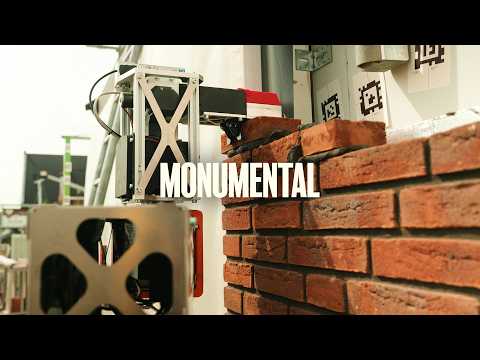
Monumental operates as an autonomous subcontractor so builders can hire the machines – which are worth up to US$100,000 – as they would other trade crew.
The firm then delivers the robots to the site, executes the build and charges for the physical output, billing customers on a straightforward rate per square meter of finished wall.
The startup has already taken autonomous building from a futuristic concept to a proven reality, having successfully built the walls for over 100 homes, a school, a hotel, a community hub, and even canal barriers across the Netherlands and the UK.
The Palantir playbook
Co-Founders Salar al Khafaji and Sebastiaan Visser previously built the data startup Silk, which was acquired by Palantir in 2016.
At Palantir, they mastered the forward-deployed engineering model, sending highly capable engineers directly into the field to solve client onsite problems.
Monumental states that it is the first company to successfully bring this aggressive, execution-heavy playbook to the physical robotics industry.
“Construction costs have exploded while the industry itself has barely changed in decades,” says Vinod Khosla, Founder of Khosla Ventures.
“Monumental is solving this by bringing robotics into the physical world, and the proof is already standing: canal walls, houses, a school... beautiful buildings, built at scale, don’t have to cost what they cost today.”
Company portals



Executives

Salar al Khafaji
Founder/CEO
Vinod Khosla
Founder