MWC 2026: NVIDIA on Telco’s Shift to Becoming AI-Native
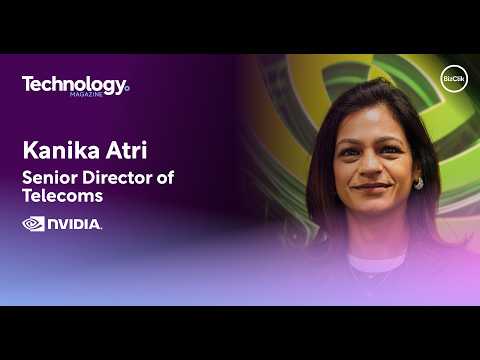
Telecoms is moving through a profound architectural shift, with networks becoming AI-native, software-defined and increasingly capable of autonomous operations. That’s the view of Kanika Atri, NVIDIA’s Senior Director of Telecoms.
In conversation with Technology Magazine at MWC 2026, Kanika says the result is an industry that will do more than provide connectivity, also delivering intelligence both for itself and for other sectors.
“The telecom industry is now dawning on a new role to also become AI service providers,” she says. “It’s going beyond connectivity and delivering intelligence. AI is actually shaping the future of the industry, both internally and externally.”
Why 6G is a software-defined reset
Kanika describes 6G as a generational change unlike previous mobile transitions.
While earlier cycles brought major capabilities every decade or so, she says 6G is arriving in an AI era that demands a much more flexible approach.
“When 5G was defined, AI was not really a thing,” Kanika explains. "But 6G has been born in the AI era."
“This transition is almost discontinuous and revolutionary because it’s not just about what new capabilities 6G will have – it’s a complete architectural transformation.”
For Kanika, the key shift is that telecoms is moving to a fully software-defined stack.
That, she says, breaks the historic dependency on hardware upgrade cycles and allows innovation to happen continuously.
“This means it’s completely decoupled from the hardware,” she adds.
“You do not need to wait 10 years to introduce new capabilities. You can move at the pace of software’s continuous innovation.”
“This is a seismic shift. 6G will be built on this new architecture so that it is fully software defined.”
This, she says, is how NVIDIA’s 6G commitment has been founded, with leading telecom operators and partners.
Agentic AI and autonomous operations
Alongside the 6G vision, Kanika also points to the growing importance of Agentic AI in telecom operations.
As networks scale and complexity rises, operators can no longer rely on manual processes alone, she insists.
“Autonomous operations in telco networks is not just a nice to have., it’s going to be essential,” she says, “because the scale at which these networks operate, that complexity is impossible to humanly manage.”
Because of this, Kanika draws a clear distinction between automation and autonomy – emphasising how the industry needs to pull off more than task execution if it wants truly self-managing networks.
From her perspective, autonomy means systems that can self-configure, self-optimise and self-heal, with humans stepping in only when needed.
“To do that, you need models, you need agents,” Kanika explains. “What we’ve announced in Barcelona are blueprints – basically, recipes for how to take a large language model and train it with telecom network data so that it can speak the telco language.
“Then, on top of that, we’re looking at how you build agents that solve problems. So we’ve also announced some blueprints for energy efficiency. These are things that telcos care about every day.”
AI-RAN is moving fast
At MWC, Kanika also points to the momentum behind AI-RAN as evidence that the industry is already moving from concept to execution.
NVIDIA’s partnership with Nokia, she says, for example, has progressed rapidly since it was announced last year.
“Nokia has been the MWC highlight for me,” she says. “It’s not even been six months but, in that time, Nokia has ported its software onto NVIDIA’s accelerated infrastructure. It completed its first full end-to-end calls on commercial phones and on mid-band spectrum using commercial radios.
“It’s amazing to see the progress being made with T-Mobile and IndoSat, too."
She adds that the pace of development across the wider ecosystem has been especially striking, with new radio partners, COTS servers and customer collaborations all emerging around the AI-RAN opportunity.
The expectation now, she says, is that field trials will follow soon.
From connectivity to intelligence
For Kanika, the long-term opportunity is bigger than network optimisation.
She believes telecoms will become a foundational layer for physical AI, connecting robots, sensors and autonomous vehicles through AI-native wireless infrastructure.
“Networks are not just going to be serving humans as they do today,” she argues. “They’re going to become the fabric for physical AI – millions, maybe billions of robots, sensors, autonomous vehicles and other moving objects.
“The one ubiquitous thing that will connect and serve intelligence to them is going to be an AI-native wireless network. That itself is a growth driver and is how this industry can not only serve others, but also transform itself and become much more profitable.”
This encapsulates her view of the long-term future.
In the nearer term, she says, telcos also have a more immediate opportunity: AI inference demand is growing quickly and existing edge infrastructure can help meet that need.
NVIDIA’s role, she adds, is to help operators see that demand not only as a challenge, but as a new growth opportunity.
Company portals

Executives
Kanika Atri
Senior Director, Telecoms | Product Management | Marketing