NASA: AI's Role in the Search for Life on Mars
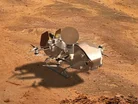
As NASA pushes forward in its quest to answer some of humanity’s biggest questions – Where did we come from? Where are we going? And are we alone? – AI may hold part of the key.
In her doctoral thesis, Life and AI at NASA: An Ethnography of How Scientists and Engineers Make Tools to Explore Other Worlds, Alicja Ostrowska, a doctoral candidate at Chalmers University of Technology, explores how AI is shaping the field of astrobiology.
Her research draws on fieldwork conducted with scientists and engineers at NASA’s Goddard Space Flight Center, where teams are designing rovers, robots and rockets to search for biosignatures – the telltale signs of life – on distant planets and moons.
Robot missions and spectrometry
As of 2026, NASA’s Curiosity and Perseverance rovers continue to traverse the surface of Mars, gathering samples and relaying enormous datasets to Earth.
These astrobiology missions probe for traces of ancient life from an era when the planet was warmer and more hospitable.
Each rover houses sophisticated mass spectrometers in their core, which generate spectral profiles of samples to pinpoint molecules – data then scrutinised by scientists back home.
Among the most intriguing targets beyond Mars is Titan, Saturn’s largest moon, famed as “the only world besides Earth with stable surface liquids”.
Its challenge lies in the vast distance: Titan and its mysteries sit 1.5 billion kilometres from our reach.
Given this vast distance, any data beamed from Titan would require 70-90 minutes to reach Earth.
Even then, scientists anticipate some loss along the way, as Alicja notes: "Throughout the interstellar journey at the speed of light, the signal becomes weaker and weaker, the farther away the planet is.”
With its bold Dragonfly mission to probe Titan’s surface slated for launch in July 2028 and arrival in 2034, NASA is leaning on AI to tackle the data-distance dilemma.
AI for science autonomy
For a team of scientists and engineers at NASA Goddard Space Flight Center, the answer to data transfer challenges lies in what’s termed “science autonomy”.
In her thesis, Alicja defines science autonomy as the idea that “scientific instruments should operate, analyse, tune and direct themselves autonomously”.
She writes: “The plan is to train algorithms – AI, machine learning, deep learning, etc – to prioritise which data is valuable in searching for signs of life and habitability on other planets and moons.
“In future missions, algorithms might make decisions about what is worth knowing about the universe.”

The National Institute of Standards and Technology (NIST) maintains authoritative mass spectrometry reference databases, while NASA supplies vast, publicly accessible datasets from missions like Hubble, James Webb, Kepler, TESS, Spitzer, WISE and Chandra – archived in repositories such as MAST, IRSA, HEASARC and the Planetary Data System, all fuelling machine-learning applications.
Uncrewed robotic missions, including the European Space Agency’s ExoMars Rosalind Franklin rover bound for Mars and NASA’s Dragonfly to Titan, feature onboard spectrometry instruments for sample analysis: ExoMars will transmit data to Earth for ML-assisted processing, whereas Dragonfly will harness AI to autonomously prioritize and analyde data right on Titan.
“The AI being developed at Goddard will make decisions about which mass spectra are the most interesting to send to Earth,” Alicja notes.
“Ultimately, when NASA scientists on Earth receive the data analysed by AI, they will see it on a computer screen with a display of the top categories, suggesting which are the most likely to fit the sample”.
On NASA’s Technology Readiness Level (TRL) scale from 1 to 9 – where 1 marks basic research and 9 signifies a “flight proven” tool successfully deployed in space – AI development for these applications currently sits at TRL 3.
Concerns of using AI for astrobiology
The key challenge in deploying AI for these complex missions is that “AI is only as good as the data it learns from”.
Since we lack any data directly from Titan, scientists and engineers are training these algorithms on so-called “planet analogs” – Earth-based field sites mimicking extraterrestrial environments.
Alicja points out that this data often hails from locations “that are accessible, popular or prestigious to study. This is one example of how the data that AI is trained on, are biased towards phenomena that are charismatic or relevant for industrial purposes, rather than planetary science.”
Even setting aside this favouritism, the available data remains “biased heavily toward Earth life”.
As certain elements on other planets could disrupt the instruments in these experiments, there's a risk of skewed results.
Database gaps, inconsistencies in NIST data quality and unknown compounds pose additional hurdles that must be tackled.
As an emerging field, when weighing its current discovery methods, some scientists call astrobiology “one single, great analogy” altogether.