NASA Taps Planette AI for Quantum Weather Prediction System
NASA has selected Planette, a San Francisco-based weather prediction company, to develop QubitCast, a quantum-inspired AI system that will be designed to predict extreme weather events months in advance.
With this new partnership, the team at NASA is hoping to plug a big gap in science's current forecasting capabilities. At the moment, meteorologists often struggle to provide accurate predictions beyond a 10-day timeframe.
While some companies, like the UK's Met Office, have been offering two-week-long forecasts for many years now, predictions that go beyond this length struggle to maintain accuracy.
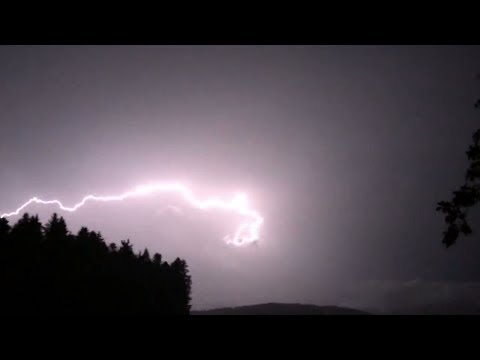
As things stand, weather modelling systems require huge amounts of energy and computational resources, but they often miss the complex patterns that signpost severe weather events such as hurricanes, heatwaves and thunderstorms.
For QubitCast, NASA is hoping to create an energy-efficient system that goes far beyond anything today's systems can manage, both in terms of precision and timeframe.
Is quantum theory the key to accurate long-term forecasting?
With QubitCast, NASA and Planette plan to use algorithms that are inspired by the principles of quantum physics. In particular, QubitCast will lean into quantum theory's idea of exploring multiple possibilities at once.
This approach should allow the system to process a massive amount of atmospheric, ocean and land data far more efficiently than conventional methods.
"You can think of it like reading the entire history of Earth's systems all at once," says Dr Kalai Ramea, Co-Founder and CTO of Planette.
"Instead of slowly scanning year by year and missing critical details, our approach allows us to spot anomalies, those needles in the haystack that signal extreme weather events, much faster and more accurately than traditional AI models ever could, while using far less energy."
What's more, the technology should be able to operate on conventional computers rather than requiring quantum computing hardware, which costs eye-watering sums and is still years away from maturity.
As a result, NASA is hoping that QubitCast will be up and running in good time.
Advanced, energy-efficient computing
Current physics-based simulation models consume substantial energy and computational power while AI models attempting to understand Earth's interconnected systems often become overwhelmed by complex, high-dimensional data.
QubitCast promises to deliver more accurate predictions while using significantly less computing power and energy than existing systems.
The quantum-inspired approach distils complex information into simpler forms while preserving critical details needed for accurate forecasting.
This efficiency could make long-range weather prediction more accessible and cost-effective for organisations requiring extended forecasting horizons.
The commercial applications of the technology
The technology targets subseasonal-to-seasonal forecasting, covering predictions from two weeks to two years ahead.
"Too many critical decisions are made in the dark because reliable long-range forecasts simply haven't been available," explains Dr Hansi Singh, Co-Founder and CEO of Planette.
"QubitCast changes that equation by making S2S forecasting not just more accurate but practical to deploy at scale when making highly consequential decisions."
Hansi anticipates that the tech will be useful across all kinds of sectors and in all sorts of applications, including agricultural planning, emergency management and energy grid stability.
It's possible that the system could allow farmers to plan their crop cycles more effectively, help emergency response teams to prepare for hurricane seasons and assist energy companies in making sure that the flow of electricity is never put under too much strain.
Expanding research portfolio
This partnership between the two organisations forms a part of NASA's Small Business Innovation Research grant, which Planette has received to help build on its recent advancements in weather intelligence tech.
Earlier this year, the firm received a Phase I SBIR grant from the National Science Foundation to develop NIVA, its foundational AI model for Earth system analysis.
Planette has also launched Eddy, a technology which makes long-range weather predictions freely available to the public.
For Planette's team, the aim is to bridge the gap between short-term weather reports and long-term climate projections, offering insights from one week to six months ahead with plans for multi-year outlooks.
It's an impressive aim, but with NASA's help and guidance, not even the sky is the limit for this project.