NVIDIA: How Agentic AI is Proving the AI Bubble Wrong

NVIDIA’s record-breaking growth continues to silence predictions that the AI bubble is on the verge of collapsing.
Reporting full-year revenue of US$215.9bn, up 65% year-on-year, the chipmaker remains at the epicentre of the global AI infrastructure surge.
Now the world’s most valuable publicly listed tech company, NVIDIA posted US$68.1bn in quarterly revenue – a 73% increase from the same period last year and a 20% jump from the previous quarter.
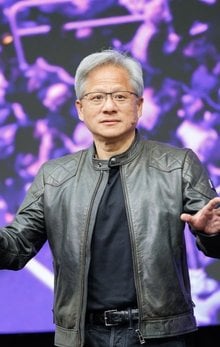
“Computing demand is growing exponentially – the agentic AI inflection point has arrived,” says Jensen Huang, Founder and CEO of NVIDIA.
“Grace Blackwell with NVLink is the king of inference today – delivering an order-of-magnitude lower cost per token – and Vera Rubin will extend that leadership even further.

“Enterprise adoption of agents is skyrocketing. Our customers are racing to invest in AI compute – the factories powering the AI industrial revolution and their future growth.”
Even as revenue surged to new records, equity investors offered only a muted response, with NVIDIA’s share price edging up around 1.4% by the close and adding roughly 0.2% in after-hours trading as markets digested the latest phase of the AI infrastructure boom.
Data centre dominance buoys results
The engine of Nvidia’s performance remains its data centre business, which now accounts for 91% of sales as the company rides unprecedented investment in AI training and inference workloads.
Fourth-quarter revenue from this segment hit a record US$62.3 billion, up 22% sequentially and 75% year-on-year as demand for advanced GPUs and accelerated computing platforms continued to scale across hyperscale environments.
Deep partnerships on AI infrastructure with AWS, Meta, Anthropic, xAI and CoreWeave, alongside participation in the US Department of Energy’s Genesis Mission to cement US leadership in AI, further fuelled the latest revenue surge.
Utilising major cloud providers like AWS – alongside Google Cloud, Microsoft Azure and Oracle Cloud Infrastructure as they roll out Vera Rubin-based instances – NVIDIA is further entrenching its dominance across the AI infrastructure stack.
“We specialise in markets where our computing platforms can provide tremendous acceleration for applications,” says Colette Kress, NVIDIA’s Executive Vice President and Chief Financial Officer.
“These platforms incorporate processors, interconnects, software, algorithms, systems and services to deliver unique value.
“Our platforms address four large markets where our expertise is critical: data centre, gaming, professional visualisation and automotive.”
NVIDIA gaming and professional visualisation
NVIDIA’s gaming and professional visualisation divisions also delivered strong momentum both in the fourth quarter and over the full year, underlining demand beyond core data centre workloads.
Professional visualisation recorded the sharpest quarterly uplift, with revenue reaching US$1.3bn in Q4 – a 74% increase on the previous quarter and a 159% surge compared to the same period last year.
Driven by strong adoption of its Blackwell architecture, full-year professional visualisation revenue climbed 70% to reach US$3.2bn.
Gaming Q4 revenue came in at US$3.7bn, up 47% year-on-year, also fuelled by robust demand for Blackwell-powered platforms, even as results were 13% lower than Q3 as channel inventory normalised following the peak holiday cycle.
For the full year, gaming revenue rose 41% to a solid US$16bn, while NVIDIA continued to expand its gaming ecosystem and creator workflows by tightly integrating high-performance GPUs with software and services that elevate gameplay, visual fidelity and content productivity.
NVIDIA AI for autonomous vehicle deployment
Beyond data centres, visualisation and gaming, NVIDIA is also intensifying its expansion into automotive and applied AI.
Propelled by accelerating adoption of its autonomous driving platforms, Q4 automotive revenue rose 6% year-on-year to US$604m, while full-year revenue climbed 39% to US$2.3bn – underscoring the growing role of AI in next-generation mobility.
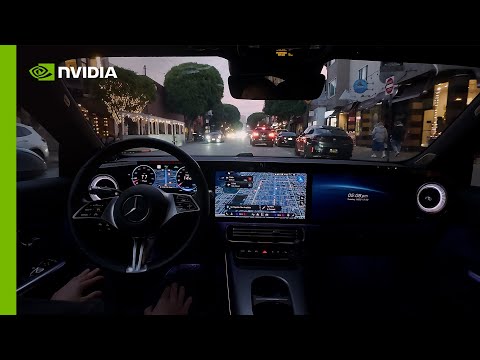
NVIDIA has unveiled the Alpamayo family of open AI models, simulation tools and datasets engineered to accelerate the next wave of safe, reasoning-based autonomous vehicle development.
By delivering open models alongside advanced simulation environments, NVIDIA seeks to dismantle development hurdles for carmakers building advanced driver assistance and self-driving systems.
Its partnership with Mercedes-Benz advances further, with the all-new CLA featuring upgraded Level-2 driver assistance powered by NVIDIA DRIVE AV, exemplifying the company’s drive to establish DRIVE as the standard AI computing foundation for tomorrow’s vehicles.
Company portals

Executives
Jensen Huang
Founder and CEO