NVIDIA’s Alpamayo Brings Reasoning to Self‑Driving Tech

NVIDIA’s Alpamayo suite brings together open AI models, simulation frameworks and data resources built to accelerate the creation of safer, reasoning-driven autonomous vehicles (AVs).
At its core, Alpamayo focuses on enabling AVs to handle rare and unpredictable edge cases through advanced vision-language-action (VLA) models.
These VLAs interpret complex driving environments, articulate decision processes and deliver transparency for auditable autonomous systems.
With Alpamayo, NVIDIA becomes the first company to introduce an open reasoning VLA model purpose-built to address such high-stakes driving scenarios.

About Alpamayo 1
NVIDIA says the technologies within Alpamayo 1 are designed to bring human-like reasoning to AV decision-making.
It introduces a new approach based on VLA models, guiding AV systems through rare and complex driving scenarios in a logical, step-by-step manner.
Traditionally, most AV systems separate perception and planning – a divide that limits their scalability when facing unfamiliar or unplanned events.
By contrast, Alpamayo allows vehicles to not only interpret their surroundings but also articulate the reasoning behind their actions.
Rather than operating directly within AVs, Alpamayo’s models function as large-scale “teacher” systems, enabling developers to distil their insights into leaner, production-ready AV software.
The technology is built on NVIDIA’s Halos safety architecture – a comprehensive stack combining vehicle hardware, AI models, chips, development tools and simulation software to support safe and scalable AV innovation.
Alpamayo 1 further integrates powerful simulation tools and curated datasets to enhance autonomous driving development.
The most downloaded robotics model
Alpamayo 1 is open source, with its datasets available on Hugging Face.
Hugging Face is a New York-based open-source AI platform and community where developers can share, explore and collaborate on machine learning models, datasets and applications.
Alpamayo 1 has quickly become Hugging Face’s most-downloaded robotics model, surpassing 100,000 downloads and continuing to grow.
Matt Cragun, Director of Product Management for Autonomous Vehicles and Simulation, says: “This is exciting. Alpamayo is off to a great start.
“We've gotten lots of great feedback from the community that is helping us make it even better. More to come..."
Reasoning in autonomous vehicles
Several leading mobility companies have already shown interest in Alpamayo to advance their reasoning-based AV research.
Early adopters include Berkeley DeepDrive, JLR and Uber, each exploring how Alpamayo’s models can strengthen decision-making and safety in next-generation AV systems.
Sarfraz Maredia, Global Head of Autonomous Mobility and Delivery at Uber, says: “Handling long-tail and unpredictable driving scenarios is one of the defining challenges of autonomy.
“Alpamayo creates exciting new opportunities for the industry to accelerate physical AI, improve transparency and increase safe level 4 deployments.”
Lucid, a manufacturer of advanced EVs, partnered with NVIDIA in 2025 to develop passenger vehicles equipped with Level 4 autonomous driving capabilities.
Kai Stepper, Vice President of ADAS and Autonomous Driving at Lucid Motors, says: “The shift toward physical AI highlights the growing need for AI systems that can reason about real-world benevolence, not just process data.
“Advanced simulation environments, rich datasets and reasoning models are important elements of the evolution.”
NVIDIA says future models in the Alpamayo family will incorporate larger parameter counts and more advanced reasoning capabilities.
They will also offer greater input and output flexibility, broadening their potential for commercial applications across the autonomous vehicle ecosystem.
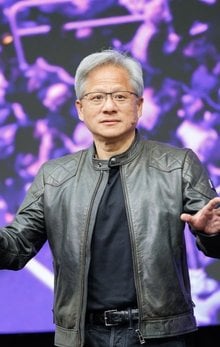
Jensen Huang, Founder and CEO of NVIDIA, says: “The ChatGPT moment for physical AI is here, when machines begin to understand, reason and act in the real world.
“Robotaxis are among the first to benefit.
“Alpamayo reasoning to autonomous vehicles, allowing them to think through rare scenarios, drive safely in complex environments and explain their driving decisions, it's the foundation for safe, scalable autonomy.”
Company portals



Executives
Jensen Huang
Founder and CEO
Kay (Kai) Stepper
Vice President, Head of ADAS and AD
Sarfraz Maredia
President, Autonomous Mobility & Delivery