
Schneider Electric CEO: The AI Energy Infrastructure Risk

Global electrical infrastructure faces mounting pressure as AI workloads threaten to destabilise power networks, according to the chief executive of Schneider Electric, who has outlined plans to redefine the company's market position.
At Schneider Electric's 2025 Innovation Summit held in Copenhagen, Olivier Blum presented forecasts suggesting worldwide electricity demand could rise by 60% within the next 15 years.

Olivier identified AI, automation and connected devices as the primary factors behind this projected increase, characterising energy volatility and unpredictable pricing as "the new normal".
"Energy is both the blood of modern life and a bulwark against its greatest threat: climate change," Olivier says.
Transforming industrial identity
The French industrial manufacturer has announced a strategic shift away from its heritage as an electrical equipment producer towards positioning itself as what Olivier termed the world's foremost "energy technology company".
This transformation centres on Schneider Electric's EcoStruxure platform, which Olivier described as an "open, intelligent IoT-enabled platform" that connects systems, data and people across industrial and commercial environments.
The technology currently operates across more than one million buildings globally and supports 40% of the world's hospitals, according to Olivier.
Schneider Electric submitted over 1,400 patent applications during the previous year, concentrating on developments including liquid cooling solutions for data centres and AI-optimised HVAC systems.
Energy is both the blood of modern life and a bulwark against its greatest threat: climate change.
Schneider Electric's SpaceLogic Room Controller incorporates embedded AI to reduce building energy consumption, turning them from "passive consumers to active energy producers", Olivier suggests.
Environmental performance and commitments
Schneider Electric has built its corporate positioning around sustainability principles, receiving recognition from Sustainability Magazine, TIME and Statista on two occasions as the world's most sustainable company.
Schneider Electric reports achieving a 75% reduction in Scope 1 and 2 emissions since 2017, with its net zero commitments validated by the Science Based Targets initiative.
Schneider Electric's decarbonisation efforts have concentrated predominantly on operational emissions, whilst the more complex challenge of Scope 3 supply chain impacts receives comparatively less emphasis.

Olivier referenced two initiatives designed to address broader decarbonisation: the Zero Carbon Project and Materialize, which engage with suppliers and customers respectively.
Schneider Electric also maintains SE Ventures, an investment vehicle exceeding $1 billion in value, which backs start-ups focused on sustainable innovation.
Schneider Electric's partner network encompasses over one million professionals, ranging from electricians to system integrators, who implement Schneider technologies for end users.
Balancing competing demands
The dilemma confronting Schneider Electric, and the wider energy industry, presents considerable complexity. Organisations must enable AI expansion while simultaneously decarbonising at sufficient pace to achieve climate commitments.
Olivier's strategy emphasises improving data centre efficiency through innovations including "software-defined power" and advanced cooling technologies.
By framing itself as an "energy technology" leader rather than exclusively as a sustainability advocate, Schneider Electric appears to acknowledge pragmatically that energy consumption will continue its upward trajectory.
Grid infrastructure must become "more agile to handle volatility and renewables", according to Olivier, with Schneider's IoT platforms and AI microgrid advisors helping to balance supply.
Adapting established operations
Throughout its two-hundred-year history, Schneider Electric has navigated multiple technological transitions.
This latest repositioning arrives as electrification expands across transport, heating and industrial processes, whilst renewable energy sources introduce additional complexity to grid management.
"We can't just react to these changes - we must lead," Olivier explains.
Whether Schneider's technology can reconcile surging energy demand with decarbonisation imperatives remains the central question for Schneider Electric and the broader energy transition.
Company portals

Executives
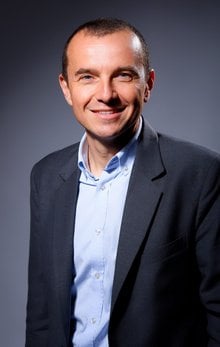
Olivier Blum
Chief Executive Officer