Rolls-Royce to Power AI Operations with Nuclear Energy
As AI continues to evolve, concerns are growing over the amount of energy and water its infrastructure consumes.
Data centres around the world are still heavily reliant on fossil fuels. In fact, these high polluting sources account for 56% of all the energy consumed by data centres, according to the Environmental and Energy Study Institute.
Rolls-Royce is taking steps to address this issue, though, by exploring the potential of nuclear power.
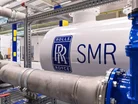
The engineering giant is aiming to power its AI operations using Small Modular Reactors (SMRs) going forward.
While the goal here is sustainability, the team at Rolls-Royce sees this move as a step closer to becoming the UK's most valuable company. This is a road Rolls-Royce has been travelling down for some time now, and it has been surpassing leader after leader on the London Stock Exchange in recent months.
"There is no private company in the world with the nuclear capability we have," Tufan Erginbilgic, CEO at Rolls-Royce, told BBC News recently.
"If we are not the market leader globally, we did something wrong."
Is nuclear the key to sustainability in AI?
The initiative focuses on SMRs, which offer a more efficient alternative to traditional nuclear plants with faster construction times. Rolls-Royce has secured agreements to develop three SMRs in the UK and six in the Czech Republic.
Each SMR can generate up to 300 MW of electricity, with global demand projected to reach 400 units by 2050, according to Erginbilgic. The Information Technology and Innovation Foundation supports this outlook, identifying SMRs as the future of nuclear power generation due to their efficiency and cost-effectiveness.
This approach aligns with other tech giants' strategies, such as Google's partnership with Kairos Power, which aims to launch its first SMR by 2030 to support clean energy needs for AI operations.

Rolls-Royce's relationship with AI
Rolls-Royce's AI journey began in 1999, initially focusing on predictive maintenance for jet engines.
The company has since expanded its AI applications to include robotic quality control in manufacturing and collaboration with R2 Data Labs for data-driven performance improvements.
The company currently employs sustainable AI practices through technologies like mtu EnergetIQ, which optimises power generation, storage, and requirements based on weather data, electricity prices, and customer needs.
"If you want to achieve perfect interplay in leveraging the strengths of the different technologies, not just today, but tomorrow, next week and beyond, then what you need isn't a fixed operating strategy but one that constantly recalculates itself automatically," says Jan Henker, Senior Expert Automation and Controls at Rolls-Royce.
"That requires an over-arching, data-driven solution – in other words, the optimiser function of mtu EnergetIQ."

The economic and environmental impact of SMRs
Each SMR facility will deliver stable, affordable, and emissions-free energy capable of powering one million homes for at least 60 years. The 470 MW of low-carbon energy produced by each unit equals the output of 150 onshore wind turbines.
The initiative promises substantial economic benefits, with potential contributions of US$73bn (£54bn) to the UK economy between 2025-2105.
The manufacturing strategy emphasises local production, with 90% of SMR assembly planned for factory environments, supporting quality control and international deployment while creating 40,000 regional UK jobs by 2050.
Tony Blair, former British Prime Minister and Executive Chairman at the Institute for Global Change, is a firm believer in the power of SMRs and nuclear power more generally.
"SMRs can be a cornerstone of the long-term, secure and low-cost decarbonised energy system that can power the future economy," he says.