Sony AI-Controlled Robot Beats Elite Table Tennis Players
For years, AI has reigned supreme in the digital world. It has outplayed grandmasters at Chess, mastered the complexities of programming language and dominated high-speed virtual racing.
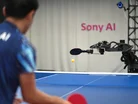
However, Sony AI has demonstrated the power of AI in the physical reality of a sports arena with Project Ace, the first autonomous system capable of competing with – and defeating – professional-level human table tennis players.
The research signals a leap from virtual mastery to physical precision.
“This breakthrough is much bigger than table tennis,” says Peter Stone, Chief Scientist at Sony AI. “It represents a landmark moment in AI research, showing, for the first time, that an AI system can perceive, reason and act effectively in complex, rapidly changing real-world environments that demand precision and speed.
“Once AI can operate at an expert human level under these conditions, it opens the door to an entirely new class of real-world applications that were previously out of reach.”
The anatomy of a champion
Table tennis is a nightmare for traditional robotics. It needs a system to process a ball moving at high speeds with complex spin, requiring reaction times measured in milliseconds.
To overcome this, Sony AI equipped Ace with a sophisticated system of proprietary tech, including nine active pixel sensor cameras with event-based vision sensors to track 3D position and angular velocity.
Ace also has a control system based on reinforcement learning, allowing the robot to adapt to an opponent’s style rather than relying on rigid, pre-programmed scripts.
The results speak for themselves. In initial evaluations, Ace secured three victories in five matches against elite players. In more recent trials conducted in March 2026, the AI defeated three separate professional players at least once.
“This research has shown that an autonomous robot can, in fact, win at a competitive sport, matching or exceeding the reaction time and decision making of humans in a physical space,” says Peter Dürr, Director of Sony AI in Zürich and project lead for Ace.
“Table tennis is a game of enormous complexity that requires split-second decisions as well as speed and power. This research breakthrough highlights the potential of physical AI agents to perform real-time interactive tasks, and represents a significant step toward creating robots with broader applications in fast, precise and real-time human interactions.”
The challenge of the real world
Transitioning Ace from a controlled simulation to a chaotic real-world match wasn’t without its hurdles. Peter notes that the unpredictability of human intuition and the laws of physics provided the ultimate test.
“There were multiple challenges; however, the primary challenge was that we didn’t have a perfect model of how human players behave,” he explains. “This meant that even if the robot did very well in simulation, it may have weaknesses that human players can find and exploit.
“Another challenge was to get the physics model right for high-level table tennis, which features very fast shots and extreme spin. For example, we discovered at some point that our physics model worked well for slower shots, but we overestimated the drag forces for very fast shots, which led to the robot overshooting the table in the real world.”
Despite these obstacles, Ace’s performance in the short game was striking. It scored 16 direct aces against elite players, while its human counterparts managed only eight against the machine.
Collaboration, not replacement
Sony AI sees a future of mutual evolution between humans and AI.
During the trials, professional player Kinjiro Nakamura observed Ace executing shots that had never been seen in traditional human play.
“Just like in other games where AI agents outperform human players – for example, chess or Go – I do not expect that our research will take anything away from the human vs. human game,” Peter says.
“On the contrary, Kinjiro Nakamura made a particularly interesting comment about seeing our system play a specific shot that he hadn’t seen humans play. He thought it would be plausible for a human to apply to their game.
“This showed that physical AI agents have the potential to teach human players new aspects of the game and enrich human vs. human play.”

From the court to the real world
While Ace is currently a master of the paddle, the underlying technology has implications that stretch far beyond sport.
The ability to combine low-latency perception with adaptive decision-making is critical for safety-critical environments.
When asked about the roadmap for this technology, whether we are looking at robots for dangerous tasks or a centaur model where AI acts as an extension of the human body, Peter remains focused on the broader horizon of possibility.
“This is a research project, and it is important to note that it was developed and tested as a way to push the individual technologies to learn what is possible, rather than determining a specific application,” he responds. “That said, we can imagine there are many ways that the technology might be applied.”
According to Sony AI, the potential applications include:
- Elite Sports Analysis: Precise measurement of trajectory and spin in baseball, tennis or badminton.
- Safety-Critical Systems: Rapid sensing and adaptation in environments where human reaction time is insufficient.
- Immersive Media: New forms of real-time media capture where speed and responsiveness are essential.
As Ace continues to sharpen its serve, it’s proving that the bridge between digital intelligence and physical action is firmly built.
Company portals

Executives
Peter Dürr
Director
Peter Stone
Chief Scientist