The Tech Behind Ford’s Shift from BEV to EREV
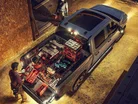
Ford’s latest F-150 Lightning integrates Extended Range Electric Vehicle (EREV) architecture, combining advanced battery systems with an onboard generator to deliver a technology-backed range exceeding 700 miles.
Production of the all-electric F-150 Lightning, once the best-selling electric pickup in the US, concluded in 2025.
The new model signals a major tech-driven shift in Ford’s manufacturing strategy – evolving from a fully battery-electric platform to EREV technology that leverages hybrid power management and energy-optimised control systems for greater efficiency and flexibility in extended-range performance.
What is an EREV?
EREVs typically feature a compact internal combustion engine (ICE) generator designed solely to recharge the vehicle’s battery pack, rather than drive the wheels directly.
In some classifications, they fall under the broader category of plug-in hybrid electric vehicles (PHEVs).
Both EREVs and PHEVs offer dual charging functionality – drawing power from standard EV charging infrastructure while also enabling refuelling at conventional petrol stations for extended operational range.
The previous generation F-150 Lightning operated as a battery electric vehicle (BEV), drawing all propulsion power directly from its high-capacity lithium-ion battery system.
It delivered an estimated range of 300 miles with a 123 kWh pack, or up to 320 miles with the larger 131 kWh configuration.
However, in rural regions – where pickup demand remains highest – the limited availability of charging infrastructure likely contributed to slower adoption rates of fully electric models.
The next-generation F-150 Lightning
Doug Field, Ford's Chief EV, Digital and Design Officer, says: "The F-150 Lightning is a ground breaking product that demonstrates an EV pickup can still be a great F-Series.
"Our next-generation F-150 Lightning EREV will be every bit as revolutionary. It delivers everything Lightning customers love, near instantaneous torque and pure electric driving.
“But with a high-power generator enabling an estimated range of 700+ miles, it tows like a locomotive. Heavy-duty towing and cross-country travel will be as effortless as the daily commute."
The next-generation F-150 Lightning introduces enhanced power export capabilities, allowing the vehicle to supply electricity to external systems – ranging from campsite setups to home backup during outages.
Like the previous model, the new EREV will be assembled at Ford’s Rouge Electric Vehicle Centre in Dearborn.
Production of the current all-electric F-150 Lightning has since concluded, as teams at the Dearborn Truck Plant transition to supporting gas and hybrid F-150 production lines.

Changes in Ford’s EV policy
President Donald Trump’s Executive Order 14154, UNLEASHING AMERICAN ENERGY, established a federal mandate to phase out subsidies and policy incentives that favour EVs in the marketplace.
The expiration of the New Clean Vehicle Credit, Previously-Owned Clean Vehicle Credit and Qualified Commercial Clean Vehicle Credit in September 2025 removed key financial incentives for consumers and fleet operators considering EV adoption.
In addition to these regulatory changes, the sector continues to feel the impact of elevated tariffs on critical minerals used in battery manufacturing.
Essential EV battery components – such as lithium, nickel and cobalt – remain costly due to sustained global demand across energy, electronics and manufacturing sectors.
According to the IEA, the global trend toward higher import tariffs on these materials could drive up battery production costs, potentially reversing some of the substantial price reductions achieved since 2015.
Ford’s US$19.5bn loss
Ford projects a loss of approximately US$19.5bn, with the bulk recognised in the fourth quarter of 2025 and the remainder expected across 2026 and 2027.
The financial hit is partly tied to the company’s strategic restructuring of its EV portfolio.
In response to subdued consumer demand, rising production costs and shifting US regulatory policies, Ford plans to scale back select electric models that no longer present a sustainable business case.
The company has also shelved plans for a new all-electric commercial van originally intended for the European market.
“The operating reality has changed, and we are redeploying capital into higher-return growth opportunities: Ford Pro, our market-leading trucks and vans, hybrids and high-margin opportunities like our new battery energy storage business.”
Company portals

Executives

Doug Field
Chief EV, Digital and Design Officer
Jim Farley
Chief Executive Officer