Waymo, Netflix & Apple: Why AI’s Future Depends on the Edge

Edge computing is a driving force that’s reshaping the digital world’s approach to speed, scale and intelligence.
For years, the cloud has dominated as the backbone of computing – centralising vast volumes of data and processing power in remote data centres.
But as the volume of connected devices continues to grow and applications demand instant responsiveness, the limits of distance and latency are getting in the way.
This is why the new frontier is at the edge: with billions of intelligent end-points sitting closer to where data is created, decisions are made and actions happen in real time.
This change should not be taken as a rejection of the cloud but instead as a rebalancing act – as edge computing distributes processing workloads away from distant servers and toward the devices, sensors and local nodes that interact directly with the physical world.
From the intelligence inside autonomous vehicles, wearable devices, industrial robots and content delivery networks, what unites them is the same principle: keep computational logic close to the action and minimise the lag caused by round trips to the cloud.
This is further propelled by the fact that today’s digital economy runs on immediacy.
A few milliseconds can separate a safe self-driving manoeuvre from a crash or be the difference between a seamless video stream and a frustrating buffer wheel.
Edge systems achieve this responsiveness by blending the best of both worlds – using local processing for the time-critical, privacy-sensitive or high-bandwidth tasks, while still syncing with the cloud for model training, fleet coordination or large-scale analytics.
And, as AI becomes embedded in everything from traffic management to retail checkout, the interplay between cloud and edge will define computing’s next decade.
STL Partners predicts that the edge computing market will reach US$424bn by 2030 thanks to the ongoing boom in content delivery and computer vision, with connected vehicles, IoT devices and smart infrastructure also predicted to impact this upward trajectory.
This means that enterprise architects now face a new design challenge: placing workloads optimally across a continuum that stretches from massive hyperscale data centres to tiny chips inside wearables.
Waymo: The edge, on wheels
Think of an autonomous vehicle as a rolling edge data centre. For a company like Waymo – owned by Google’s parent Alphabet – the cloud is essential for training its AI driver but useless for a split-second braking decision.
The car cannot wait for a signal to travel to a data centre and back to know it should stop for a pedestrian.
This is why each Waymo vehicle is equipped with a suite of sensors including LiDAR radar and high-resolution cameras, generating terabytes of data every hour.
This data is processed in real time by the Waymo Driver, an immensely powerful on-board computer. This edge system performs the critical tasks of perception, prediction and navigation locally.

“Achieving fully autonomous freeway operations is a profound engineering feat – easy to conceive, yet hard to truly master,” says Waymo Co-CEO Dmitri Dolgov.
“This milestone is a powerful testament to the maturity of our operations and technology.”
The cloud is used to update the fleet and analyse driving logs – but the immediate, life-saving intelligence lives at the edge.
Binging on Netflix? You need edge computing for that

Streaming a video without buffering? Thank edge computing. Netflix’s global dominance is built not just on content but on its Open Connect programme, a massive content delivery network (CDN) that is a model of edge architecture.
This means that instead of serving every episode of Stranger Things from a few giant data centres, Netflix places its own red server boxes – called Open Connect Appliances (OCAs) – deep inside local Internet Service Provider (ISP) networks all over the world.
“In anticipation of this growing demand from consumers and in line with our long-term vision of entertaining the world, we knew we had to invest in our own global content delivery network – and that’s how the Open Connect program was born,” explains Gina Haspilaire, Netflix’s Vice President of Open Connect Partnerships and Planning Content Delivery.
“We developed an infrastructure that efficiently delivers quality entertainment to our members – no matter where they are around the world or what device they’re watching on – in partnership with internet service providers (ISPs) worldwide.
When you press play, the video is streamed from an OCA in your city, not from a server across the globe, drastically reducing latency and ensuring a high-quality stream.
So, in this instance, the cloud handles your login and recommendations, while the edge delivers the video.
Apple: The edge on your wrist

The Apple Watch is one of the most popular personal edge computers in the world.
While the iPhone and iCloud are central to its ecosystem, the watch’s most critical functions are performed locally for two simple reasons: speed and privacy.
When the watch detects a hard fall or a car crash, for example, it must react instantly – it cannot afford a network delay to ask a cloud server for permission to call emergency services.
Likewise, sensitive health data like your heart-rate rhythm (EKG) is processed directly on the S-series chip.
This philosophy is central to Apple’s new AI features.
“We’ve extended iPhone’s industry-leading security to the cloud, with what we believe is the most advanced security architecture ever deployed for cloud AI at scale,” Apple’s Senior Vice President of Software Engineering Craig Federighi says.
“Private Cloud Compute uses your data only to fulfill your request and never stores it, making sure it’s never accessible to anyone, including Apple. And we’ve designed the system so that independent experts can verify these protections.”
This hybrid approach – which starts with on-device processing – means personal data stays secure at the edge, on your wrist.



Executives
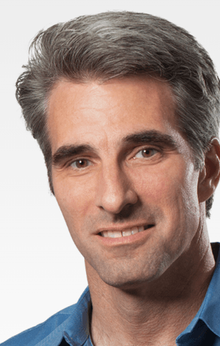
Craig Federighi
Senior Vice President Software Engineering
Dmitri Dolgov
Co-CEO

Gina H.
Vice President, Open Connect - Network Strategy, Planning, and ISP Partnerships