WEF: Behind NVIDIA's Jensen Huang's Five-Layer AI Approach
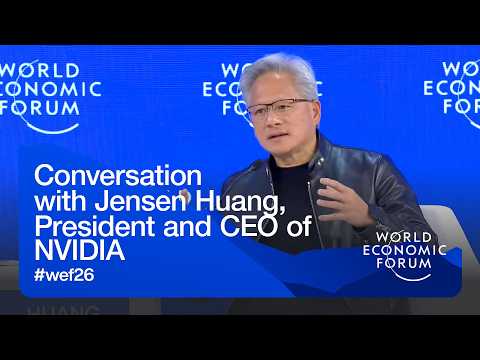
NVIDIA President and CEO Jensen Huang, one of the most influential voices in AI, has joined global leaders at the World Economic Forum (WEF) to discuss the accelerating scale of AI adoption and its implications for business and society.
Outlining his vision for the next phase of AI’s global rollout, Jensen argued that the technology should be treated as fundamental infrastructure – an essential layer underpinning both economic growth and national competitiveness.
In conversation with Larry Fink, BlackRock CEO and Co-Chairman of the WEF, Jensen said: “AI is infrastructure and there’s not one country in the world I can’t imagine that you need to have AI as part of your infrastructure, because every country has its electricity, you have your roads - you should have AI as part of your infrastructure.”
He went on to note that AI accessibility is improving rapidly, enabling countries to develop their own models with relative ease.
With the right technical expertise and data foundations, Huang believes that nations can now import AI and tailor it to their unique needs and capabilities.
“I really believe that every country should get involved to build AI infrastructure, build your own AI, take advantage of your fundamental natural resources which is your language and culture,” Jensen told the WEF audience, “and have your national intelligence be part of your ecosystem.”
AI is not a single technology
NVIDIA’s success is rooted in the bold vision and strategic clarity set by its Founder and CEO, Jensen Huang.
Rather than viewing AI as a singular technology, Jensen conceptualises it as a “five-layer cake” – a structured ecosystem where each layer builds upon the last to create scalable, intelligent systems.
According to Jensen, the foundation of this “cake” is energy: “It’s [AI] processed in real time and it generates intelligence in real time. It needs energy to do so.”
The second layer comprises chips and computing infrastructure – the space Jensen describes as his own domain and the beating heart of NVIDIA’s innovation.
Sitting above this is cloud infrastructure, followed by the AI models layer.
“This is where people think AI is, but don’t forget that in order for those models to happen, you have to have all of the layers underneath it,” Jensen explained.
Finally comes the application layer, where AI manifests in usable, value-driven tools and services.
Jensen says that “this layer on top ultimately is where economic benefit will happen”, because it includes AI-powered systems for financial services, healthcare and manufacturing that directly generate value and productivity gains.
This integrated approach, Jensen adds, marks the beginning of what he calls “the largest infrastructure buildout in human history”.
Where people fit in
According to Jensen, the global AI buildout is already fuelling rising demand for skilled labour, particularly in technical and trade professions.
“We’re going to have plumbers and electricians and construction and steel workers and network technicians and people who install and fit out the equipment,” he explained.
He also highlighted AI’s transformative impact on specialised industries such as healthcare.
In radiology, for instance, AI has become an indispensable diagnostic tool. Yet rather than replacing professionals, Jensen noted that the technology has increased the number of radiologists.
“If you reason from the first principles, not surprisingly, the number of radiologists has gone up,” Jensen said. “The fact that they’re able to study scans now infinitely fast allows them to spend more time with patients.”
On the subject of productivity, Jensen pointed to the ongoing shortage of around five million nurses in the US as a powerful example of AI’s potential to amplify human capacity: “Now they can use AI to do the charting and transcription of patient visits.
“Hospitals do better, and they hire more nurses. Surprisingly, or not surprisingly, AI is increasing productivity, and as a result, they want to hire more people."
As this technological shift accelerates, Jensen stressed that AI literacy is becoming a foundational skill for today’s workforce.
He said: “It is very clear that it is essential to learn how to use AI, how to direct it, guardrail it, evaluate it.”
Company portals



Executives
Jensen Huang
Founder and CEO
Larry Fink
Chairman and Chief Executive Officer