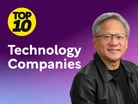
Top 10: Technology Companies
10. Oracle
Revenue: US$53bn (FY 2024)
Employees: 160,000
CEO: Safra Catz
Founded: 1977

Thanks to its diverse and comprehensive suite of enterprise software and cloud solutions, Oracle stands out as a technology leader.
It has a strong global presence and clear focus on innovation and security.
Oracle’s offerings span from database management and cloud infrastructure to business applications, making it a go-to provider for organisations of all sizes across various industries.
9. Tesla
Revenue: US$97.6bn (2024)
Employees: 122,000
CEO: Elon Musk
Founded: 2003

Tesla has revolutionised the automotive industry and accelerated the global transition to sustainable energy. It is far more than a car company – it is a technology firm that designs, develops and manufactures EVs, battery energy storage systems and solar products.
Its vehicles, including the best-selling Model Y and Model 3, are known for their cutting-edge software, over-the-air updates and advanced driver-assistance systems like Autopilot.
Tesla’s vertical integration – from its Gigafactories to its Supercharger network – gives it a distinct advantage in the EV and clean energy markets.
8. TSMC
Revenue: US$88.3bn (2024)
Employees: 73,000
Chairman & CEO: C. C. Wei
Founded: 1987

The world’s first and largest dedicated semiconductor foundry, TSMC plays an important role in the global economy.
It operates a pure-play foundry model – meaning it manufactures chips designed by other companies but does not design its own.
Its manufacturing expertise and technological leadership in advanced process nodes make a primary producer for industry leaders like Apple, Nvidia and AMD.
Without TSMC, modern consumer electronics and AI would be impossible, giving it a unique and powerful position in the supply chain.
7. Broadcom
Revenue: US$51.6bn (fiscal year 2024)
Employees: 37,000
President & CEO: Hock Tan
Founded: 1991

Broadcom is a global technology leader in both semiconductor and infrastructure software solutions, built through a series of major strategic acquisitions including LSI, Brocade, CA Technologies, Symantec’s enterprise security business and, most recently, VMware.
Its dual-pronged strategy makes it a critical supplier for a vast range of technologies, from networking and broadband to mainframe software and cybersecurity.
Its products are essential components in data centres, wireless devices and enterprise IT systems, positioning it as a foundational technology provider for the world’s most successful companies.
6. Meta
Revenue: US$164.5bn (full year 2024)
Employees: 76,800
CEO: Mark Zuckerberg
Founded: 2004

As well as owning a vast portfolio of social media applications boasting more than three billion monthly active users, Meta has embarked on an ambitious pivot toward building the metaverse, investing heavily in its Reality Labs division and Quest VR headsets.
All happening under the leadership of Mark Zuckerberg, Meta is also a key player in AI, developing and open-sourcing powerful models like Llama to drive its platforms.
5. Amazon
Revenue: US$638bn (annual revenue, 2024)
Employees: 1.5 million
President & CEO: Andy Jassy
Founded: 1994

Amazon has evolved from an online bookstore into a global “everything store” and technology powerhouse.
Despite its e-commerce platform having fundamentally reshaped retail worldwide, the company’s primary profit engine is Amazon Web Services (AWS), the world's leading cloud computing platform.
AWS provides the critical infrastructure for countless businesses and is a leader in offering cloud-based AI and machine learning services.
Amazon also produces a successful line of consumer electronics, with its technology embedded into the daily lives of millions of consumers.
4. Alphabet
Revenue: US$350bn (annual revenue, 2024)
Employees: 183,000
CEO: Sundar Pichai
Founded: 1998 as Google

Google’s parent company Alphabet commands the digital advertising landscape through its search engine and YouTube video platform.
Its business model is built on organising the world’s information and monetising user engagement.
Beyond advertising, Alphabet is a major player in cloud computing with Google Cloud and is pursuing long-term “moonshot” projects in areas like autonomous driving through Waymo and life sciences with Verily.
The company is now leveraging its deep expertise in AI to enhance its core products and compete in the new Gen AI era.
3. Apple
Revenue: US$391bn (fiscal year ending September 2024)
Employees: 164,000
CEO: Tim Cook
Founded: 1976

Apple is a major force in consumer technology, built around a tightly-integrated ecosystem of hardware, software and services.
The iPhone continues to be its flagship product and the gateway to its high-margin Services division, which includes the App Store, Apple Music and iCloud.
While facing challenges in new product performance, Apple is making long-term bets on future platforms with the Vision Pro headset for spatial computing and a privacy-centric approach to AI with Apple Intelligence.
Its dominance in brand loyalty and ecosystem lock-in provide a powerful defence against competitors.
2. Microsoft
Revenue: US$245bn (2024)
Employees: 228,000
Chairman & CEO: Satya Nadella
Founded: 1975

A dominant force in the tech space for decades, Microsoft has reinvented itself as a cloud-first giant, structured around its core pillars of Productivity through Microsoft 365, Intelligent Cloud with Azure and Personal Computing with Windows and Xbox.
Its Azure platform is a key player in the AI race, bolstered by a strategic, multi-billion-dollar partnership with OpenAI, which gives it premier access to models like GPT-4.
Microsoft is embedding AI capabilities with Copilot across its entire software portfolio – from the Office suite to Teams and Windows – to redefine productivity and solidify its enterprise stronghold.
To secure its long-term position and reduce third-party reliance, the company is making massive investments in its own custom AI chips, Maia and Cobalt, and a global network of AI data centres.
Its multifaceted strategy, combined with the strength of its Xbox gaming division, ensures its continued influence across both consumer and corporate technology.
1. Nvidia
Revenue: US$60.9bn (fiscal year 2024)
Employees: 36,000
President & CEO: Jensen Huang
Founded: 1993

Propelled by the Gen AI revolution, Nvidia has become the world’s most valuable technology company, with its market cap now at more than US$4tn.
Originally a leader in graphics processing units (GPUs) for the gaming market, its shift to data centre and AI applications has been transformative for the business and wider tech ecosystem.
Nvidia’s high-performance chips, including the A100 and H100, are the standard for training and running advanced AI models.
This hardware dominance is fortified by its proprietary CUDA software platform, which offers a mature ecosystem of libraries and tools, making it difficult for others to rival.
This makes Nvidia an engine for cloud providers and tech giants globally.
The company’s strategy is now evolving beyond selling individual components to providing entire AI “factories” – fully integrated systems of hardware, networking and software – further cementing its foundational role in the AI era.
Read this feature in the upcoming September edition of Technology Magazine by clicking here.