
Barrelhand & UNESCO’s Digital Human Artefact Bound for Space
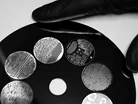
In the quiet vastness of space, a tiny nickel disc no larger than a pound coin is set to become humanity's most enduring time capsule.
In collaboration with UNESCO, American innovation platform Barrelhand has created the Memory Disc V3 — a remarkable technological achievement designed to preserve human culture, language and art for millions of years beyond Earth.
Copies of the disc will accompany astronauts on lunar missions in 2025 and 2027, whereupon they will be deposited on the Moon’s surface by lunar rovers and lunar landers operated by Astrobotics, Astrolab and ispace.
The thinking behind this project is to protect the legacy of humanity in space, if our species ever becomes extinct.
It is also regarded as a universal way of communicating with intelligent life, should it ever visit the Moon.
Extra-terrestrial time capsule projects like these have been completed before, most notably the Voyager Golden Records.
These identical metal discs also contained a selection of audio and visual artefacts from the Planet Earth, and they both accompanied the Voyager spacecrafts upon their launch in 1977.
A nano-engraved legacy of life on Earth
Measuring just 19mm in diameter and a mere 1.2mm thick, the Memory Disc V3 utilises revolutionary NanoFiche technology to encode data at an astonishing 133,000 DPI resolution.
This allows features as small as 200 nanometres – roughly 420 times finer than a human hair – to be engraved onto raw nickel, creating an archive that requires no power source and remains resistant to cosmic radiation, extreme temperature fluctuations, and the vacuum of space.
Unlike conventional digital storage media that degrade over time, the Memory Disc V3 is designed to survive for millennia, even billions of years, accessible through simple optical magnification.
Barrelhand says it serves as “a modern-day Rosetta Stone”, preserving humanity's essence for future generations or potentially even other intelligences.
Cultural preservation beyond our atmosphere
The disc's contents represent a thoughtfully curated collection of humanity's linguistic, artistic, and cultural achievements:
- UNESCO's constitution: The powerful statement "Since wars begin in the minds of men, it is in the minds of men and women that the defences of peace must be constructed" has been translated into 286 languages, showcasing Earth's linguistic diversity and providing potential pattern recognition keys for any future interpreters.
- 106 curated artworks: Spanning 30,000 years of human creativity from all continents, the collection includes cave paintings alongside works by contemporary artists like Kara Walker, George Rouy and Yoshitaka Amano. Notably, it even features two children's paintings from the Real Options for City Kids foundation.
- Literary treasures: The original French edition of Antoine de Saint-Exupéry's "Le Petit Prince" offers a philosophical exploration of human perception and curiosity through allegory and metaphor.
- Sound as visual art: An ultra-high-resolution waveform by electronic musician Richard D. James (Aphex Twin) transforms audio into a standalone hieroglyph of sound.
- Universal metrics: Fundamental scientific measurements and directional references, including a pulsar map inspired by the 1977 Voyager Golden Record, provide cosmic coordinates for Earth.
From a psychological anchor to a cultural monument
What began as a psychological support tool for astronauts has evolved into something far more profound.
Michael Sorkin, Co-Founder of Barrelhand and Lead Designer of the Memory Disc, describes it as "both an archive and a bridge—designed to resonate with any intelligence driven by curiosity".
British artist George Rouy, whose work "Formless Being" is preserved on the disc, reflects on the significance of the project.
"This mission offers the culture of our world on Earth an entirely new horizon and opportunity for new encounters, stripped of Earthly conventions," he says.
Beyond the Moon
Barrelhand is already working to extend the Memory Disc's reach to upcoming crewed missions and deep space probes.
In partnership with UNESCO, the company continues to develop a sustainable framework for cultural preservation in space.
Julien Lamamy, CEO of ispace Europe, contextualises the broader significance: "As humanity explores space, it is essential that we carry not just our technology, but also our stories, values, and heritage."

‘The eternal language of art’
Perhaps most profound is the Memory Disc's continuation of humanity's oldest tradition of communication.
Long before written language, our ancestors left their mark through art, from the 30,000-year-old cave paintings of Chauvet-Pont-d'Arc to the rock art of Hampi.
Japanese artist Yoshitaka Amano, whose work "Hiten" appears on the disc, captures this sentiment: "Art has the power to transcend time and history... As I aim for the myths of the future, I create my works with a sense of fun and imagination. If someone in the future finds happiness through viewing my work, there could be no greater joy for me."
In sending this tiny nickel disc beyond our atmosphere, humanity is engaging in perhaps its most ambitious thought experiment, creating not just a time capsule but an invitation to discovery that may endure long after our civilisation has transformed or even ceased to exist.
As the Memory Disc travels to new frontiers aboard rovers and landers, it carries with it not just data, but the very essence of what makes us human – our creativity, our diversity and our enduring desire to connect across the vast expanses of time and space.
Explore the latest edition of Technology Magazine and be part of the conversation at our global conference series, Tech & AI LIVE.
Discover all our upcoming events and secure your tickets today.
Technology Magazine is a BizClik brand