Nvidia's GR00T N1 and the Future of Global Humanoid Robots
Humanoid robotics have progressed from a theoretical concept to reality at an accelerating pace over the past decade.
Once confined to research labs and science fiction, they are now entering industries across the world – from taking care of labour tasks for people, to reading human emotions of patients in hospital care.
More recently, the convergence of advanced AI models, vastly improved computing power and breakthroughs in materials science, has created conditions for humanoid robots to move into more practical deployment across global businesses.
Now, Nvidia has announced at its GTC event a new suite of technologies aimed at accelerating humanoid robot development, including Isaac GR00T N1, a foundation model designed to provide robots with generalised reasoning and skills.
What are humanoid robots?
Humanoid robots aren’t just designed to assist human activity, but also to look and function like us too, featuring a torso, head, arms and legs.

These robots are increasingly being hired for various business applications, including corporate events, exhibitions, retail and hospitality.
They enhance customer engagement, demonstrate brand innovation and offer versatile solutions for tasks such as welcoming guests, providing information and even performing light duties.
Humanoid robots in manufacturing
Jensen Huang, Nvidia’s Founder and Chief Executive Officer, believes that practical implementation of humanoid robots in real-world settings is approaching quickly, particularly in manufacturing.
“When, literally, humanoid robots are wandering around, which is not five years away. This is not a five-years-away problem, this is a few-years-away problem,” he told journalists after his speech at GTC.
The manufacturing sector is likely to be the first adopter of humanoid robots: “because the domain is much more guard-railed and the use case is much more specific,” he says.
“The value of it is very, very easy to determine. The going rate for renting a human robot is probably US$100,000 and I think it's pretty good economics.”
While current applications are primarily in structured environments like factories and warehouses, ongoing development aims to expand their capabilities in more complex settings, potentially revolutionising industries facing labour shortages.
Nvidia's Isaac GR00T N1 Foundation Model: Introducing dual-system architecture for robotics
Nvidia’s GR00T N1 foundation model – a pre-trained AI system that serves as a starting point for more specialised applications – features what Nvidia calls a dual-system architecture inspired by human cognition.
The model includes what Nvidia labels “System 1,” described as a fast-thinking action component that mirrors human reflexes or intuition and “System 2,” a slow-thinking model for deliberate decision-making.
The vision language model in System 2 allows the robot to understand its environment and receive instructions to plan actions, which System 1 then translates into precise movements.
The GR00T N1 model can also generalise across common tasks such as grasping, moving objects and performing multi-step operations that require long context.
It’s fully customisable, allowing developers to train it further with real or synthetic data for specific robots or tasks.

In a demonstration, Jensen showed a humanoid robot from 1X, a robotics company, autonomously performing domestic tidying tasks using a policy built on GR00T N1.
“With Nvidia Isaac GR00T N1 and new data-generation and robot-learning frameworks, robotics developers everywhere will open the next frontier in the age of AI,” he says.
“The future of humanoids is about adaptability and learning,” Bernt Børnich, Chief Executive Officer of 1X Technologies adds.
“While we develop our own models, Nvidia's GR00T N1 provides a significant boost to robot reasoning and skills.
“With minimal post-training data, we fully deployed on NEO Gamma – advancing our mission of creating robots that are not just tools, but companions capable of assisting humans in meaningful, immeasurable ways.”
Nvidia, Google DeepMind and Disney Research: Creating Newton, the physics engine
Nvidia also announced a collaboration with Google DeepMind and Disney Research to develop Newton, an open-source physics engine that will allow robots to handle complex tasks with greater precision.
Built on the Nvidia Warp framework, Newton will be optimised for robot learning and compatible with simulation frameworks such as Google DeepMind's MuJoCo and Nvidia Isaac Lab.
The companies plan to enable Newton to use Disney's physics engine as well.
MuJoCo-Warp
Google DeepMind and Nvidia are additionally working to develop MuJoCo-Warp, which is expected to accelerate robotics machine learning workloads by more than 70 times and will be available through Google DeepMind's MJX open-source library and through Newton.
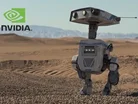
Disney Research will use Newton to advance its robotic character platform for entertainment robots, such as the Star Wars-inspired BDX droids that appeared on stage during Jensen's keynote at GTC.
“The BDX droids are just the beginning,” says Kyle Laughlin, Senior Vice President at Walt Disney Imagineering Research & Development.
“We're committed to bringing more characters to life in ways the world hasn't seen before, and this collaboration with Disney Research, Nvidia and Google DeepMind is a key part of that vision.
“This collaboration will allow us to create a new generation of robotic characters that are more expressive and engaging than ever before – and connect with our guests in ways that only Disney can.”
“The age of generalist robotics is here,” Jensen concludes.
Explore the latest edition of Technology Magazine and be part of the conversation at our global conference series, Tech & AI LIVE.
Discover all our upcoming events and secure your tickets today.
Technology Magazine is a BizClik brand