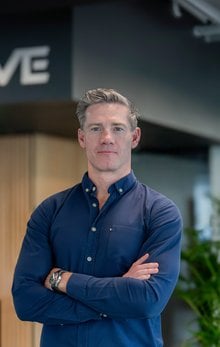
Angus Jones on How to Pivot From Finance to Tech Leadership

What does it take to swap high-pressure financial trading for senior tech leadership – and move across the globe in the process?
Angus Jones is the Managing Director for Asia-Pacific at Hyve Managed Hosting, a global cloud solutions provider headquartered in Brighton, UK, that works with public sector and large corporate organisations.
After transitioning from Sydney’s fast-paced trading floors to the UK tech sector, Angus is now returning home to spearhead Hyve’s Australian expansion. He discusses how to manage a career change without losing seniority, mastering the balance between technical detail and high-level strategy, and applying a risk-and-reward mindset to drive long-term business growth.
What are the most significant parallels between managing foreign exchange and interest rate risks, and overseeing the commercial strategy for a managed hosting provider like Hyve?
Both roles have required me to manage global teams across different time zones and each industry operates in a highly regulated and compliance-heavy environment where requirements are constantly changing.
Hyve has customers in numerous countries and this exposes us to foreign exchange (FX) risk, which needs to be monitored and managed. Understanding macroeconomic drivers is obviously key when managing FX and interest rate risk. It’s equally important when considering global business strategy.

Moving from finance to a senior leadership role in a completely different sector is a bold move. For professionals feeling stuck in their current industry, what is your blueprint for successfully reinventing your career without losing the seniority you’ve already earned?
It is a bold move and I am sure if I moved into another role within financial services, there would have been more similarities and greater knowledge cross-over than there was when moving into the tech space. However, I believe that kind of thinking stops a lot of people from changing industry.
What I have found is that the performance culture and professionalism that was demanded of me when working in banking and financial markets is something that carries over seamlessly into any industry. The risk and reward mindset I had when working in the finance sector translates well to the managed hosting sector with its focus on measurable decisions and high growth.
I also think that experience and maturity hold significant value. What I would tell another senior professional looking to reinvent themselves is that every business will require balancing revenue and costs and almost every business will have a customer to support, whether it be internal or external.
Equally, the vast majority of businesses will have people that need to be managed and require leadership. So, just lean into your experiences and your strengths. You can learn the technical intricacies of the business as you go.
How do you balance the need for technical deep-dives with the need to maintain a high-level strategic vision?
I do believe that the better I understand the technical intricacies of the business, the more effective I can be at managing things at a higher level. But at the same time, I don’t want to be bogged down by the technical details, which take me away from my core responsibilities. For me, it’s about finding that balance, which is not a ‘one size fits all’.
My ability to operate at both a strategic level and within the technical details will be stronger than some but less developed than others, so I just need to find what I am capable of without degrading my ability to carry out my top-level role.
Initially, I had to spend a large amount of time on the technical details, which meant I was extremely busy. Now that I have built a solid understanding of what’s under the hood, I can allocate a lot more time to big-picture and strategic thinking.
You are currently preparing to lead Hyve’s expansion into Australia after a stint in the UK. Beyond the logistics of moving a family across the globe, what are the primary cultural or commercial nuances you’ve identified that will dictate how Hyve’s growth strategy differs between the UK and Australian markets?
Culturally, I don’t see many differences. Language, terminology and legal frameworks are broadly similar.
The Australian market is smaller and is a little further down the road in terms of cloud adoption than the UK but those are the only meaningful differences I have identified.
In terms of growth strategy, there will be some variances, which is partly due to the maturity of the business in the UK and the 15-20 years of brand recognition and trust that’s been built up, which we don’t have in Australia.
Australia’s cloud market is also more mature, which means there is significant competition out there – but equally, a large pool of potential customers, making the process of educating prospects easier than in the UK.
Ultimately though, just as in other countries, success will be about building a local team with a consistent culture and training approach, while developing a healthy pipeline without rushing deals.
Across your time at Hyve how has your definition of the company’s performance evolved, and how do you instil an endurance-based mindset in your team?
Even though the business has been around for over 15 years, Hyve still operates with a startup mindset.
We are always thinking about growth and looking to the future. And this does require an endurance-based mindset, as we are still a long way from our ultimate goal.
I believe if we focus on the fundamentals, success will follow. Naturally, metrics such as revenue and profit are critical – but for a company that is looking to continue to grow significantly, we need to keep pushing our brand.
We also need to have sight of what makes us stand out from our competitors, which is our management layers and dedicated support teams. We need our customers to have an amazing experience with us, so they can act as positive advocates for Hyve. Word-of-mouth is a powerful form of advertising.
If a CTO tells another CTO how good Hyve have been hosting their critical systems and solving their problems around their infrastructure, that builds more trust and positive brand messaging than pretty much any other channel can provide. The short answer is, if we look after our customers, the rest should look after itself.